

• Welcome to Photrio!
    Registration is fast and free. Join today to unlock search, see fewer ads, and access all forum features.
    Click here to sign up

Any cheap 110 cameras with sharp lenses? Other than Pentax Auto 110?

Recent Classifieds

Forum statistics

Threads
202,850
Messages
2,846,545
Members
101,567
Latest member
FilmByJasper
Recent bookmarks
1
Wondering when someone would mention the Canon.
Trouble with 110 was that no one ever made a full manual full mechanical camera. A camera that had full and independent adjustments for shutter speed, aperture and focus. And didn’t need batteries to operate.
But, I suppose with the ‘not designed to be reloaded cartridge’ (unlike the easy to reload Minolta cartridge) such a camera would be, at least for me, not desirable. Ain’t no way I’m paying $8 each for Lomo film (when it’s even available).
I’ll just stick to my Minolta 16II with the ‘0’ lens attached most of the time. Even with rising film prices Eastman 7222 single perf Double-X can be used at less than $1 per reload if you have a few cartridges on hand.
 
Kodak Extramate

From Kodak sub club

(1978) Top of the line Kodak 110. Five shutter speeds from 1/30 - 1/350. This was Kodak's most versatile pocket camera -- equal to almost any photo situation, yet small enough to fit in your pocket. The lens is extraordinary -- a super-fast 25mm (f1.9) four-element lens. It was one of the speed-demons of the submini world. Wide open and stopped down, it can produce negatives with edge-to-edge sharpness. One reason is this Kodak lens is designed with an aspheric element -- a design usually limited to expensive lenses. The viewfinder is little short of amazing in a 110 pocket camera. It's large, bright and displays 110% of the picture area, which is outlined by a projected reticle with parallax correction. Focusing aids and exposure data are also clearly visible at all times. You can focus and adjust the camera without taking it from your eye. The tiny integral flash has an effective range of 20 feet with ASA 400 film. It recycles in an astonishingly brief two seconds with fresh batteries. In many ways this "can-do" camera from Kodak is a joy to handle. The shutter release is firm and precise. The smoothly operating focus wheel fits nicely under your fingertip. And there's a sliding lens/viewfinder cover you can't misplace. k
 
As a Minolta 16 user one camera I’ve wanted from them was a working QT. The operating word here is ‘working’, don’t know if it’s just me but of the 4 samples I’ve looked at through the years not one has been operational. Not taking about the built in meter, the mechanical shutter, aperture and focus will work independently from that.
I did keep one that was $10 with a non operating shutter, figuring it was just gummed up and that I could open the camera and flush it out. Sorry, no go, and as seemingly simple as a 2 speed shutter should be.....well, it aint!
Wanted this model because it had a focusing lens and was not battery dependent and had a larger 13X18mm frame.

A surprisingly good camera from the Minolta 16 line is the Ps with the 2 speed shutter. Still regular 10X14mm frame but the focus is fixed at 5 meters. That means you can get pretty good shots at long distance by stopping down to f8 or smaller. The 25mm f3.5 triplet is good enough and although bigger than the 16Ii because of a non retractable viewfinder you can at least preview a frame without extending the vf like the 16II and then losing a shot if you close up the camera without taking the shot. I picked up the camera and close up lens set at a photo show for $2 and the camera had a used up cartridge in it too.... I originally bought it just to get the cartridge.
 
I've got a working QT (electronics are dead, but the exposure control and focus work fine). It's my second favorite Minolta-format camera, behind my Kiev 30 (I like the 30 better than the 303, which lacks a PC socket). Some days, I like it better.
 
Kodak Ektramax
First time I even hear of that model. I think for the west-german market Kodak refrained to german-made type 110 models.
 
A extraordinary model due to the combination of features (RF, focusing, aperture) but for instance beaten on focusing by Agfa. It only makes sense if one needs to use a certain aperture.
But even over here I never came one across...

However the prices you list are far fetched.
 
The Ektar lens on my Kodak Trimlite 48 is very sharp. Some of the Minolta bar shaped non-SLR cameras also have decent lenses.
 
No one's mentioned the Pocket Fujica 350 zoom- I've only run a few (expired) rolls through mine and have only had one developed so far, but definitely sharper than a point and shoot.
s-l300.jpg
ft008.jpg
 
Nobody to mention Canon 110ED with 2.0 five elements lens, rangefinder, hot-shoe, date imprinting, 8sec-1/500, 2.0-16.

Even better is newer 110ED 20 which automatically recognize higher speed cartridges.

A kind APUGer sent me one of these it looks very nice and promising but I can't get it to work reliably..
 
I haven't used a 110 camera in many years. The last one I used was the Minolta 110 zoom. That was back in the early 2000's when you could still get it developed at your local photo lab. I dropped off the roll and came back a few hours later to see the lab tech with a puzzled look on her face. She commented that she had never seen really good prints from 110. The Minolta has aperture priority, bulb and x-sync. The one I had was easy to use and gave great results. I didn't use it much and thought of it more as a novelty than as a camera I would use frequently.
 
The Pocket Instamatic 60 was more refined than even that, because it also worked really well with Kodachrome 64.
I have my Dad's holiday travel slides (and the matching 110 projector) to prove it.

I have one of those (Instamatic 60). I use it as a portable rangefinder with my MF folders.
 
Last edited:
No one's mentioned the Pocket Fujica 350 zoom- I've only run a few (expired) rolls through mine and have only had one developed so far, but definitely sharper than a point and shoot.
View attachment 258914 View attachment 258915

Awesome photo. That 'look' is pretty much why I'm interested in 110. I suppose the key to my investigation is I don't need a camera that has a lot of control since all photos will likely be taken in good sunlight. What I do want is the 'degradation' of any image to be done via large grain rather than focus issues due to poor quality lenses.
 
Awesome photo. That 'look' is pretty much why I'm interested in 110. I suppose the key to my investigation is I don't need a camera that has a lot of control since all photos will likely be taken in good sunlight. What I do want is the 'degradation' of any image to be done via large grain rather than focus issues due to poor quality lenses.
Thank you. I've found I like using expired color film in general for the degraded grindhouse look. That roll took me well over a year to shoot because I didn't want to deal with the manual focus, but was genuinely surprised at how sharp the results were. Here's most of the frames that came off the roll:
https://www.lomography.com/homes/th...354186-pocket-fujica-350/photos?order=popular

Also, this Thursday I will be dropping off a 1981 expired Kodacolor 400 I ran through this camera. If I get any results at all from that I'll consider it a success. I also ran a 1992 expired gold 200 through it after I finished the 400, but it'll probably be a little while before I have that one processed.
 
Thank you. I've found I like using expired color film in general for the degraded grindhouse look. That roll took me well over a year to shoot because I didn't want to deal with the manual focus, but was genuinely surprised at how sharp the results were. Here's most of the frames that came off the roll:
https://www.lomography.com/homes/th...354186-pocket-fujica-350/photos?order=popular

Also, this Thursday I will be dropping off a 1981 expired Kodacolor 400 I ran through this camera. If I get any results at all from that I'll consider it a success. I also ran a 1992 expired gold 200 through it after I finished the 400, but it'll probably be a little while before I have that one processed.

Have you been able to hone in on how expired is the sweet spot between being too far gone and too unaffected by age?
 
Have you been able to hone in on how expired is the sweet spot between being too far gone and too unaffected by age?
Working on it. I don't find much much expired 110 film outside of ebay, and I've mostly used point and shoot for 110. So long as I don't forget, I'll message you a few samples later.
 
I have a Minolta Zoom 110 (Mark I)...had it from new in about 1980. It is capable of *very* good results. Sadly mine developed a fault circa 1985 and two attempts at getting it repaired (the most recent in 2020) have drawn a blank....so it's probably taken it's last photos. But definitely recommended.
 
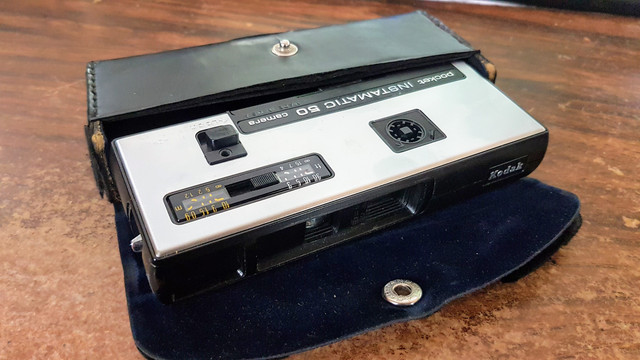
Found this online at a local estate sale for $20 CAD (~$15 USD) so I decided to grab it although I think a zoom model may still be in my future. It's in really nice shape.

20201111-142559-2.jpg


When I was a kid my 110 camera was a Kodak Ektralite 10. This is way better spec'd

Kodak Ektralite 10
25mm f/8 fixed focus
1/125 or 1/250 mechanical shutter speed
Built in flash

Kodak Pocket Instamatic 50
26mm f/2.7-17 scale focus lens
10s - 1/250 electronic shutter with auto exposure
Flash cube, cable release, and tripod sockets.
Definitely has some weight and subclub.org says
"Some describe it as frighteningly sharp."

So that seems to fit the bill! Assuming I can find a battery...
 
Last edited:
I just checked the manual on the Instamatic 60. As is the case with many tiny format cameras, not all the best features are on all the cameras. The rangefinder focusing on that is amazing. However, aperture selection is left to the camera and is unknown. The reason this is important is you posted "...Sharp Lens" and no tiny format lens will be sharp at a small aperture. It is just physics. One way around it is the either use neutral density when in sun light (might have to make your own filter) or use slow film.
What is the cutoff for sharpness with the aperture? It depends on how big you make your prints. If you make 8x10 then I'd not stop down past f5.6.

The reason I point that out is that it looks like a nice camera, but if you test it in bright sun with 400 ISO film you might toss it in the garbage for making fuzzy images, whereas I'll bet at f4 it is very very sharp. You need to trick it into shooting at f4 to get your best images.

I have neutral density filters for all my 8mm movie cameras, my 16mm film cameras and, of course, the ND filter is built into the Minox LX.
 
Here is an example. This is from a Minolta that zone focuses but has user-set aperture. This is f4 on that camera, yours should be just as sharp.
Minolta16mm.jpg
 
I just checked the manual on the Instamatic 60. As is the case with many tiny format cameras, not all the best features are on all the cameras. The rangefinder focusing on that is amazing. However, aperture selection is left to the camera and is unknown. The reason this is important is you posted "...Sharp Lens" and no tiny format lens will be sharp at a small aperture. It is just physics. One way around it is the either use neutral density when in sun light (might have to make your own filter) or use slow film.
What is the cutoff for sharpness with the aperture? It depends on how big you make your prints. If you make 8x10 then I'd not stop down past f5.6.

The reason I point that out is that it looks like a nice camera, but if you test it in bright sun with 400 ISO film you might toss it in the garbage for making fuzzy images, whereas I'll bet at f4 it is very very sharp. You need to trick it into shooting at f4 to get your best images.

I have neutral density filters for all my 8mm movie cameras, my 16mm film cameras and, of course, the ND filter is built into the Minox LX.

Yes neutral density might be the way to go. Currently the main issue is it and many older cameras of this type with electronic shutters use a long discontinued battery. Luckily this one came with a dead battery inside and I have already opened it up and am engineering a replacement solution.
 
The Submini-L mailing list just in the past few days had a message about someone making a 3D printed shell that fits the K battery socket in those cameras and accepts (IIRC) four 675 alkaline button cells. Alternatively, if you have a shell, you can probably figure out how to make it work with those cells.
 
Found this online at a local estate sale for $20 CAD (~$15 USD) so I decided to grab it although I think a zoom model may still be in my future. It's in really nice shape.

20201111-142559-2.jpg


When I was a kid my 110 camera was a Kodak Ektralite 10. This is way better spec'd

Kodak Ektralite 10
25mm f/8 fixed focus
1/125 or 1/250 mechanical shutter speed
Built in flash

Kodak Pocket Instamatic 50
26mm f/2.7-17 scale focus lens
10s - 1/250 electronic shutter with auto exposure
Flash cube, cable release, and tripod sockets.
Definitely has some weight and subclub.org says
"Some describe it as frighteningly sharp."

So that seems to fit the bill! Assuming I can find a battery...

I use the Instamatic 60 with Kodak Microfilm. I put a piece of exposed film over the sensor to work as an ND filter. Works great. As for the battery, a few button cells and silver foil does the trick at replicating the K cell. I have a few flash cubes but never really bothered with them.
 
Photrio.com contains affiliate links to products. We may receive a commission for purchases made through these links.
To read our full affiliate disclosure statement please click Here.

PHOTRIO PARTNERS EQUALLY FUNDING OUR COMMUNITY:


Ilford ADOX Freestyle Photographic Stearman Press Weldon Color Lab Blue Moon Camera & Machine
Top Bottom