• Welcome to Photrio!
    Registration is fast and free. Join today to unlock search, see fewer ads, and access all forum features.
    Click here to sign up

Acetic acid as stop bath for film?

Wheels within Wheels

D
Wheels within Wheels

  • 1
  • 0
  • 18
R-A-O-B Club

A
R-A-O-B Club

  • 0
  • 0
  • 23

Recent Classifieds

Forum statistics

Threads
203,222
Messages
2,851,657
Members
101,730
Latest member
joswr1ght
Recent bookmarks
0
if you want to use stop bath, that is fine
if you don't want to use it, but water instead it is fine too.
kodak and others over the years have said water is fine ..
they have also said stop is fine too, depending on the film
(pinholes are sometimes a byproduct of stop bath)

i think the manufacturers knew long ago that
you can't please everyone all the time ... so
do what you want and don't worry about it
 
I've stated all along in this thread and a previous one that there's not been a balanced open approach to both the water/stop-bath or alternative wash techniques issues.

I've added the following link to the Water as stop bath thread as it's relevant to this one:
A summing up on Water as a Stop Bath.


My comments in both threads have been that all the manufacturers recommend either a stop bath or a water rinse for films, it's a simple choice. My point is and always has been that they still make these recommendation today, the most recent in the Tmax datasheets, as they do the two alternative wash techniques. Ron (PE) states in post #132 of this thread "I have not posted on the other Stop thread." but if you read the other post I've linked to you'll find that's quite untrue, OK there's one new thread he's not posted on as well.

This is what KODAK currently say with film developing:

We can assume Kodak know best, which is also what Mason (Ilford) & by default Levenson (Kodak) said as well mid 70's

FINAL STEPS
Rinse at 65 to 75°F (18 to 24°C) with agitation in KODAK
Indicator Stop Bath or running water for 30 seconds.

That's up to date Kodak information that's in the current Tmax data sheet, and in other film data sheets as well.

I really cannot comprehend how anyone can argue over the order of the either / or but that’s what's being done with both the use of a wash or stop and also the two different wash techniques. This is what I call Bull-shit, it's also farcical. These are simple processes.

Mason (Ilford) states clearly the Stop bath stage is superfluous to the overall processing of films or papers, and this is also backed up by both Fuji & Kodak who include no rinse or stop in their mechanical film processing data & Ilford state that there should be no problem in machines with no facility for a stop bath. That's for films and RC papers. (Mason of Ilford with GIP Levenson of Kodak as his editor).

We can ALL read the same recommendations from Kodak, Ilford etc, and that data is current, the latest data particularly from Kodak was very recent after the release of the new Tmax 400.

Obviously I'm not one of the harshest critics :smile: that Ron (PE) refers to as I have published Original Emulsion, Developer and other Photographic formulae of my own :D as well as many coating results – vehicles with images on them. However some formulae are still in commercial use or were for specialist purposes and can't be placed on APUG. One was a monobath for projection speed emulsions, but it was designed for a specific emulsion, but I could easily adjust it for a particular paper, like Ilford Multigrade :D

Unlike others I'm only posting readily available information. You need to interpret manufacturers recommendations for yourselves how much you trust the manufacturers is up to you. I have no problem with any of their recommendations I choose a middle road on film washing and either/or with regards to stop bath.

I'll add that I've been making images on a serious aminly commercial/professional basis for 40 years that's when I had my first magazine & newspaper front page images, I've also worked as a Photo-chemist for many years and then switched to more specialist precious metal recovery. I had my first camera aged 2, and began darkroom work at 9 or 10.

Ian

 
Last edited by a moderator:
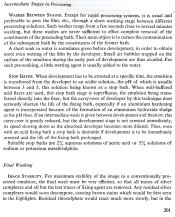
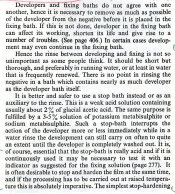
Excerpt from Mason on prewet, stop and rinse

See the following scan of the excerpt from Mason (Ilford) on these 3 subjects. I think that I have posted it before. Some other authors add that lack of a stop bath can lead to staining.

Please note that Mason qualifies his statement regarding Stops being superfluous. That is my problem here, that the entire statement is not being used, but rather parts are being taken out of context. In fact, Mason says that a stop bath is desirable depending on overall process conditions. (taken out of context - read it for yourself to get the entire subject in perspective)

I have posted scans of the entire instruction pages from Kodak and references to both Kodak and Ilford web pages on this subject in my effort to get the readers to see the entire subject in context.

PE
 

Attachments

  • mason on stops.jpg
    mason on stops.jpg
    392.9 KB · Views: 125
Ron, I despair.

It makes Zero difference what you say or post any longer, Kodak STILL say that we can use a water rinse or stop-bath, I made it VERY clear in my summing up in previous posts that there can be benefits of using a stop bath to the longevity of a fixer, I acknowledged all Mason said. Why do you keep arguing ? For the sake of it I think.

My experience is as valid as yours, regardless of the fact you once worked for Kodak, please respect that fact. I haven't disagreed with Kodak's recommendations at all, but you are and are using invalid arguments and flanneling which I call Bull-shit.

There's NO ARGUMENT. A rinse instead of a stop-bath works. That's personal experience and Kodak, Ilford, Agfa etc recommendations as well.

WHO ARE YOU to disagree with your former employer ? Who do we trust you or Kodak ?

It's really that simple . . . . . . . . . . . .

Ian
 
Last edited by a moderator:
Gents, who cares?

Use it or not, it's a choice, stop or water.

Is it that big of a deal?

The sandbox is out of sand. Ask for Billy Martin.
 
More quotes then

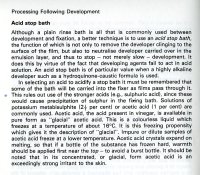
Usually, I would just give up, but this is important. Contrary to what has been stated several times I do not just refer to Kodak references as you, our readers have seen. And I wish to add that the language in these references are usually similar to this...

A rinse with water is often used after development (and that is usually all that is quoted by many people here on APUG), but the statement goes on to say something like this....

however, a better method is to use a stop bath!

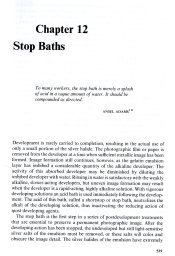
That is the point here in my references to Haist, Jacobson, and Jacobson, and Jacobson. In fact, Haist devotes nearly 20 pages in a full chapter to stop baths and starts his chapter with a quote from Adams (the Negative) who used stop baths. Note that Jacobson and Jacobson suggest a water rinse and a stop bath as well.

So, the "however", and the "although" and the "on the other hand" statements included in the references that I have posted here are the things that supply the "gotchas" in good processing. And, they are what are commonly ignored in many posts. Please note that my references again draw mainly from Ilford as did my last post which referred to Mason of Ilford and not Kodak as has been stated.

So, I urge you to read the attached excerpts and to judge for yourselves which is the best technique for your workflow, and which is the most complete presentation to you all of the entire facts from the literature out there. I do not excerpt, I have shown you scans of as much as practical or referred to URLs.

References:

1. Haist "Modern Photographic Processing VI"
2. Jacobson and Jacobson "Developing - The Negative Technique"
3. Jacobson "The Manual of Photography" (Formerly the Ilford Manual of Photography)

PE
 

Attachments

  • Jacobson on stops.jpg
    Jacobson on stops.jpg
    288.7 KB · Views: 100
  • JandJ on stops.jpg
    JandJ on stops.jpg
    294.5 KB · Views: 109
  • haist on stops.jpg
    haist on stops.jpg
    253.8 KB · Views: 111
Gents, who cares?

Use it or not, it's a choice, stop or water.

Is it that big of a deal?

The sandbox is out of sand. Ask for Billy Martin.

See my post above.

One is good and the other is better! You find that out if you read the whole reference!

PE
 
If we put this much energy and thought into concepts, visualization, and the understanding of how lighting affects our images, I'll bet we would all be making some incredible and important art. It is a shame that discussing whether or not a stop bath should be used or not takes so much damned time and energy.

Seriously, folks. The evidence has been presented and the arguments made on both sides...and even after all that, it doesn't really matter. Either method will work. Try both and see which you prefer. The stop bath is the least of your worries when processing film. If we are going to have one of these stupid threads, I'd prefer it to be about developer or fixer.
 
Yet, PE, film manufacturers tell us to do either, without referring to Haist, Jacobson and Jacobson, etc.
The fools, 'ey?
:wink:

Notice what the texts you quote actually say?

The last says a stop bath stops development faster than a water wash. What do they say in situations like this? "duh..."?
That's of no importance unless you are in a great hurry to stop development, i.e. if the stopping power of water would be too weak. We know however that it works perfectly fine, without such problem.
It then goes on (ironically?) by warning us that not 'just any old' acid fluid would do.

The one before that thinks using a stop bath is safer.
But it's safer, because it stops developing quicker.
Yet as we know, a wash works fine. So what's the problem again?

Then to the first quote.
It too warns against a water rinse, prefers an acid bath, because of the danger that a highly active developer will not be stopped soon enough by water alone.

If your intention was to point us to mention of the problems of not using a stop bath, we need to be quoted different texts, or different parts of the same texts.
 
Well, actually, the quoted persons worked for Ilford and Kodak if you note the posts, and the references all state a preference and give varying reasons including yellowing with keeping with just a rinse. So it isn't a matter of the authors and the companies ignoring each other but rather a cooperation between them. Mason, Jacobson and Haist all worked for photographic companies on process chemistry as I did. You can use either as long as you know the pros and cons. If I left out the alternate view point I would be remiss. If I stressed one over the other, that would not be right either I have let the two companies and the three authors state their cases. I can only point you to the full references without abridgment and let you decide. (well, in the case of Haist, 20 pages was a bit much to scan :wink: )

It is also of interest that the nonuniformity mentioned in some articles may be more apparent in LF or MF, and so preference may vary with film size.

You might also note that the film manufacturers give preferences in some documents but not others.

And, this may not be trivial to you in 10 or 20 years, just like wash method may not be trivial. In my own work with wash, I have found that the stain grows slowly over many years.

PE
 
  • Deleted member 2924
  • Deleted
Well, PE, in 20, or 40 years, or so (migh, how time flies...), i have yet to see the beginning of a problem.
:wink:

Re references: i would not expect you to scan the full text, all 20 pages or so. But it would help your case if the bits you have scanned would actually say something in support of your point.
:wink:

But i thought that we (you too) had established that manufacturers had no problem with either method?
Here too you confirm that they do not.
I can understand why someone might have a preference. But are you not pushing it a bit too much?
 
Guys;

I have over 2000 PMs and probably about that many e-mails from APUG users. Quite a few of them involve rinse vs stop and how to wash film and paper. I try to strike a balance by stating both sides as I have here and the pros and cons of both methods. I cannot give anyone a definitive answer nor can anyone. And, I do not draw on just Kodak sources.

In all cases, the pros seem to be on the side of using a stop for all cases, but this is just "seems to be". I have posted about 12 references on this subject specific to film and two specific to paper. They span sources from Kodak to Ilford as well as the 4 authors who worked in the industry.

Based on the literature and my experience, I use a Stop Bath for paper and use either for film depending on developer and format (size). I also use a stop for film when development times are short. So, I pretty much use what is in the literature, but I cannot give a one-sided argument here, nor can I let a one-sided argument stand. I have to show both sides and show pros and cons. Even so, I cannot guarantee anything. I have tried using a water rinse for paper and have gotten quite a few stained prints either right off or in several months. This was done with 3 different fixers.

In the end, the results of all of our work are valuable to someone, either us or our descendants and so I do take the conservative approach. I have given all of the relevant references as far as I am able and can do no more than that. I have always said "do what works for you" as after all, you are out to please yourselves in a hobby or earn money as a business. In the latter case, if it sells, it worked for you, so my adage works for all aspects of our analog work.

In my personal and professional work spanning over 60 years, I can say that there are slight density variations and contrast variations when a rinse is used after development. This can be seen in a single piece of film or from run to run. I often make a MacBeth color checker exposure at the head and tail of my roll using a standard exposure to look at end to end uniformity.

PE
 
  • Deleted member 2924
  • Deleted
it never ceases to amaze me how
people can get so worked up
about not using stop bath ...

i've got better things to worry about
 
I'm wondering why all b&w inversion recipes don't call for a stop bath after the first developer and before the bleaching step...
Going straight from the first developer to the bleach isn't recommended nor it's the same of passing through an acetic acid stop bath in terms of neutralizing action of the developer...
Sorry to have jumped like this on the topic...

Ok, here is the answer.

1. The bleach is an oxidant and the developer is a reductant, and it is never a good idea to mix them together. Therefore, you should rinse out the developer.

2. The bleach is very acidic and acts as in the Jacobson and Jacobson reference, as both a rinse and then a stop.

3. The process has many following steps which continually alter the pH back and forth, the process goes pretty much to completion regarding silver use and does eventually accomplish all that a simple negative process should do and then some.

So, those are the reasons a B&W reversal process is designed the way it is.

Oh, and the clearing bath(s) used are also similar to some of the Stop baths noted in my references, being Sulfite solutions. And, the strong bleach bath destroys and residual developing agents from the first developer almost instantly.

I hope this helps you understand the entire scope of this question better.

PE
 
it never ceases to amaze me how
people can get so worked up
about not using stop bath ...

i've got better things to worry about

U got that Right!

Although I must say, PE is on the SAFE side of this argument.

I say that because while it may be true that Kodak may have said "or",
they have never said water was better than a stop bath, nor that it was a complete (in every sense of the term) equal.

Many years ago, AGFA spoke to this problem, although the focus was on the fixer bath, the subject is nevertheless discussed.

The original is in German. I will summarize it here:

1.
Even if a water rinse is used between the developer and the fixer,
some developer will be carried over into the fixer.

2.
This condition results in a discoloration of the fixer.

3.
Under such a condition, the gelatin of the emulsion easily discolors or yellows.

4.
This problem can be entirely prevented by the use of an acidic fixer
rather than a neutral or alkaline one.

*
Finally,
I speculate that the concept of the stop bath was an extension or derrivation of this observation, although I don' know that for sure. How relevant this history is, I will leave to everyone to decide for themselves, but I think we can do well to acknowledge that equivalent may not mean true equality.

Kodak also often say that other manufacturers materials can be used,
yet warn that equlivent results may not be obtained... so are they equal?

Equal but different. Equal in some ways but unequal in otherways.
 
The truth is out there! It will become more important as you lose photo engineers!

Nice summary Ray. Thanks. If you put it in chronological order, you will see some interesting things which I have alluded to.

Best wishes.

PE
 
Based on the literature and my experience, I use a Stop Bath for paper and use either for film depending on developer and format (size). I also use a stop for film when development times are short. So, I pretty much use what is in the literature, but I cannot give a one-sided argument here, nor can I let a one-sided argument stand. I have to show both sides and show pros and cons. Even so, I cannot guarantee anything. I have tried using a water rinse for paper and have gotten quite a few stained prints either right off or in several months. This was done with 3 different fixers.

PE

Now you've admitted the ether/or (for films) can we quit the one sided argument that you've waged through almost all your posts in more than one thread on this topic.

It's so simple film manufacturers say stop bath or water rinse and even no stop/rinse stage at all (with mechanical processing).

Ian
 
[...] So, I pretty much use what is in the literature, but I cannot give a one-sided argument here, nor can I let a one-sided argument stand. I have to show both sides and show pros and cons. [...]

But that, PE, is exactly what you do: present a one sided argument.

Yes, you quote literature that suggests both to be fine. You say that you don't use a stop bath sometimes.
But still, you keep pushing a "you must use stop or else..." argument.

Your 'no it isn't' everytime an 'it's o.k. to use a water rinse' is proposed is confused by you saying things like the above "I pretty much use what is in the literature", because - as the quotes you offered too show - the literature says it is o.k.
Hence the long thread. Hence perhaps too the many PMs you say you receive asking about this.
 
The truth is out there! It will become more important as you lose photo engineers!

Nice summary Ray. Thanks. If you put it in chronological order, you will see some interesting things which I have alluded to.

And yes, the truth is out there.

Where are those yellow stained negatives, i wonder.
How many of your un-stopped negatives have turned yellow?

And, but that's perhaps another thread, why would it matter? A yellow tint alone doesn't ruin a negative. Why, in the early days we all remember so well, B&W film were given a yellow tinted gelatin coating, to counter excessive blue sensitivity.
:wink:
 
I have a related query:

It seems to me that there are two reasons for using a stop bath with film. To stop development at the correct time and also to neutralise whatever remains in the tank so as to not contaminate the fixer for further use.

On the basis that most fixer is acidic and if the fixer is being used once then discarded, is there any reason to use a stop or water rinse at all or is it o.k. to pour out the developer then pour in the fixer?

I have done this a couple of times with no apparent problems but would normally use a water rinse.


Steve.
 
In theory yes, you can miss out the entire stop bath/rinse stage, that's exactly what Kodak & Fuji do with their smaller film processing machines. Ilford's machines (when they still made them)used a stop bath step but they say it's OK with their chemistry in machine with no stop bath facility.

In practice you run the risk of dichroic fog in a tank if you can't get the fixer into the tank fast enough with good agitation. The bigger the tank the higher the rusk.

Ian
 
I think that you guys are having a lot of fun doing this.

I will be more specific. In practice, I do use a rinse sometimes with slow development and single rolls of 35mm film. I use a stop with more than 1 roll, 120 and larger film and especially with shorter development times. I mostly use a stop with film though. I always use a stop with sheet film! I always use a stop with paper!

As the size of the negative goes up, or the number of rolls increases, your ability to dump all of the developer out of a tank and get a good rinse decreases and therefore a stop becomes more useful in stopping development uniformly. Getting a good rinse with sheet film in tanks is virtually impossible.

Now, it is interesting that Ilford uses a Stop step in their machines as the preferred method. You can use a rinse they say, but the Stop appears to have been preferred as noted by Ian above. Why?

I have never seen dichroic fog take place with modern films.

And, with all of the actual references that I posted here, I seriously doubt that anyone can say that my arguments have been one sided. I have not posted only parts of sentences from referenced works, I have posted the entire reference as far as practical (Haists 20 pages being the exception).

As far as yellowed negatives, no, I have not seen any in my personal work thankfully, but then I do use a Stop more often than not, however to see that said in the literature, someone must have seen it happen so I believe it when I read it. Do you? That is where you will have to make up your own mind.

On a separate track though, I have seen yellowing in prints in which the process did not use a stop.

PE
 
Washing, why is it always washing. If it isn't washing it is stop baths. IDK why, when Kodak states clearly that continuous washing and the use of a stop bath is preferred. Ilford gives continuous washing the pride of being placed first in their list of wash methods too and also suggest a stop bath. Oh well.

Maybe because it really doesn't matter, it all works fine enough for our purposes without getting into "how many angels can dance..."

Furthermore, I think that the acceptable error rate in B&W photo processing is much higher than most people believe. I think it scares away a lot of those who are new to film, those who are so worried about making up the exact dilution, worried that the stop temp is 1 degree hotter/colder than the dev, and a million other variables that are a part of the process. If one is reasonably accurate and consistent, you will still get wonderful negatives.

PE asks, why is it always washing? Or stop baths? Because if it's not washing or stops baths, it's fixing. ;-) And don't forget flattening.
 
I thought that SOMEONE is supposed to be monitoring these threads to make sure personal attacks do not take place. That someone is failing us. Maybe he or she needs to be replaced. We are in danger of losing the "voice" of the most experienced and best informed member of this forum.
 
I posted this elsewhere, but it applies here: Dead Link Removed

We can tell everyone about the problems of digital but we seem unable to convert anyone to analog or to prevent anyone from going digital. I can try my best to present both sides of a story, but if the readers ignore one side or another, then I have accomplished nothing in the end.

I hope that you see my point!

People will do what they want in spite of the fact that the literature says "a water rinse is fine, but a Stop Bath is better". Even Mees, that fine old English expert in R&D and Photography says that! So, ignore my words. They are nothing in the end. You can lead a horse to water but you cannot make them drink.

PE
 
Photrio.com contains affiliate links to products. We may receive a commission for purchases made through these links.
To read our full affiliate disclosure statement please click Here.

PHOTRIO PARTNERS EQUALLY FUNDING OUR COMMUNITY:


Ilford ADOX Freestyle Photographic Stearman Press Weldon Color Lab Blue Moon Camera & Machine
Top Bottom