

• Welcome to Photrio!
    Registration is fast and free. Join today to unlock search, see fewer ads, and access all forum features.
    Click here to sign up

A very low contrast, low pH, full speed POTA variant

Recent Classifieds

Forum statistics

Threads
201,943
Messages
2,832,442
Members
101,028
Latest member
Aruz446
Recent bookmarks
1

removed account8

Member
Allowing Ads
Joined
Feb 2, 2010
Messages
47
Format
Multi Format
I thought this would be fun to post based on continuing experiments with low contrast developers. This was only a first attempt in this particular direction so I'm wondering how far it can go with modifications, substitutions etc. It is essentially a modification of Horwitz's D-512 which was based on research by Levy into the superadditivity of Phenidone and Pyrogallol.

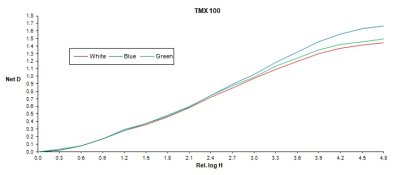
It is only preliminary and should be considered a "first cut", but perhaps worth playing with. The formula is:

20g sodium sulfite
1g Pyrogallol
1g Dimezone-S
--------------
1L

A H&D curve for 35mm TMX is attached. Development time was 10:00 at 68F, without any fancy routines. Basic inversion agitation for 30 seconds initially, followed by 10 seconds each minute. There appeared to be some orange-ish imagewise stain at high exposure densities so I measured using white light, blue and green. Preliminary observations:

-Marked toe contrast and full film speed (equivalent to normal development in XTOL)
-Equivalent contrast of ~N-3 or more in ZS terms
-Uniform development
-Normal fog level (same as XTOL)
 

Attachments
  • TMX.jpg
    TMX.jpg
    31.6 KB · Views: 438
Last edited by a moderator:

Rudeofus

Member
Joined
Aug 13, 2009
Messages
5,119
Location
EU
Format
Medium Format
Very interesting variation, but I wonder why it has to use Pyrogallol as secondary developer, and not one of the less toxic options. The composition of this developer also suggests that one must mix it from scratch every time one wants to use it, there is no convenient concentrate like Pyrocat.
 
OP
OP

removed account8

Member
Allowing Ads
Joined
Feb 2, 2010
Messages
47
Format
Multi Format
Agree it is a one-shot scratch mix but I'd call it a "special purpose" developer rather than a general purpose developer like Pyrocat etc.

Also agree it would be worth trying other variations with a more friendly substance than Pyro. Perhaps an amount of HQ or even sodium ascorbate. Substitutions/alterations would have to be determined empirically, and image structure characteristics need to be evaluated, but what I find particularly interesting is the high emulsion speed and extreme low contrast this preliminary formula gives at a relatively low working pH.

In Anchell/Troop some similar things were suggested as ways of "stabilizing' the original POTA formula, but the suggestions were primarily aimed at document films and contain relatively small amounts of the secondary/regenerating agent.

Lots of things one could experiment with here. Less sulfite, maybe add a small amount of alkali, further dilution, etc.

Since I don't have a pH meter, any idea approximately what the pH of this working solution would be?
 
Last edited by a moderator:

Rudeofus

Member
Joined
Aug 13, 2009
Messages
5,119
Location
EU
Format
Medium Format
Also agree it would be worth trying other variations with a more friendly substance than Pyro. Perhaps an amount of HQ or even sodium ascorbate.
The great thing about Ascorbate would be that Pat Gainer already did most of the work for us and provided us with a nice curve plot what we should expect from low amounts of Ascorbic Acid. Conclusion: we will most likely get a straight curve, and an emulsion speed comparable to regular PC developers, i.e. full speed.

In Anchell/Troop some similar things were suggested as ways of "stabilizing' the original POTA formula, but the suggestions were primarily aimed at document films and contain relatively small amounts of the secondary/regenerating agent.
My reading of TFDC is that they recommended highly diluting common developers while keeping them quite alkaline. I tried that once (in a very unprofessional test) with Delta 3200, and the results were unsatisfactory. Delta 3200 in POTA and Delagi 8, on the other side, can give you very nice results.

Since I don't have a pH meter, any idea approximately what the pH of this working solution would be?
I did measure pH of POTA some time back: 8.42. POTA contains more Sodium Sulfite and no Pyrogallol, but I would suggest that your soup was somewhere in that pH range.

Reformulate it to use a different second dev, and I'll measure pH for you :tongue:
 

Gerald C Koch

Member
Allowing Ads
Joined
Jul 12, 2010
Messages
8,131
Location
Southern USA
Format
Multi Format
With moderate to large amounts of sulfite the action of pyrogallol is very similar to that of Metol. In addition it is super-additive with phenidones.
 

Rudeofus

Member
Joined
Aug 13, 2009
Messages
5,119
Location
EU
Format
Medium Format
With moderate to large amounts of sulfite the action of pyrogallol is very similar to that of Metol.
Is 20-30 g/l a "moderate to large amount" ?
 
OP
OP

removed account8

Member
Allowing Ads
Joined
Feb 2, 2010
Messages
47
Format
Multi Format
Good question.

But if Pyrogallol in the presense of moderate/large amounts of sulfite functions similarly to Metol, does that mean it is no longer superadditive with Phenidones when there is a lot of sulfite? (because Metol is not superadditive with Phenidones as far as I know).

A lower amount of sulfite (say 5-10g/L) might be something to try here. My first experiment will be to replace the Pyro with HQ and see what happens from a sensitometric perspective. The idea is to retain both high emulsion speed and extreme low contrast.

To respond to Rudeofus's earlier comment regarding FDC recommendations, I have to say in general I have not found the "dilute for higher speed" maxim to work very well with general purpose developers. "Dilute and increase alkalinity for higher speed" seems to work sometimes (depending on the film), but not very well either. That's why in my quest for high speed/low gamma development (without golfball grain) I decided to go in the opposite direction recommended in FDC. Research by Levy and Shepp/Kammerer seems to point in this opposite direction. Who knows - maybe we can even find a tanning/staining Pyro formulation which works at a low pH.
 

Shawn Dougherty

Member
Allowing Ads
Joined
Jul 22, 2004
Messages
4,129
Location
Pittsburgh
Format
Multi Format
A lower amount of sulfite (say 5-10g/L) might be something to try here. My first experiment will be to replace the Pyro with HQ and see what happens from a sensitometric perspective. The idea is to retain both high emulsion speed and extreme low contrast.

I would be very interested in a (non-staining) developer, like what you mention above, which gives decent film speed and is mixed up as needed for extremely high contrast scenes... especially a developer that allowed use of "normal" agitation procedures or more specifically rolling in tubes. I'm following this with interest.
 

Gerald C Koch

Member
Allowing Ads
Joined
Jul 12, 2010
Messages
8,131
Location
Southern USA
Format
Multi Format
By moderate I mean any amount of sulfite that is higher than the low concentration needed for stain formation.

Pyrogallol and any of the phenidones is a super-additive combination. While the Kendall-Pelz Rule is not directly concerned with super-additivity the definition of the groups can be used to predict which combinations are super-additive. Pyrogallol is in group (a) and phenidone in group (e). and so match the definition.
 
Last edited by a moderator:
OP
OP

removed account8

Member
Allowing Ads
Joined
Feb 2, 2010
Messages
47
Format
Multi Format
Thanks for reminding me I wanted to try out H&W Control (or at least the formulas in the patent), which also went in this general direction - ie based on Phenidone with some "stability" provided by the small amount of a superadditive secondary agent. However it uses a carbonate alkali, which is something I was trying to get away from.
 

Gerald C Koch

Member
Allowing Ads
Joined
Jul 12, 2010
Messages
8,131
Location
Southern USA
Format
Multi Format
Michael, you might also want to look at the Perfection XR-1 developer formula.
 
OP
OP

removed account8

Member
Allowing Ads
Joined
Feb 2, 2010
Messages
47
Format
Multi Format
Thanks, Gerald - that was another one on my list to try eventually. I wonder what the practical differences are (if any) between the two generally accepted formulas for XR-1. I'm tempted to first try the one with less Phenidone, which has slightly more HQ and Borax.
 
OP
OP

removed account8

Member
Allowing Ads
Joined
Feb 2, 2010
Messages
47
Format
Multi Format
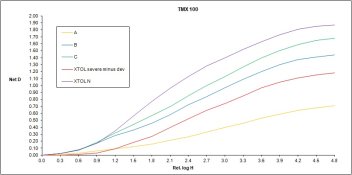
Attached is some more work on this (and indirectly some work on superadditivity) for discussion:

On the attached plot, "B" is the developer outlined in the original post in this thread. "A" has no secondary agent. "C" replaces the Pyro with the same weight in Hydroquionone. So the formulas are (in g/L):

Developer A
Sulfite (anhydrous):20g
Dimezone-S:1g

Developer B
Sulfite (anhydrous):20g
Pyrogallol:1g
Dimezone-S:1g

Developer C
Sulfite (anhydrous):20g
Hydroquinone:1g
Dimezone-S:1g

Development time for A, B and C was 10:00 at 68F, with 30s initial agitation followed by 10s/minute. Development times for XTOL (1+1) N and minus were 11:00 and 6:30 respectively at 68F, with the same agitation scheme as for developers A, B and C. B+F levels (35mm roll film) were:

A:0.22
B:0.22
C:0.23
XTOL (1+1) severe minus dev: 0.20
XTOL (1+1) N: 0.21
 

Attachments

  • graph.jpg
    graph.jpg
    61.8 KB · Views: 337
Last edited by a moderator:
OP
OP

removed account8

Member
Allowing Ads
Joined
Feb 2, 2010
Messages
47
Format
Multi Format
Now some questions since I don't remember pH calculations very well:

I assume the pH values for developers A, B and C are approximately the same, and that this value would be approximately equal to the pH of a plain 2% sulfite solution. If this is the case:

1) Suppose I wanted to try adding 1g Metol to developer A. Since the Metol salt is acidic, how much would this lower the pH of developer A? Additionally, if one then wanted to bring the pH back up to where it was, how much Borax decahydrate would one need to add?

There is a hint to this in Haist where he describes D-76 as essentially 2g/L Metol free base in a 10% sulfite solution, the Borax having been added to just neutralize the acidity of the Metol salt. This would appear to mean 2g/L Borax neutralizes 2g/L Metol. I wonder if this 1:1 weight/weight neutralization ratio holds for other amounts of Metol? Or am I just way off altogether :smile:

2) Suppose I wanted to add varying amounts of ascorbic acid to developer A (starting with say 1g/L). Again, how much would this lower the pH? And how much alkali (say Borax deca.) would have to be added to compensate?
 

Rudeofus

Member
Joined
Aug 13, 2009
Messages
5,119
Location
EU
Format
Medium Format
2) Suppose I wanted to add varying amounts of ascorbic acid to developer A (starting with say 1g/L). Again, how much would this lower the pH? And how much alkali (say Borax deca.) would have to be added to compensate?

The pKa values for Ascorbic Acid are, according to this web page, 4.10 and 11.79. This means, at the pH you aim at, that Ascorbic Acid will have one proton completely dissociated and the other one held tight. Ideally you would therefore add 1 mol NaOH per mol Ascorbic Acid added to your developer, which means about 0.23 g NaOH per gram Ascorbic Acid.

Since Borax/Metaborates show buffering at pH 8, I would advise against using them to compensate pH drops from other addenda, unless you have a pH meter and are willing to accept different buffering behavior.
 
OP
OP

removed account8

Member
Allowing Ads
Joined
Feb 2, 2010
Messages
47
Format
Multi Format
Thanks for this. I forgot about the buffering properties of borates in this pH range - and ideally I would not want to increase buffering. Unfortunately that means NaOH though. I have some, but it scares me a little... :smile:
 

Alan Johnson

Subscriber
Allowing Ads
Joined
Nov 16, 2004
Messages
3,381
Crawley BJP Dec 16 1960 noted that the metol-phenidone-hydroquinone combination reduces overall contrast and allows the shadows to increase in contrast more, giving an increase in speed.

If you want to get a pH meter I have found the cheap pen-type ones intended for fish tanks sold on ebay are OK for developers, last a long time stored in a saturated solution of potassium chloride (KCl is sold as a health supplement).A higher pH calibration buffer I make from 5g/L Borax, pH=9.2.
 
OP
OP

removed account8

Member
Allowing Ads
Joined
Feb 2, 2010
Messages
47
Format
Multi Format
I've always been curious about what is actually going on when Metol and Phenidone are used together, and when they are used together with HQ (as in a few of Crawley's developers and XR-1). Clearly they are each individually superadditive with HQ, but how do Metol and Phenidone interact? They shouldn't be superadditive, and perhaps are even "competitive" or "antagonistic" in some sense. Then there are the interactions between oxidation products, depending on how much sulfite etc. Highly complex to analyze for sure.
 

Gerald C Koch

Member
Allowing Ads
Joined
Jul 12, 2010
Messages
8,131
Location
Southern USA
Format
Multi Format
Michael, I have only seen one comment on the interaction between Metol and phenidone. It was a long time ago in one of the magazines, Modern Photography or Popular photography. The article said that the two were antagonistic toward each other.

Whether two developing agents are super-additive can be determined by which Kendall-Peltz group they each belong to. One of the developing agents must be in the group containing the dihydroxybenzenes like hydroquinone. Since this is not the case the two are not super-additive.
 
Last edited by a moderator:
OP
OP

removed account8

Member
Allowing Ads
Joined
Feb 2, 2010
Messages
47
Format
Multi Format
Understood. I guess I will have to test the addition of Metol to a PQ formulation to see what happens from a sensitometric perspective. (of course there are image structure characteristics to consider as well).

The problem I keep running into is how to keep everything else constant (including pH) when adding Metol (since the Metol salt is acidic and will lower the pH of the solution to some extent). Haist seems to imply the 2g/L Borax in D-76 neutralizes the acidity of 2g/L Metol. But I don't know if we can assume that ratio holds for say 1g/L Metol.
 

Xmas

Member
Allowing Ads
Joined
Sep 4, 2006
Messages
6,398
Location
UK
Format
35mm RF
Use a borax boric acid buffer like ID68s the relative proportions control the pH sensibly and there are look up tables for the proportions.
 
Photrio.com contains affiliate links to products. We may receive a commission for purchases made through these links.
To read our full affiliate disclosure statement please click Here.

PHOTRIO PARTNERS EQUALLY FUNDING OUR COMMUNITY:


Ilford ADOX Freestyle Photographic Stearman Press Weldon Color Lab Blue Moon Camera & Machine
Top Bottom