• Welcome to Photrio!
    Registration is fast and free. Join today to unlock search, see fewer ads, and access all forum features.
    Click here to sign up

A New Cuprotype?

Forum statistics

Threads
203,437
Messages
2,854,702
Members
101,842
Latest member
Madmac
Recent bookmarks
0
That's an interesting idea though I'm unable to fathom what ferricyanide and ferrocyanide do to reduce stain. However, tartaric acid could potentially help as it is copper chelate. I didn't add dichromate as restrainer in the sensitiser and on hindsight I should have.

For intensifying, in a different test, I have tried developing in copper sulphate + tartrate + thiocyanate and it seems to work (sample size = 1). But I didn't do more tests because developing in a thiocyanate broth defeats the purpose of adding thiocyanate to the sensitiser. 😀 Your idea of toning in ferricyanide + ferrocyanide + tartaric acid could potentially help if the plain ferricyanide developer isn't converting all copper(i) thiocyanate to copper(i) ferrocyanide. John Mercer used ammonium chloride with ferricyanide in his experiments to convert copper(i) thiocyanate to copper(i) ferrocyanide. That could be another avenue if I were to redo this experiment again.

I thought it was an interesting observation and surprised me to see such whites. I could quote what CoPilot (now has renamed itself to Ferra in my conversations) tells me. It says Kferro could act as a mild complexing agent and binding stray Cu2+ ions, where the tartaric acid lowers the pH which keeps the copper ions moure soluble and may prevent precipitation of hydroxides and oxides.
I would have to try again to repeat to see if the observation is repeatable. I was hoping you may have some scraps left to confirm.
 
I thought it was an interesting observation and surprised me to see such whites.
I would have to try again to repeat to see if the observation is repeatable. I was hoping you may have some scraps left to confirm.

It is indeed an interesting observation. Unfortunately, I don't have ferrocyanide at the moment and it won't be before October I can get new chemicals. I'll remember and give the ferri+ferro+tartaric mixture a try when I get the chance.
 
It is indeed an interesting observation. Unfortunately, I don't have ferrocyanide at the moment and it won't be before October I can get new chemicals. I'll remember and give the ferri+ferro+tartaric mixture a try when I get the chance.
you can reduce some KFerri to KFerro in a simple way though
 
Jan,

I'm reluctant to use ascorbic acid (or any acid) with ferricyanide. So I tried the following:

Solution A
Water: 10 ml
Potassium ferricyanide: 0.2 g
Sodium sulphite: 0.1 g
Potassium ferricyanide: 0.2 g

Solution B
Water: 10 ml
Tartaric acid: 0.2 g
Sodium carbonate: just enough to get pH ~6

Add solution B to A and stir well.

I brushed this mix over a cuprotype print, left the print untouched for 10 minutes, washed in dilute citric acid followed by normal water wash.

I didn't notice any intensification of the darks or lightening of the lighter tones unfortunately.

Sulphite reduces ferricyanide to ferrocyanide and hence solution A is a mix of both ferricyanide and ferrocyanide. There is also some sulphate in it due to the oxidation of sulphite. And pH is higher than your mix. No idea if these differences played any role.

I will get some ferrocyanide in the near future and give it a try as I remain intrigued by the possibility of contrast increase.
 
It seems that the exposure time of this process can be shortened down to classic cyanotype times by briefly heating the exposed print to >100°C before washing it, e.g. with a clothes iron with a sheet of paper in between.
I'm not using this process productively but rather was just trying to see if it works with my UV enlarger (no, the contrast is too low), and noticed that it gave more density with warm or even boiling water, then tried the clothes iron on a whim.
I made a comparison chart, using a printer test page on a transparency as step wedge, they came out a bit overexposed but the main point gets across nonetheless. For reference I also made a cyanotype print. The exposure was made with a 90W 395nm LED from ~10cm distance, hence the low times.
The unevenness in the prints comes from my poor coating job...
untoned.jpg


I also tried complex copper toning:
toned.jpg

I used the recipes from Frank Gorgas Article and 125gsm "Canson 'C' a grain" drawing paper (it's nice for experiments since it dries really quick and washes easily, but I wouldn't use it for anything productive)
 
Nice finding! The application of heat to the exposed print is making more Sulphide available (by breaking down Thiosulphate) to the formation of Copper Sulphide, I guess. A more acidic sensitiser/developer may help further, if you want to try, as Thiosulphate breaks down more easily in acid.

BTW @nmp @Jan de Jong and others: delighted to see Hypo-Cuprotype now being taught in wokshops.
 
The application of heat to the exposed print is making more Sulphide available (by breaking down Thiosulphate) to the formation of Copper Sulphide, I guess.

Wouldn't this lead to uniform fogging? From what I saw I think the mechanism is that exposure first forms some intermediate compound that is both heat and light sensitive, and also water soluble but a bit slow to dissolve. When doing the hot-water-only tests I spilled cold water on some prints before pouring the hot water, this only lead to a slight lightening (see the top print in the second image in #155). When a print was in cold water for longer (10-20s) and then put into hot water, there was still a slight darkening of the print.

A more acidic sensitiser/developer may help further, if you want to try, as Thiosulphate breaks down more easily in acid.
Acid does not seem to help. I just tried this with citric acid and also malic acid, if anything it slightly worsened the results, especially when the paper was completely dry.
 
exposure first forms some intermediate compound that is both heat and light sensitive, and also water soluble but a bit slow to dissolve.

Interesting! How do you know this intermediate compound is light senstive? Does the print darken if exposed to UV light after washing away the residual sensitiser?

Acid does not seem to help. I just tried this with citric acid and also malic acid, if anything it slightly worsened the results, especially when the paper was completely dry.

Thiosulphate breaks down producing Sulphor Dioxide and nascent Sulphur in acidic medium turning the solution milky white, but this process is slow in room temperature and when weak acids are used. This phenomenon has been known to printmakers for more than 100 years now and has been used in the past as a Sepia toner for Silver prints. In the case of Cuprotype, Cu(+) formed after reduction of Cu(++) would form a Sulphide of Copper, when nascent Sulphur is readily available or at least that was my expectation.
 
Nice finding! The application of heat to the exposed print is making more Sulphide available (by breaking down Thiosulphate) to the formation of Copper Sulphide, I guess. A more acidic sensitiser/developer may help further, if you want to try, as Thiosulphate breaks down more easily in acid.

BTW @nmp @Jan de Jong and others: delighted to see Hypo-Cuprotype now being taught in wokshops.

Thanks for the info on Anne Eder's workshop! I live only about an hour from the workshop site and might, if Anne agrees, make a visit to her workshop. It is always fun to visit with other practitioners of the black alt arts.

These recent results on temperature and cuprotype are very interesting. I hope to give this a try at some point.
 
Interesting! How do you know this intermediate compound is light senstive? Does the print darken if exposed to UV light after washing away the residual sensitiser?

It's just a guess, since additional exposure does turn it into the final pigment after all. But it might also just be a reaction with additional ferrous ions produced by the exposure?

In the case of Cuprotype, Cu(+) formed after reduction of Cu(++) would form a Sulphide of Copper, when nascent Sulphur is readily available or at least that was my expectation.

From my experience this should not happen easily: I have experimented with acid+hypo as a toner for CuCl-prints, and it does produce sulfide with the metallic copper, but it does not give staining with the CuCl or Cu2O in the unexposed areas, they dissolve instead (it also bleaches the image a bit, is hard to get right and STINKS). Polysulfide toner OTOH readily tones/stains everything from Cu0 to Cu2+...
 
Nice finding! The application of heat to the exposed print is making more Sulphide available (by breaking down Thiosulphate) to the formation of Copper Sulphide, I guess. A more acidic sensitiser/developer may help further, if you want to try, as Thiosulphate breaks down more easily in acid.

BTW @nmp @Jan de Jong and others: delighted to see Hypo-Cuprotype now being taught in wokshops.

Very nice example of the use of the colors by Anne Eder, good to hear the process finds some use 😀

Interesting to see the experiments with heat, I have done some of that in the past but more for Cyanotype.
 
Nice finding!

+1. I will try this out myself when I get a chance.

The application of heat to the exposed print is making more Sulphide available (by breaking down Thiosulphate) to the formation of Copper Sulphide, I guess. A more acidic sensitiser/developer may help further, if you want to try, as Thiosulphate breaks down more easily in acid.

I have tried washing in acidic medium (cirtic, sulpamic) and it did not add density but rather remove it. Density gain after acid treatment seems to work only after ferricynide toning.

BTW @nmp @Jan de Jong and others: delighted to see Hypo-Cuprotype now being taught in wokshops.
Wonderful! Nice to see the process has created interest among other mainstream practitioners than just us nerds...

:Niranjan
 
Hi@nmp:
Background:

I thought it would be a good idea to open a new thread continuing the work started in an another thread started by @Jan de Jong on possibility of a VDB-like process using residual silver content in a depleted fixer:


There it was demonstrated that a photogram can be made with a photosensitizer consisting of used film fixer, CuSO4 and ferric ammonium citrate (FAC). Questions regarding the role of CuSO4, which is obviously not a part of a typical VDB recipe, in the image formation led to the possibility that the active ingredient in the observed photo activity may also be the thiosulfate ions and not necessarily only the silver ones. Based on that, I speculated what would happen if a photosensitizer was made simply with pure sodium thiosulfate in lieu of the spent fixer. The image obtained in that case would be more akin to a cuprotype dating back to 1850’s and 1860’s (works of Burnett and Obernetter) with the most recent update by Jim Patterson:


Upon quick examination, I found that an image did form with such a photosensitizer on exposure to UV. This was followed up with some preliminary work by me presented on that thread to look at the viability of this process. Since the scope of this work is no longer use of spent fixer and the outcome no longer a variant of VDB-like process as originally premised, I felt a separate thread will be more appropriate - where a discussion with digital negatives can also be possible.

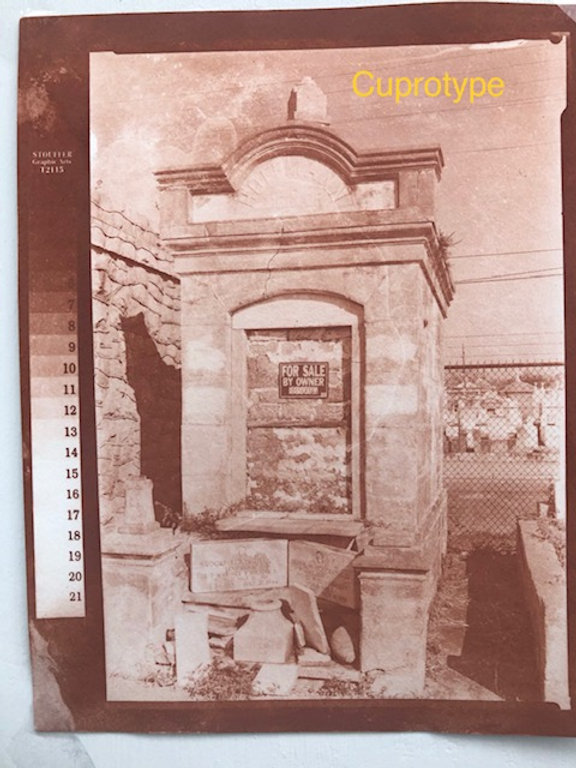
Continuing that work, based on a starter set of sensitizer formulation and process conditions, I was able to print an actual image of what I am terming as the New Cuprotype, to differentiate it from Patterson's version. The two are similar in that they both use FAC and CuSO4 in the photosensitizer. In the Patterson process, first a Cu(i) image is formed from Cu(ii) reduced by Fe(ii), itself the result of UV photoreduction of Fe(iii), which is then converted to a grey Cu(i) thiocyanate image by developing in ammonium thiocyanate. Finally, a copper(ii) ferrocynide, also known as Hatchett’s brown, image is formed by treatment with potassium ferricyanide.

In the current process the “developer” in a sense is the sodium thiosulfate, incorporated in the photosensitizer - so no separate intermediate image is required. A strong print-out of yellowish-brown image is obtained upon exposure. The exact nature of the pigment responsible for the image at this stage is not being proposed yet, but it’s safe to say it is some form of complex between Cu(i) and sodium thiosulfate. The development is simply washing out of the un-reacted chemicals in the paper in a similar fashion as cyanotype. Unlike cyanotype though, there does not seem to be any intensification of the image from what is already printed out during exposure. Copper ferrocyanide image is then obtained by treatment with potassium ferricyanide as usual.

In short, we may have stumbled upon a new cuprotype variant - thanks to @Jan de Jong' s creative experimenting.

The print in the next post.


:Niranjan.

Niranjan,

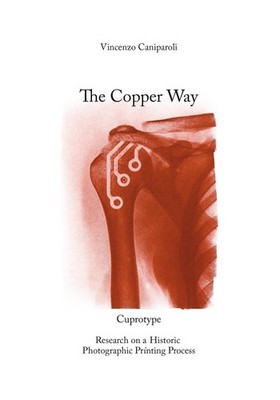
Vincenzo Caniparoli, who is the author of a recent book on the cuprotype process, has published a document critiquing hypo-cuprotype:


His main argument seems to be this:
  • In the presence of thiosulfate, copper(I) doesn't form a precipitate and instead participates in stable complexation equilibria with thiosulfate ions.
  • Under these conditions, copper(I) is retained in a soluble and dispersed form within the sensitized layer.
  • Consequently, the image-forming species is not immobilised chemically and remains susceptible to redistribution and removal.
  • During washing, water removes some part of these soluble complexes. The residual image is governed largely by how much copper(i) is physically entrapped within the paper fibers. Therefore, image density is dependent more on the properties of the substrate than on the chemical immobilsation.

From this he concludes that the "role of thiosulfate is thus intrinsically incompatible with direct image formation."

I am not a chemist to authoritatively critique his argument, but it seems to go against the empirical fact that many have successfully made toned cuprotype prints using this process. No idea if Vincenzo has ever made a hypo-cuprotype print himself by following the steps given here or missed the fact that toning with potassium ferricyanide produces a healthy print.
 
I think the assumption that only cu(i)-thiosulphate complexes are formed is incorrect. Thiosulphate is sensitive to UV light and breaksdown to various sulphur speices. So, it is likely that an insoluble cu(i) sulphide is formed during the exposure.
 
Last edited:
I think the assumption that only cu(i)-thiosulphate complexes are formed is incorrect. Thiosulphate is sensitive to UV light and breaksdown to various sulphur speices. So, it is likely that an insoluble cu(i) sulphide is formed during the exposure.

If thiosulfate was photosensitive to any appreciable (i.e. image forming) degree than we wouldn't need FAC. I doubt though....easy to check - just leave out the FAC in the recipe and see if you get an image.

:Niranjan.
 
Hi@nmp:


Niranjan,

Vincenzo Caniparoli, who is the author of a recent book on the cuprotype process, has published a document critiquing hypo-cuprotype:


His main argument seems to be this:
  • In the presence of thiosulfate, copper(I) doesn't form a precipitate and instead participates in stable complexation equilibria with thiosulfate ions.
  • Under these conditions, copper(I) is retained in a soluble and dispersed form within the sensitized layer.
  • Consequently, the image-forming species is not immobilised chemically and remains susceptible to redistribution and removal.
  • During washing, water removes some part of these soluble complexes. The residual image is governed largely by how much copper(i) is physically entrapped within the paper fibers. Therefore, image density is dependent more on the properties of the substrate than on the chemical immobilsation.

From this he concludes that the "role of thiosulfate is thus intrinsically incompatible with direct image formation."

I am not a chemist to authoritatively critique his argument, but it seems to go against the empirical fact that many have successfully made toned cuprotype prints using this process. No idea if Vincenzo has ever made a hypo-cuprotype print himself by following the steps given here or missed the fact that toning with potassium ferricyanide produces a healthy print.

Hi@nmp:


Niranjan,

Vincenzo Caniparoli, who is the author of a recent book on the cuprotype process, has published a document critiquing hypo-cuprotype:


His main argument seems to be this:
  • In the presence of thiosulfate, copper(I) doesn't form a precipitate and instead participates in stable complexation equilibria with thiosulfate ions.
  • Under these conditions, copper(I) is retained in a soluble and dispersed form within the sensitized layer.
  • Consequently, the image-forming species is not immobilised chemically and remains susceptible to redistribution and removal.
  • During washing, water removes some part of these soluble complexes. The residual image is governed largely by how much copper(i) is physically entrapped within the paper fibers. Therefore, image density is dependent more on the properties of the substrate than on the chemical immobilsation.

From this he concludes that the "role of thiosulfate is thus intrinsically incompatible with direct image formation."

I am not a chemist to authoritatively critique his argument, but it seems to go against the empirical fact that many have successfully made toned cuprotype prints using this process. No idea if Vincenzo has ever made a hypo-cuprotype print himself by following the steps given here or missed the fact that toning with potassium ferricyanide produces a healthy print.

There is something "insoluble" (or solubility difference to be more precise) happening, otherwise how to explain this:

https://www.photrio.com/forum/attachments/2022-08-03-0001-jpg.311846/

The image stays stable even after 30 minutes of washing. Whereas in absence of thiosulfate, it must be first treated with a thiocyanate to form a stable image without washing.

I am open to alternative chemical explanation, but it has to fit within the empirical observations. You wouldn't get a strong tonal range by having Cu(i) "physically entrapped within the paper fibers."

Seeing is believing!

:Niranjan.
 
Good to know. Thanks for sharing.

I want to thank Vincenzo for taking the time to analyse the chemistry behind my copper‑fix process. His explanation of the Fe(III) → Fe(II) → Cu(I) sequence and the stability of Cu(I)–thiosulfate complexes is absolutely correct for a solution‑phase system.

However, a few practical observations from working with the process show that the behaviour in a drying paper matrix is not fully captured by a purely theoretical, homogeneous model.

1. The process is not happening in a beaker The chemistry takes place in a semi‑dry coating on paper, with local pH differences, oxygen exposure, drying effects, and cellulose binding. Under these conditions, Cu(I) does not behave exactly as it does in a fully aqueous solution.

2. The emulsion loses power if it sits, but works when coated immediately If the sensitizer is left mixed for too long, it weakens noticeably.But if I coat the paper right after mixing, the dried sheet remains active and prints normally even days later.This suggests that some of the chemistry “locks in” during drying, which is not accounted for in a solution‑only model.

3. The image survives washing and tones instantly If the image were only soluble Cu(I)–thiosulfate complexes trapped in the fibers, washing should remove almost everything and toning should be slow.Instead, even faint images react immediately in a citric‑acid ferricyanide bath.This indicates the presence of Cu(I)/Cu(0)/Cu₂O‑type species that are still chemically accessible, not just soluble complexes.

4. The yellow colour is consistent with Cu(I) oxides The bright yellow tone matches Cu₂O and other Cu(I) species that can form during drying or mild oxidation.It does not match copper sulfides, but it also does not require the image to be purely soluble.

In short: Vincenzo’s theoretical analysis is correct for a homogeneous solution, but the real process takes place in a drying, heterogeneous paper layer where Cu(I) can undergo disproportionation, oxidation, and binding that lead to a stable, image‑forming deposit.My intention is not to contradict his expertise, only to point out that the practical behaviour shows additional pathways that are not captured by the simplified model.

I appreciate the discussion — it helps refine the understanding of what’s actually happening in this unusual copper system.

(of course I had this written by Copilot)

My interest is not so much how it works, but that it works. It has an extreme exposure lattitude, can be toned, and leave behind the impression of my plants, leaves and grasses. My interest is in the copper - iron mixes in general. I am not looking for photo grade but chemical processes that can record light, preferably in this case non silver, not (extreme) toxic.

I encourage you to order the English version of Vinzenzos book, " The Copper Way " easiest to buy on Ebay. Not making commercial but this is so specialized and probably the first book ever covering only this subject: It is only Euro 29,99 excl shipment.

I hope we can extend the copper processes, to that I also count the FerroBlend. I think practical in these things.


Cheers
Jan.
 
If thiosulfate was photosensitive to any appreciable (i.e. image forming) degree than we wouldn't need FAC. I doubt though....easy to check - just leave out the FAC in the recipe and see if you get an image.

:Niranjan.

I meant photo-degradation of Thiosulphate due to UV light. It's of course not a substitute for FAC.

[Edit: This is an interesting read on the subject of photo-degradation of Copper-Thiosulphate complex though it focuses on UV-C: https://www.mdpi.com/2075-4701/9/11/1178
]
 
Last edited:
There is something "insoluble" (or solubility difference to be more precise) happening, otherwise how to explain this:

https://www.photrio.com/forum/attachments/2022-08-03-0001-jpg.311846/

The image stays stable even after 30 minutes of washing. Whereas in absence of thiosulfate, it must be first treated with a thiocyanate to form a stable image without washing.

I am open to alternative chemical explanation, but it has to fit within the empirical observations. You wouldn't get a strong tonal range by having Cu(i) "physically entrapped within the paper fibers."

Seeing is believing!

:Niranjan.

Absolutely. This is what I commented yesterday on Vincenzo's FB post that I linked earlier:

"Even assuming that there are multiple pathways, it is a fact that an image does get formed after exposure and this image remains on the paper after washing. The image-forming substance is obviously an insoluble cu(i) species. If it were not as you seem to believe, then by your own argument even some cu(ii) would have remained in the paper and would have caused significant staining after ferricyanide toning. But that isn't the case.

By the way, this forum post shows the image that remains in the print after washing (and before toning): https://www.photrio.com/forum/threads/a-new-cuprotype.193432/post-2576914 It appears robust to me with details throughout the exposure scale which it wouldn't be if a dispersable species were formed after exposure."
 
Photrio.com contains affiliate links to products. We may receive a commission for purchases made through these links.
To read our full affiliate disclosure statement please click Here.

PHOTRIO PARTNERS EQUALLY FUNDING OUR COMMUNITY:


Ilford ADOX Freestyle Photographic Stearman Press Weldon Color Lab Blue Moon Camera & Machine
Top Bottom