
• Welcome to Photrio!
    Registration is fast and free. Join today to unlock search, see fewer ads, and access all forum features.
    Click here to sign up

110/16mm Camera Image Quality

Man in black

A
Man in black

  • 1
  • 0
  • 60
New Growth

A
New Growth

  • 2
  • 1
  • 53

Forum statistics

Threads
203,354
Messages
2,853,353
Members
101,800
Latest member
alextytyty
Recent bookmarks
0
The general rule for teleconverters, as I understand it, is that you're better off cropping.

There might be an exception for a converter made by the same manufacturer as the lens you're using it with, and specifically for that exact lens -- but otherwise, the loss of image quality is probably similar or worse than with a crop to the same subject size.

And the dimmer viewfinder doesn't help in any way...

Crop 110? There's not much there to start with.

Pentax Auto 110 Super, Tri-X, HC-110B 10min

unAycJ2.jpg
xUBvKtU.jpg
UHHPYUk.jpg


9oF5BS2.jpg


I got a 'Super' a few days ago. It's the updated version. It has a few key differences so as far as I can tell so far. First off, it's slightly bigger, the shutter is recessed and the viewfinder is a bit brighter. Main issue I had to figure out is you need to clip the cassettes or reloaded film won't run. It has a little tab in there that I guess once depressed activates some sort of pin registration and the shutter won't fire.

Otherwise it's a slightly better build but is just as nice as the original. The 18mm lens and 50mm are very nice. I only had a 24mm beforehand.

I reloaded using Plus-X this time and used the method where I did not used backing paper. Just rolled a double length of 16mm in there. I taped a scrap of backingpaper over the window on the cart and it seems light tight. I should get about 50 exposures this time. Next test I'm going to try to push the Tri-X to 400.

I need a lead on cheap 16mm color cine stock for further adventures.
 
Crop 110? There's not much there to start with.

I've done mild crops on the 10x14 mm negative from a Minolta 16. With slowish film and a steady hand, there's enough there to work with (after all, a Minox has barely more than half that frame, while 110 is a little less than twice the original Minolta frame).
 
I've done mild crops on the 10x14 mm negative from a Minolta 16. With slowish film and a steady hand, there's enough there to work with (after all, a Minox has barely more than half that frame, while 110 is a little less than twice the original Minolta frame).

I guess on the print, yep. I can see that.
 
One advantage of teleconverters is that, when you are at the close focus distance limit of a lens, they do the cropping for you, without your having to move closer.
 
I guess on the print, yep.

Yes, print or scan. The idea behind what I suggested is that you can shoot a negative without converter and crop down to the converter's view and the result will be of similar or better quality than the full negative made with the converter. Or put another way, a 2x converter on 110 gives you about the same amount of image information as a 10x14 Minolta (never mind differences in distance to subject) -- but the smaller (section of) negative will be enough sharper that you're likely to find it preferable.

That said, I've owned and used converters -- got a 1.5x and 2x on M42, and a 2x for my RB67. They have their place, but they aren't ever as good as replacing a 50 mm with a 75 mm or 100 mm (never mind a 150 mm instead of both, in the M42 case) -- and with the equipment prices of even five years ago, it was still easy to justify buying the additional lens instead of the converter.

Now, the Pentax 110 SLR has few if any 3rd party lens choices and limited range in its own lenses, so you may be stuck with the converter if you can't get closer...
 
Yes, print or scan. The idea behind what I suggested is that you can shoot a negative without converter and crop down to the converter's view and the result will be of similar or better quality than the full negative made with the converter. Or put another way, a 2x converter on 110 gives you about the same amount of image information as a 10x14 Minolta (never mind differences in distance to subject) -- but the smaller (section of) negative will be enough sharper that you're likely to find it preferable.

That said, I've owned and used converters -- got a 1.5x and 2x on M42, and a 2x for my RB67. They have their place, but they aren't ever as good as replacing a 50 mm with a 75 mm or 100 mm (never mind a 150 mm instead of both, in the M42 case) -- and with the equipment prices of even five years ago, it was still easy to justify buying the additional lens instead of the converter.

Now, the Pentax 110 SLR has few if any 3rd party lens choices and limited range in its own lenses, so you may be stuck with the converter if you can't get closer...

I don't think there are any 3rd party lenses for the 110 system.
 
I don't think there are any 3rd party lenses for the 110 system.

I don't think so either -- probably because they were more complicated. The camera sets the shutter speed and aperture at the same time -- both inside the camera. But I'm sure some creative types have adapted other lenses.

Here's the differences between the Original and The SUPER model:

It's hard to improve on perfection but Pentax did it. In 1982, they came out with an improved version of the original Pentax Auto 110. Many consider it the pinnacle in 110 photography. Fortunately, it's easy to tell the difference between the models. The original just has "Auto 110" on the faceplate. This model has "Auto 110 Super" on the faceplate.
Here is a list of features which the Super has compared to the plain Pentax 110.
  • 1. The Super has a microprism focusing collar around the central split-image spot -- both have split-image and ground glass screen.
  • 2. The Super has a backlight compensation button for 1.5 EV additional exposure.
  • 3. The Super has a self-timer, with a blinking red light on the front of the camera for warning, and a plastic cover for the eyepiece to exclude extraneous light.
  • 4. The Super has a recessed shutter button and a shutter lock to avoid accidental firing of the shutter.
  • 5. The Super's yellow, low-light warning LED in the viewfinder comes on at 1/45 sec (or slower) shutter speed -- instead of 1/30 sec.
  • 6. The Super's minimum exposure is 1/400 sec at f/18 -- rather than 1/750 sec at f/13.5.
  • 7. The Super has a single stroke film advance -- rather than a two stroke one.
  • 8. The Super weights 178g -- rather than 172g.
  • 9. The Super has a captive cover for the flash connection, making it less easy to lose.
  • 10. The Super has a very slightly brighter finder.
 
I don't think so either -- probably because they were more complicated. The camera sets the shutter speed and aperture at the same time -- both inside the camera. But I'm sure some creative types have adapted other lenses.

Here's the differences between the Original and The SUPER model:

It's hard to improve on perfection but Pentax did it. In 1982, they came out with an improved version of the original Pentax Auto 110. Many consider it the pinnacle in 110 photography. Fortunately, it's easy to tell the difference between the models. The original just has "Auto 110" on the faceplate. This model has "Auto 110 Super" on the faceplate.
Here is a list of features which the Super has compared to the plain Pentax 110.
  • 1. The Super has a microprism focusing collar around the central split-image spot -- both have split-image and ground glass screen.
  • 2. The Super has a backlight compensation button for 1.5 EV additional exposure.
  • 3. The Super has a self-timer, with a blinking red light on the front of the camera for warning, and a plastic cover for the eyepiece to exclude extraneous light.
  • 4. The Super has a recessed shutter button and a shutter lock to avoid accidental firing of the shutter.
  • 5. The Super's yellow, low-light warning LED in the viewfinder comes on at 1/45 sec (or slower) shutter speed -- instead of 1/30 sec.
  • 6. The Super's minimum exposure is 1/400 sec at f/18 -- rather than 1/750 sec at f/13.5.
  • 7. The Super has a single stroke film advance -- rather than a two stroke one.
  • 8. The Super weights 178g -- rather than 172g.
  • 9. The Super has a captive cover for the flash connection, making it less easy to lose.
  • 10. The Super has a very slightly brighter finder.

Very interesting. Thanks.
 
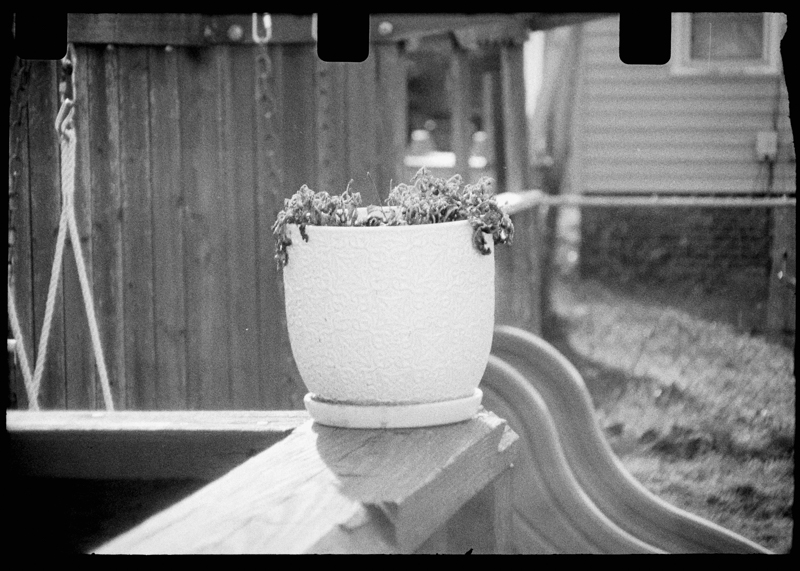
Pentax Auto 110 Super, Plus-X 16mm

CqHQUhH.jpg
gKGbsEm.jpg

nI7EK02.jpg
2yTzRZk.jpg

jwnsb2D.jpg

0EUtM5A.jpg

Two stacked teleconverters and a 50mm 2.8
aIBfhju.jpg

avk2CtU.jpg

One tele and the 50
VGGI8B0.jpg


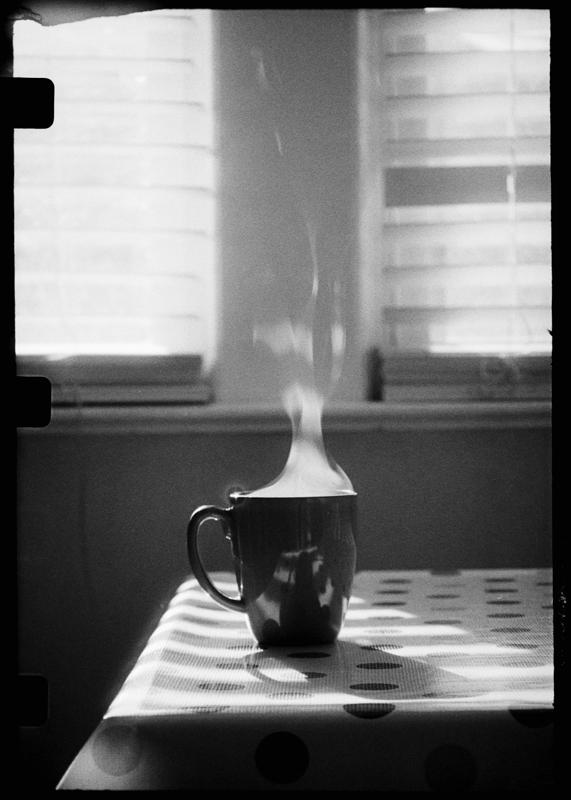
I gotta say. This camera with some modern film and modern scanning techniques can really give 35mm a run for its money. I'm a little surprised how clean some of these photos look. The mug and pines are really sharp and contrasty. I do notice a lack of anti-halation on this film. I didn't get the flares with the Tri-X. However I like the flares so it stays for now.
 
I have both, the ordinary and the Super which bares its name rightfully https://www.subcompactcam.com/110_pentax_auto.htm . I love the Super and yes, with modern film it's good.

But compared to a simple Konica Lexio 70, a tiny 135 format camera, you have similar focal length without changing lenses in a small body as well, but you have 4 times the picture surface https://www.135compact.com/konica_lexio_70.htm .

And my Sureshot 130u is even smaller but that's not the point.
 
And my Sureshot 130u is even smaller but that's not the point.
Are you sure about it? It's much thicker as far as I know, it's heavier as well and, more important, it'a not as wide at the wide end. And, most important, aperture is much smaller... I had this one as well.
 
Are you sure about it? It's much thicker as far as I know, it's heavier as well and, more important, it'a not as wide at the wide end. And, most important, aperture is much smaller... I had this one as well.

Yours is smaller. k.

Anyhow, what this has to do with 110 is debatable. I was making a statement of wonder claiming that the Auto 110 with good film and scanning can pass for 35mm.

Sure, a decent 35mm camera with good film will always surpass 16mm film. But that wasn't my point. My point is a good exposure and scan can pass for a 35mm. And this being Photrio and knowing the users base here this thread will either get dragged into a 16mm vs 35mm contest with some idiots on either side riding or dying or some technical nerds will take over and not understand the darn tootn' point I'm trying to make.

Either way, here's some Plus-X put the the Auto 110 Super.

OsndAnw.jpg


I like tea.
 
Sure, a decent 35mm camera with good film will always surpass 16mm film. But that wasn't my point. My point is a good exposure and scan can pass for a 35mm. And this being Photrio and knowing the users base here this thread will either get dragged into a 16mm vs 35mm contest with some idiots on either side riding or dying or some technical nerds will take over and not understand the darn tootn' point I'm trying to make.

Either way, here's some Plus-X put the the Auto 110 Super.

Technical nerd here, let me take over.

Indeed your properly scanned 16mm image looks better than the poorly scanned 35mm images I see from time to time (i.e. using Epson flatbed scanners).

It looks good.
 
The general rule for teleconverters, as I understand it, is that you're better off cropping.

There might be an exception for a converter made by the same manufacturer as the lens you're using it with, and specifically for that exact lens -- but otherwise, the loss of image quality is probably similar or worse than with a crop to the same subject size.

And the dimmer viewfinder doesn't help in any way...

A well designed teleconverter can actually improve picture quality, because it’s magnifies only the center portion of the converted lens.
But the crucial part is of course, that it has to be well designed.
A generic, third-party teleconverter will deliver sup par results.
 
Yes, print or scan. The idea behind what I suggested is that you can shoot a negative without converter and crop down to the converter's view and the result will be of similar or better quality than the full negative made with the converter. Or put another way, a 2x converter on 110 gives you about the same amount of image information as a 10x14 Minolta (never mind differences in distance to subject) -- but the smaller (section of) negative will be enough sharper that you're likely to find it preferable.

That said, I've owned and used converters -- got a 1.5x and 2x on M42, and a 2x for my RB67. They have their place, but they aren't ever as good as replacing a 50 mm with a 75 mm or 100 mm (never mind a 150 mm instead of both, in the M42 case) -- and with the equipment prices of even five years ago, it was still easy to justify buying the additional lens instead of the converter.

Now, the Pentax 110 SLR has few if any 3rd party lens choices and limited range in its own lenses, so you may be stuck with the converter if you can't get closer...

Photozone.de used to test Canon 70-200mm lenses, then put a Canon 1.4xTC and test same lens again. They did this with both f/4 and f/2.8 lenses, and did so with multiple generations of Canon 70-200 zooms., each time there were re-designs. Time after time, they showed that MTF values declined by about 10% with the 1.4X TC, but given the fact that FL was multiplied by 140%, a drop of IQ on the order or -10% seemed to be a good tradeoff, compared to simply cropping in the darkroom or in postprocessing digital images, both of which 'threw away' 40% of the lens' delivered resolution to the focal plane.
 
Photozone.de used to test Canon 70-200mm lenses, then put a Canon 1.4xTC and test same lens again. They did this with both f/4 and f/2.8 lenses, and did so with multiple generations of Canon 70-200 zooms., each time there were re-designs. Time after time, they showed that MTF values declined by about 10% with the 1.4X TC, but given the fact that FL was multiplied by 140%, a drop of IQ on the order or -10% seemed to be a good tradeoff, compared to simply cropping in the darkroom or in postprocessing digital images, both of which 'threw away' 40% of the lens' delivered resolution to the focal plane.

A good teleconverter is optimized for a particular focal range. With other FRs only being “fine”.
That makes zoom lenses a definite no, for critical tests.

The 300-S 2x TC coupled to the Rokkor 200mm 2.8 comes to mind. Here the the TC almost improves the already good lens.
 
Technical nerd here, let me take over.

Indeed your properly scanned 16mm image looks better than the poorly scanned 35mm images I see from time to time (i.e. using Epson flatbed scanners).

It looks good.

There. Exactly.

Thanks.

A well designed teleconverter can actually improve picture quality, because it’s magnifies only the center portion of the converted lens.
But the crucial part is of course, that it has to be well designed.
A generic, third-party teleconverter will deliver sup par results.

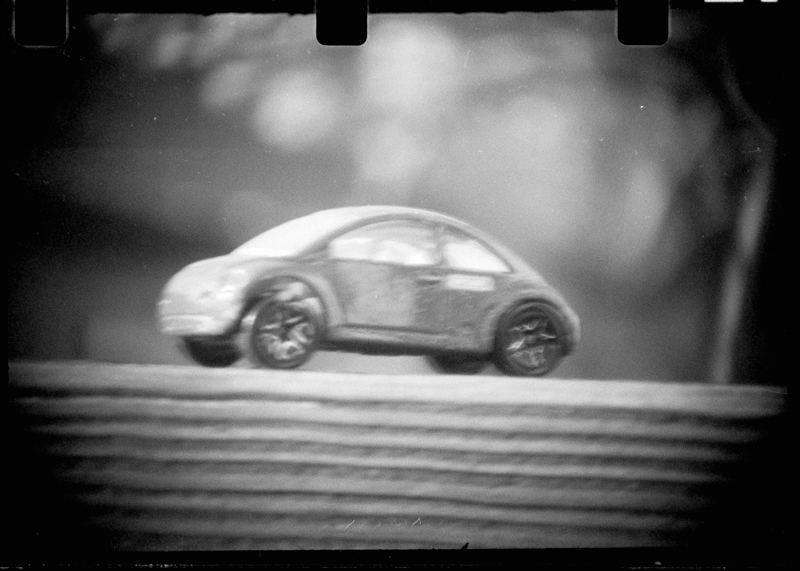
All the photos of the toy VW were taken with a teleconverter. The one with vignetting had two TCs. The others are one. I have more examples but they came out terrible more or less. I'll do the next test using a tripod I think. I couldn't keep my hands steady enough.
 
Pentax Auto 110 Super, Plus-X 16mm

CqHQUhH.jpg
gKGbsEm.jpg

nI7EK02.jpg
2yTzRZk.jpg

jwnsb2D.jpg

0EUtM5A.jpg

Two stacked teleconverters and a 50mm 2.8
aIBfhju.jpg

avk2CtU.jpg

One tele and the 50
VGGI8B0.jpg


I gotta say. This camera with some modern film and modern scanning techniques can really give 35mm a run for its money. I'm a little surprised how clean some of these photos look. The mug and pines are really sharp and contrasty. I do notice a lack of anti-halation on this film. I didn't get the flares with the Tri-X. However I like the flares so it stays for now.

These are looking really good - less grain than I would have thought for plus-x. Where are you finding plus-x in 16mm? ---jb.
 
These are looking really good - less grain than I would have thought for plus-x. Where are you finding plus-x in 16mm? ---jb.

Where else but Ebay? It's expired, not sure how old. I just had a look and it's doubled in price since the last time I bought some. Gonna have to try some DoubleX next time.
 
I thought the appeal of 16mm was the lo-fi images, increased grain etc.
I’ve been following this thread of late and could be tempted, but when I started looking at the cost of film and lack of film development equipment for the DIY’er it has lost some of its appeal.
 
I thought the appeal of 16mm was the lo-fi images, increased grain etc.
I’ve been following this thread of late and could be tempted, but when I started looking at the cost of film and lack of film development equipment for the DIY’er it has lost some of its appeal.

It's the appeal in some situations. Notice the title of this thread, it started as seeing how much you can get out of the tiny negative.

I ordered some 110 reels from etsy and they're...ok. The film really does not want to go on the reels. For the comparative price they're cheap. Everything else 110/16mm is a bargain.

Now, if I wanted lo-fi and loads of grain on my 16mm I can do that easily. But what's the challenge then?
 
It's the appeal in some situations. Notice the title of this thread, it started as seeing how much you can get out of the tiny negative.

I ordered some 110 reels from etsy and they're...ok. The film really does not want to go on the reels. For the comparative price they're cheap. Everything else 110/16mm is a bargain.

Now, if I wanted lo-fi and loads of grain on my 16mm I can do that easily. But what's the challenge then?

I get it now you've mentioned it. I guess for me and film it’s about getting the characteristic film look. I don’t want clean negatives, I want very lo-fi.
Weird hey!
 
These are looking really good - less grain than I would have thought for plus-x. Where are you finding plus-x in 16mm? ---jb.

You can get whatever you want in 16mm/110 size by slitting 35mm -- or 120 (which gives you 3 16mm slits or 4 15.25mm slits)
 
Photrio.com contains affiliate links to products. We may receive a commission for purchases made through these links.
To read our full affiliate disclosure statement please click Here.

PHOTRIO PARTNERS EQUALLY FUNDING OUR COMMUNITY:


Ilford ADOX Freestyle Photographic Stearman Press Weldon Color Lab Blue Moon Camera & Machine
Top Bottom