
I have never tried any of the Caffenol developers until tonight. I decided to try Caffenol LC+C on a partial roll of HR-50. While the images look very good and very sharp the negatives have a lot of base fog. I'm pretty sure I can print through this, but was just wondering if this was normal or not. Also, I didn't have Folger's crystals and just used my stores cheap house brand instant coffee. I don't think that would cause the fog, but you never know. Or at least I never know since this is my first try. Do other folks here get pretty heavy base fog with Caffenol?
-
Welcome to Photrio!Registration is fast and free. Join today to unlock search, see fewer ads, and access all forum features.Click here to sign up
You are using an out of date browser. It may not display this or other websites correctly.
You should upgrade or use an alternative browser.
You should upgrade or use an alternative browser.
Adox HR-50 developed in Caffenol LC+C looks like London fog?
-
A
- Thread starter John Wiegerink
- Start date
Recent Classifieds
-
For Sale Toyo 110mm lens boards (45 CF 45AR, 45ARII A11, AX
- Started by binglebugbob
-
Want to Buy Hasselblad A12 type III or IV back (Black or Silver)
- Started by jshcrlsn
-
For Sale Nikon F2S (body only, meter not working)
- Started by MCB18
Forum statistics

Yeah. It's a bit like toning cyanotypes etc. in coffee - the coffee stains the base. It's the same as your dentist complaining about "sir you must be drinking a lot of coffee, I'll ask my assistant to make an appointment with you to clean the staining a little" LOL.
Caffenol is effectively a staining developer in the 'bad' sense of the word: it adds an overall stain, but not an image-wise stain. So it's kind of the opposite of e.g. Pyrocat.
Caffenol is effectively a staining developer in the 'bad' sense of the word: it adds an overall stain, but not an image-wise stain. So it's kind of the opposite of e.g. Pyrocat.
Yeah. It's a bit like toning cyanotypes etc. in coffee - the coffee stains the base. It's the same as your dentist complaining about "sir you must be drinking a lot of coffee, I'll ask my assistant to make an appointment with you to clean the staining a little" LOL.
Caffenol is effectively a staining developer in the 'bad' sense of the word: it adds an overall stain, but not an image-wise stain. So it's kind of the opposite of e.g. Pyrocat.
Koraks,
I figured it would discolor the negatives some, but didn't think the stain would be this heavy. I'm on my way to the cottage and the negatives are left down home or I'd show them. When I get back down home I'm going to try this again, but I might try a touch of KBr in the next batch to see if it makes a difference.
I don't expect bromide to do anything about this since the staining is likely just the coffee painting the gelatin, not so much silver fogging. Although the latter can also play a part of course. In that case KBr will help tone it down a little.
Btw, I have to admit I'm kind of the wrong audience for this; I never quite understood the attraction of these coffee developers. The way I see it they're fairly inefficient and the whole eco-story to surround them sounds fishy to me in the light of the quantity of instant coffee that's needed and the overall impact that has over its product life cycle. From a technical viewpoint it's very obvious that there are plenty of superior alternatives, many of which are very cost-effective and sometimes even relatively ecologically benign (instant Mytol etc.)
Btw, I have to admit I'm kind of the wrong audience for this; I never quite understood the attraction of these coffee developers. The way I see it they're fairly inefficient and the whole eco-story to surround them sounds fishy to me in the light of the quantity of instant coffee that's needed and the overall impact that has over its product life cycle. From a technical viewpoint it's very obvious that there are plenty of superior alternatives, many of which are very cost-effective and sometimes even relatively ecologically benign (instant Mytol etc.)
I don't expect bromide to do anything about this since the staining is likely just the coffee painting the gelatin, not so much silver fogging. Although the latter can also play a part of course. In that case KBr will help tone it down a little.
Btw, I have to admit I'm kind of the wrong audience for this; I never quite understood the attraction of these coffee developers. The way I see it they're fairly inefficient and the whole eco-story to surround them sounds fishy to me in the light of the quantity of instant coffee that's needed and the overall impact that has over its product life cycle. From a technical viewpoint it's very obvious that there are plenty of superior alternatives, many of which are very cost-effective and sometimes even relatively ecologically benign (instant Mytol etc.)
I probably know less than you do when it comes to Caffenol developers. I would not have even tried a coffee style developer for HR-50, but all my chemical for developer making are at the cottage and I was down home. My grocery store had what I needed so I had to try it. I only tried this because I had just repaired a Minolta 7s rangefinder and wanted to see if it was working properly. I figured the addition of KBr would at least let me know if it was all stain or not. The funny thing about all of this is that while looking through my cabinet to see if I had any KBr down home I stumbled on a half bottle of Adox Rodinal that I forgot to bring North to the cottage. I could have used that with the HR-50 since I know the two go together very well.
Never heard of the "LC+C" variant of caffenol, would you share the recipe ?
This is Donald Qualls recipe:
Caffenol LC+C (speed enhancing low contrast microfilm developer)
8 oz Water
4 tsp (level) Arm & Hammer Washing Soda
.26 g (4 grain) Ascorbic acid or erythorbic acid (supplement or technical, 97%)
2 tsp (slightly rounded) Folger's Coffee Crystals
That's a fine reason in my book!My grocery store had what I needed so I had to try it.
This is Donald Qualls recipe:
Caffenol LC+C (speed enhancing low contrast microfilm developer)
8 oz Water
4 tsp (level) Arm & Hammer Washing Soda
.26 g (4 grain) Ascorbic acid or erythorbic acid (supplement or technical, 97%)
2 tsp (slightly rounded) Folger's Coffee Crystals
Thanks.
There is fogging with Caffenol-C even with ISO 100 films, that's why the CH variant is IMO the best starting point for any regular films. It's C-C with 1g Kbr added :
Caffenol C-H
1000 ml water
54g washing soda
16g ascorbic acid
1g Kbr
40g instant coffee
20°c, standard agitation.
Now if my math is correct, and assuming 1 tsp = 5g, LC+C is :
1000ml water
84,5g washing soda
1g ascorbic acid
-
42,3g instant coffee
I assume the developing time was quite long with your roll. Coupled with the absence of Kbr, the high level of fog doesn't surprise me.
To keep CC-H compatible with "stuff I can find in the grocery store", Kbr can be replaced with 10 time the amount of iodized salt. It's not as effective but good enough.
You mentionned testing a new repaired camera. A damaged lens could also be responsible for the "london fog", I've seen it happen with an old camera where other variables were out (fresh roll, commercial developer, bright daylight). To be sure we're not blaming the developer I'd shoot an other roll and develop it in rodinal or hc110.
pentaxuser
Member
You could always try Sam Spade's "Java" recipe. It seemed to work well in The Maltese Falcon 
pentaxuser
pentaxuser
Thanks.
There is fogging with Caffenol-C even with ISO 100 films, that's why the CH variant is IMO the best starting point for any regular films. It's C-C with 1g Kbr added :
Caffenol C-H
1000 ml water
54g washing soda
16g ascorbic acid
1g Kbr
40g instant coffee
20°c, standard agitation.
Now if my math is correct, and assuming 1 tsp = 5g, LC+C is :
1000ml water
84,5g washing soda
1g ascorbic acid
-
42,3g instant coffee
I assume the developing time was quite long with your roll. Coupled with the absence of Kbr, the high level of fog doesn't surprise me.
To keep CC-H compatible with "stuff I can find in the grocery store", Kbr can be replaced with 10 time the amount of iodized salt. It's not as effective but good enough.
You mentionned testing a new repaired camera. A damaged lens could also be responsible for the "london fog", I've seen it happen with an old camera where other variables were out (fresh roll, commercial developer, bright daylight). To be sure we're not blaming the developer I'd shoot an other roll and develop it in rodinal or hc110.
The lens on the Minolta 7s is pristine and the shutter works perfect. Also, there are no light leaks body wise. The problem was a faulty stuck rewind button. As to my developing time? I ran the roll for 12 minute with gentle agitation every 3 minutes and a temp of 69F. I'm going to try again tomorrow if it stops raining.
The difference in ascorbic acid in Caffenol C-H is 16grams compared to 1gram in Caffenol LC+C. That seems like a very big difference???? Of course the KBr in Caffenol C-H is probably the reason why there is a difference, but 15grams seem like a lot of difference to me.

John, how does this film do in PC 512 Borax?

BAC1967
Subscriber
I develop HR-50 in Beerenol with great results. The recipe I use is similar to Caffenol-C, with beer instead of coffee. I found that anhydrous Sodium Carbonate works best. I bake washing soda in the over for about 90 minutes at 250F.
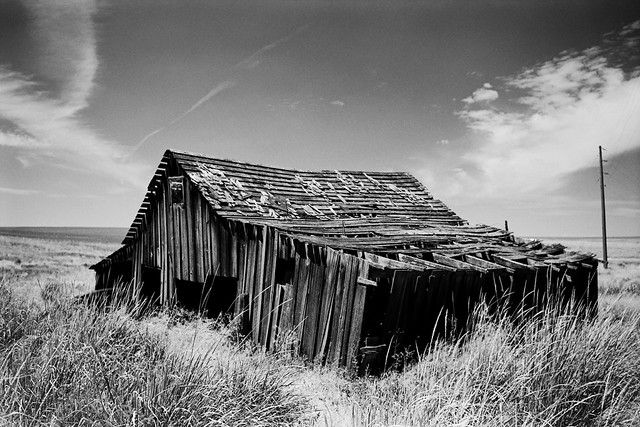 Old Paluse Barn by Bryan Chernick, on Flickr
Old Paluse Barn by Bryan Chernick, on FlickrJohn, how does this film do in PC 512 Borax?
It does very well in PC-512. bluechromis had a photo in the gallery of a harbor tower (I think) where he used PC-512 for developing HR-50 and it actually made me seriously try PC-512 with HR-50. While my shots came out pretty good, I actually found I liked HR-50 better developed in BTTB or Kqarl's 2B-1. So I didn't go any further with PC-512. The two developers I think that worked the best for me with HR-50 are Rodinal and BTTB. I still want to work with 510-pyro and Pyrocat-HDC to see how those work. But BTTB is by far the easiest to get good results with, for me anyway.
I develop HR-50 in Beerenol with great results. The recipe I use is similar to Caffenol-C, with beer instead of coffee. I found that anhydrous Sodium Carbonate works best. I bake washing soda in the over for about 90 minutes at 250F.
That's a very nice outcome. How do you find Beerenol for shadow detail? Do you have to rate it much lower than ISO 50? When I used BTTB I had to rate it no higher than an EI 32 and actually EI 25 would probably be better. Of course, that's my style metering, my meter and my vision of the scenes lighting. YMMV!
Yes, for sure.That seems like a very big difference????
You first remove water from the carbonate by baking it, then you add it to a pitcher of water. What benefit do you experience? The anhydrous carbonate will dissolve quicker and with more ease; is that the primary rationale?I found that anhydrous Sodium Carbonate works best. I bake washing soda in the over for about 90 minutes at 250F.

I develop HR-50 in Beerenol with great results. The recipe I use is similar to Caffenol-C, with beer instead of coffee. I found that anhydrous Sodium Carbonate works best. I bake washing soda in the over for about 90 minutes at 250F.
That's a pretty good result. Which formula are you using exactly?
I double checked the recipe for Caffenol C-H and it is indeed 16g of Vita-C (ascorbic acid). I did find two varieties of
Caffenol C-H. One is regular with KBr and the other is the UK version with iodized table salt to replace KBr with a common, easy to get, household item.
Caffenol C-H. One is regular with KBr and the other is the UK version with iodized table salt to replace KBr with a common, easy to get, household item.
The weather never cooperated today, but I did run a partial roll through a different camera (Contax G1) and just developed the roll in Caffenol LC+C again. This time I went and bought some new 1g capsules of Vita-C (ascorbic acid). SUCCESS! Much, much better in terms of fog/stain. Not perfect, but I know they will be much more printable than the first try with Caffenol LC+C. I really don't know where I screwed up on the first batch, but I certainly did. I'm going to do a test print tonight and see how it comes out. It does look like I'm reaching box speed, but I think by the looks of the highlight density I could go for a little more developing time. Maybe 15 minutes instead of the 12 minutes I tried. I'll post the results tonight when I finish. Fingers crossed!
BAC1967
Subscriber
That's a very nice outcome. How do you find Beerenol for shadow detail? Do you have to rate it much lower than ISO 50? When I used BTTB I had to rate it no higher than an EI 32 and actually EI 25 would probably be better. Of course, that's my style metering, my meter and my vision of the scenes lighting. YMMV!
I don't think HR-50 is the best for shadow detail but Beerenol does pretty good for shadow detail with most films. I often rate films slower than the box speed, but I find HR-50 does great at 50.
BAC1967
Subscriber
Yes, for sure.
You first remove water from the carbonate by baking it, then you add it to a pitcher of water. What benefit do you experience? The anhydrous carbonate will dissolve quicker and with more ease; is that the primary rationale?
I'm not a chemist so I don't know what exactly is going on with it. When I was developing my recipe I consulted with Reinhold, one of the authors of the Caffenol Cookbook & Bible. He gave me several tips that pointed me in the right direction. I tried several recipe variations before I settled on one that works best for me.
BAC1967
Subscriber
That's a pretty good result. Which formula are you using exactly?
I created a Beerenol group on Flickr, this link will take you to my recipe and some tips.
Beerenol Recipe
Sodium carbonate = sodium carbonate. Whether you remove water first, then add it back, or don't remove it first - it doesn't matter. It's the same stuff. That is, assuming you compensate for the difference in molar weight. Since removing the water (by cooking it in the oven) removes weight (the water evaporates, the carbonate remains), what you're left with is more concentrated. You would get the same effect by just using more of the decahydrate in the first place; there's plenty of tables with conversion factors. It'll save yourself the step of having to bake it.I'm not a chemist so I don't know what exactly is going on with it.

You should have used Caffenol CL and not LC+C as this variant is for microfilms. Adox HR-50 is a modified Agfa Gevaert Aviphot 80.
Staining can be easily removed with Kbr as seen here :

Staining can be easily removed with Kbr as seen here :
Staining can be easily removed with Kbr as seen here :
So there's no image-wise stain? Not a true staining developer?
| Photrio.com contains affiliate links to products. We may receive a commission for purchases made through these links. To read our full affiliate disclosure statement please click Here. |
PHOTRIO PARTNERS EQUALLY FUNDING OUR COMMUNITY:  |