

• Welcome to Photrio!
    Registration is fast and free. Join today to unlock search, see fewer ads, and access all forum features.
    Click here to sign up

Xray film hand rolled onto 120 backing paper: Kodak paper specifically is completely ruining the rolls but not ilford etc?

Recent Classifieds

Forum statistics

Threads
204,274
Messages
2,866,513
Members
102,207
Latest member
gustavocf
Recent bookmarks
1

Crimeo

Member
Joined
Apr 21, 2026
Messages
47
Location
Canada
Format
35mm
I am cutting down 36"x24" medical xray film and rolling it onto used 120 backing papers myself.

Whenever I use any of the Ilford or other brands with matte normalish paper types, it works great. Whenever I use the kodak gold style glossier 120 paper, the final developed roll is plastered with spots and gunk.

Obviously I can just avoid those papers, but I'd like to if possible know what on earth could be going on here. How is this not also affecting the original kodak films on those same rolls?
 
Can't help you with the backing paper issue, but I'm surprised that you are even able to roll this stuff, considering it's base is thicker, compared to 120 films...
 
Welcome to Photrio!
My guess is that the Kodak backing paper for some reason is more hydrophilic and absorbs moisture more readily and/or the inks are more liable to become photo-active in contact with an emulsion if moisture is present.
 
Can't help you with the backing paper issue, but I'm surprised that you are even able to roll this stuff, considering it's base is thicker, compared to 120 films...

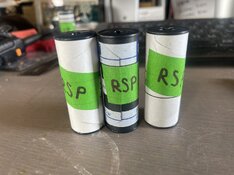
It hurts my fingers a bit to hold it hard enough for it to not spring apart, but yeah you can do it. It just baaaarely fits under the flange without burning the edges with light. You gotta rubber band it to store and still pinch it hard while loading anything until it's all set up.
 
The films and backing papers are designed together, because backing paper induced problems are a result of the emulsion and the ink and the paper interacting with each other.
If you rerolled the Kodak films with Ilford backing paper, you would encounter problems.
If you rerolled Ilford film with Kodak backing paper you might encounter problems too.
The economies mean that none of the film manufacturers can afford to have separate and different backing papers for each of their film offerings, so the Kodak stuff has to work with black and white negative film, colour negative film, and colour slide film, of all the various types.
Most likely it costs the film manufacturers more for to buy the backing paper for each roll of film than it does to make the roll itself. Ilford has admitted that publicly.
 
I am cutting down 36"x24" medical xray film and rolling it onto used 120 backing papers myself.

Whenever I use any of the Ilford or other brands with matte normalish paper types, it works great. Whenever I use the kodak gold style glossier 120 paper, the final developed roll is plastered with spots and gunk.

Obviously I can just avoid those papers, but I'd like to if possible know what on earth could be going on here. How is this not also affecting the original kodak films on those same rolls?

I also do not know what is going on, but you are not alone with this problem.
 
It hurts my fingers a bit to hold it hard enough for it to not spring apart, but yeah you can do it. It just baaaarely fits under the flange without burning the edges with light. You gotta rubber band it to store and still pinch it hard while loading anything until it's all set up.

My method: Rubber bands or 3d printed film clips to keep the roll secure, and then into 120 film canisters and/or dark bags for added protection.
 
Show an image. I'm not sure that in the struggle to wind you aren't contaminating the stuff. Small sample size.
 
The films and backing papers are designed together, because backing paper induced problems are a result of the emulsion and the ink and the paper interacting with each other.
If you rerolled the Kodak films with Ilford backing paper, you would encounter problems.
If you rerolled Ilford film with Kodak backing paper you might encounter problems too.
The economies mean that none of the film manufacturers can afford to have separate and different backing papers for each of their film offerings, so the Kodak stuff has to work with black and white negative film, colour negative film, and colour slide film, of all the various types.
Most likely it costs the film manufacturers more for to buy the backing paper for each roll of film than it does to make the roll itself. Ilford has admitted that publicly.

Well I don't doubt this. It does make me want to try. Not bad enough to actually do it though
 
It took Kodak a very considerable multi year research effort to develop backing paper printing that didn't react with film (also known as wrapper offset), and Ilford had problems too.

It was a very difficult problem for the big players to solve, so I'm not surprised that you would have trouble with X Ray film that was never designed to be in contact with a backing paper.
 
If you rerolled the Kodak films with Ilford backing paper, you would encounter problems.
If you rerolled Ilford film with Kodak backing paper you might encounter problems too.

Matt can I ask what makes you more definite in your above Kodak films statement than you are in your Ilford films statement? Do you know for a fact that Kodak films with Ilford backing paper will give problems but are only speculating about whether Ilford films with Kodak backing paper may do the same and if so what is the evidence you have?


Thanks

pentaxuser
 
Is this xray film with emulsion on both sides? Maybe the gelatine in emulsion on the side in contact with the backing paper has affinity for the pigments in the latter.

Yes it has an emulsion on both sides. I would have assumed pigments were just lamp black in glue for all backing papers though. Kodak ones are very glossy and ilford are matte, I am guessing more so than pigments it's like a lacquer or something
 
A normal (bluer clear one) photo using ilford paper, versus a kodak papered one. This speckly heavy fog (all on the one emulsion side not the other) is almost as dense as the photos

1776972907270.png
1776972925643.png
 
Matt can I ask what makes you more definite in your above Kodak films statement than you are in your Ilford films statement? Do you know for a fact that Kodak films with Ilford backing paper will give problems but are only speculating about whether Ilford films with Kodak backing paper may do the same and if so what is the evidence you have?


Thanks

pentaxuser

Kodak had to deal with all three/four types of films - 2 general types of black and white negative, colour negative and colour transparency when they had all their problems, and tried anything and everything they could to source new backing paper to replace the old stuff that they finally ran out of, and couldn't replicate with modern sources.
The stuff that Ilford had arrived at obviously didn't work for Kodak.
Earlier, Ilford had a much less complex problem to deal with when they made all their changes to deal with backing paper issues - just their range of black and white negative film.
It may well be that the more complex and likely more expensive solution that Kodak arrived at would work with the simpler Ilford films. But Eastman Kodak is protecting that tradecraft, because it is a valuable asset.
 
I would have assumed pigments were just lamp black in glue for all backing papers though.

The numbers and letters on traditional backing paper are printed using the modern soy based inks that the printing industry has transitioned to. The old inks that were formerly employed are no longer available.
The backing paper is a highly specialized product, only available from a very small selection of specialized paper suppliers, printed using very specialized techniques, with long lead times and immensely expensive minimum order quantities.
In almost all cases, modern film emulsions are far too complex and sensitive to not interact with simpler backing paper formulations.
 
The films and backing papers are designed together, because backing paper induced problems are a result of the emulsion and the ink and the paper interacting with each other.
If you rerolled the Kodak films with Ilford backing paper, you would encounter problems.
If you rerolled Ilford film with Kodak backing paper you might encounter problems too.
The economies mean that none of the film manufacturers can afford to have separate and different backing papers for each of their film offerings, so the Kodak stuff has to work with black and white negative film, colour negative film, and colour slide film, of all the various types.
Most likely it costs the film manufacturers more for to buy the backing paper for each roll of film than it does to make the roll itself. Ilford has admitted that publicly.

I've rolled all sorts of film with whatever paper I've had on hand. Never had an issue from the paper.
 
I've rolled all sorts of film with whatever paper I've had on hand. Never had an issue from the paper.

And how long has that re-rolled film spent in warehouses, shipping trucks/boats/trains, on retailer shelves and in your film storage?
Under what range of temperature and humidity conditions?
Someone doing this with the intention that they will keep the results carefully and use it and develop it promptly has to deal with far fewer variables than the film manufacturers do.
 
I normally refrigerate all my film. I never had a problem with the bad lots of Kodak film. Not that long ago I shot a roll that had set at room temperature c. 22°C for a couple years and I could see the problem.

Kodak has definitely fixed the backing paper. It may be hard to see the numbers through a red window but there's zero interaction with the film, at least the original Kodak film. I think that the Kodak engineers won the cost vs quality argument and got a supercoat over the ink. I don't know what it is but it works.
 
Can't help you with the backing paper issue, but I'm surprised that you are even able to roll this stuff, considering it's base is thicker, compared to 120 films...
It’s extremely close to not fitting, but it does fit.
IMG_3400.jpeg

I've rolled all sorts of film with whatever paper I've had on hand. Never had an issue from the paper.
Same here. Although I refuse to use Foma paper because I know that their quality control is utter crap sometimes.
 
And how long has that re-rolled film spent in warehouses, shipping trucks/boats/trains, on retailer shelves and in your film storage?
Under what range of temperature and humidity conditions?
Someone doing this with the intention that they will keep the results carefully and use it and develop it promptly has to deal with far fewer variables than the film manufacturers do.
I found a couple of rolls of Aviphot 200 in 120 I rolled that have sat around for years before I found them in a random place and shot them, so far they look the same as stuff I’ve shot right after rolling. The 220 roll I found after a similar time did not fare so well, light leaks obliterated the roll since I used Kodak paper on a Ilford spool and didn’t wrap it in foil.
 
Yes it has an emulsion on both sides. I would have assumed pigments were just lamp black in glue for all backing papers though. Kodak ones are very glossy and ilford are matte, I am guessing more so than pigments it's like a lacquer or something

Whatever it is, it was not designed keeping double-sided xray emulsion in mind. 😄 In applications such as yours, I guess one just needs to find something that works and continue use it. It is good to know that Ilford backing paper has been working fine for you.
 
Whatever it is, it was not designed keeping double-sided xray emulsion in mind. 😄 In applications such as yours, I guess one just needs to find something that works and continue use it. It is good to know that Ilford backing paper has been working fine for you.

+1
It is good that @Crimeo has been able to find something that functions satisfactorily for them with respect to their very non-standard use of materials.
Most of the posts in this thread are about this question:
Whenever I use any of the Ilford or other brands with matte normalish paper types, it works great. Whenever I use the kodak gold style glossier 120 paper, the final developed roll is plastered with spots and gunk.

Obviously I can just avoid those papers, but I'd like to if possible know what on earth could be going on here. How is this not also affecting the original kodak films on those same rolls?

Emphasis added.
 
Most of the posts in this thread are about this question:


Emphasis added.

One plausible reason could be that Kodak films don't have gelatine in the non-emulsion side whereas OP's film being a double sided emulsion has gelatine as noted in post #11. Now, with exposure to ambient moisture, the gelatine in the double-sided xray film could be locking up with some stuff in the backing paper.
 
Photrio.com contains affiliate links to products. We may receive a commission for purchases made through these links.
To read our full affiliate disclosure statement please click Here.

PHOTRIO PARTNERS EQUALLY FUNDING OUR COMMUNITY:


Ilford ADOX Freestyle Photographic Stearman Press Weldon Color Lab Blue Moon Camera & Machine
Top Bottom