

• Welcome to Photrio!
    Registration is fast and free. Join today to unlock search, see fewer ads, and access all forum features.
    Click here to sign up

Xray film hand rolled onto 120 backing paper: Kodak paper specifically is completely ruining the rolls but not ilford etc?

Crimeo

Member
Joined
Apr 21, 2026
Messages
2
Location
Canada
Format
35mm
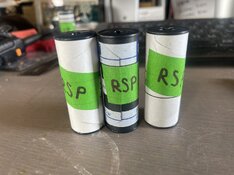
I am cutting down 36"x24" medical xray film and rolling it onto used 120 backing papers myself.

Whenever I use any of the Ilford or other brands with matte normalish paper types, it works great. Whenever I use the kodak gold style glossier 120 paper, the final developed roll is plastered with spots and gunk.

Obviously I can just avoid those papers, but I'd like to if possible know what on earth could be going on here. How is this not also affecting the original kodak films on those same rolls?
 
Can't help you with the backing paper issue, but I'm surprised that you are even able to roll this stuff, considering it's base is thicker, compared to 120 films...
 
Welcome to Photrio!
My guess is that the Kodak backing paper for some reason is more hydrophilic and absorbs moisture more readily and/or the inks are more liable to become photo-active in contact with an emulsion if moisture is present.
 
Can't help you with the backing paper issue, but I'm surprised that you are even able to roll this stuff, considering it's base is thicker, compared to 120 films...

It hurts my fingers a bit to hold it hard enough for it to not spring apart, but yeah you can do it. It just baaaarely fits under the flange without burning the edges with light. You gotta rubber band it to store and still pinch it hard while loading anything until it's all set up.
 
The films and backing papers are designed together, because backing paper induced problems are a result of the emulsion and the ink and the paper interacting with each other.
If you rerolled the Kodak films with Ilford backing paper, you would encounter problems.
If you rerolled Ilford film with Kodak backing paper you might encounter problems too.
The economies mean that none of the film manufacturers can afford to have separate and different backing papers for each of their film offerings, so the Kodak stuff has to work with black and white negative film, colour negative film, and colour slide film, of all the various types.
Most likely it costs the film manufacturers more for to buy the backing paper for each roll of film than it does to make the roll itself. Ilford has admitted that publicly.
 
I am cutting down 36"x24" medical xray film and rolling it onto used 120 backing papers myself.

Whenever I use any of the Ilford or other brands with matte normalish paper types, it works great. Whenever I use the kodak gold style glossier 120 paper, the final developed roll is plastered with spots and gunk.

Obviously I can just avoid those papers, but I'd like to if possible know what on earth could be going on here. How is this not also affecting the original kodak films on those same rolls?

I also do not know what is going on, but you are not alone with this problem.
 
It hurts my fingers a bit to hold it hard enough for it to not spring apart, but yeah you can do it. It just baaaarely fits under the flange without burning the edges with light. You gotta rubber band it to store and still pinch it hard while loading anything until it's all set up.

My method: Rubber bands or 3d printed film clips to keep the roll secure, and then into 120 film canisters and/or dark bags for added protection.
 
The films and backing papers are designed together, because backing paper induced problems are a result of the emulsion and the ink and the paper interacting with each other.
If you rerolled the Kodak films with Ilford backing paper, you would encounter problems.
If you rerolled Ilford film with Kodak backing paper you might encounter problems too.
The economies mean that none of the film manufacturers can afford to have separate and different backing papers for each of their film offerings, so the Kodak stuff has to work with black and white negative film, colour negative film, and colour slide film, of all the various types.
Most likely it costs the film manufacturers more for to buy the backing paper for each roll of film than it does to make the roll itself. Ilford has admitted that publicly.

Well I don't doubt this. It does make me want to try. Not bad enough to actually do it though
 
It took Kodak a very considerable multi year research effort to develop backing paper printing that didn't react with film (also known as wrapper offset), and Ilford had problems too.

It was a very difficult problem for the big players to solve, so I'm not surprised that you would have trouble with X Ray film that was never designed to be in contact with a backing paper.
 

Forum statistics

Threads
203,439
Messages
2,854,714
Members
101,843
Latest member
digitalsuccess40
Recent bookmarks
0
Photrio.com contains affiliate links to products. We may receive a commission for purchases made through these links.
To read our full affiliate disclosure statement please click Here.

PHOTRIO PARTNERS EQUALLY FUNDING OUR COMMUNITY:


Ilford ADOX Freestyle Photographic Stearman Press Weldon Color Lab Blue Moon Camera & Machine
Top Bottom