• Welcome to Photrio!
    Registration is fast and free. Join today to unlock search, see fewer ads, and access all forum features.
    Click here to sign up

What's your latest new old camera ? (Part 2)

Cemetery Chapel

H
Cemetery Chapel

  • 1
  • 0
  • 18
2 bath test

A
2 bath test

  • 3
  • 0
  • 44

Recent Classifieds

Forum statistics

Threads
202,769
Messages
2,845,318
Members
101,513
Latest member
adammoore2011
Recent bookmarks
2
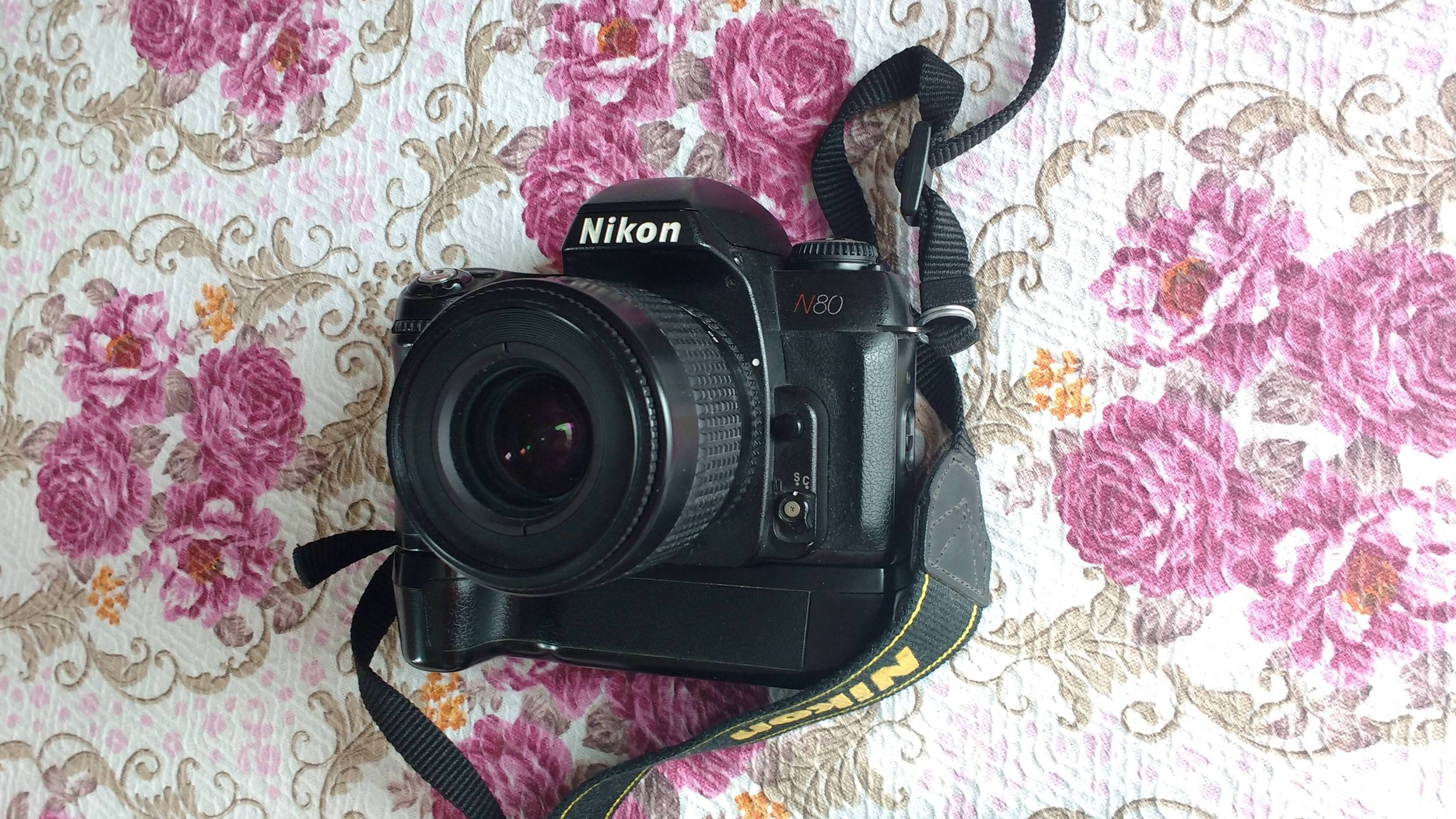
When life gives you N80, even with cheapest lens there is, even if it's plastic, you never refuse. Because how can one refuse to get one of the softest shutters among the SLR? And especially when it's all for free.

xXH5mx1.jpg


M7 Nikon N75 was not free. I bought it because my girl friend won a new 28mmm to 30mm AF zoom lens for it.
 
M7 Nikon N75 was not free. I bought it because my girl friend won a new 28mmm to 30mm AF zoom lens for it.
Wish my spouse were interested in photography a bit more than hanging my photos on the wall.
 
Probably the best mass market camera ever made. Hand built mechanical perfection, producing a camera of this quality today would cost a few thousand.
I 100% agree with you.
Hand built mechanical perfection
This is the amazing thing - these cameras just keep on keeping on!
And they take a vast array of amazing quality lenses.
I can't believe how little the market generally appreciates them.
T
 
Probably the best mass market camera ever made. Hand built mechanical perfection, producing a camera of this quality today would cost a few thousand.
It cost around 270$ with 50 mm f/2 lens back when it was released. Considering the inflation from 1968 until today and adjusting the price will give you 1992$. Let's say the body only would cost 1500$ or so.
 
It cost around 270$ with 50 mm f/2 lens back when it was released. Considering the inflation from 1968 until today and adjusting the price will give you 1992$. Let's say the body only would cost 1500$ or so.
Yes, you are probably right about that.
Today they can be found regularly for $15.
T
 
It cost around 270$ with 50 mm f/2 lens back when it was released. Considering the inflation from 1968 until today and adjusting the price will give you 1992$. Let's say the body only would cost 1500$ or so.
I'm not sure what the equivalent would be today, but the Nikkormat was considered a photography student and keen amateur camera. The Nikkormat and 50 f2 was a little more expensive than my OM1 and 50 1.8. The point is the kind of quality engineering Japan did so well in the 1970s is solely the preserve of bespoke products with prices to match. Then we took mechanical excellence for granted, now its a rich man's indulgence.
 
I wonder if contemporary cameras will last that long.


My Nikkormat FT2 is about 42 years old. It works perfectly and the meter matches my Sekonic L-308S every time.

None of the electronic film cameras (with AF motor and film drive motor) will last that long; neither will any digital camera.

I'll bet my Nikkormat will last another 42 years.

IMAG9590-1-1.jpg
 
Last edited:
I'm not sure what the equivalent would be today, but the Nikkormat was considered a photography student and keen amateur camera. The Nikkormat and 50 f2 was a little more expensive than my OM1 and 50 1.8. The point is the kind of quality engineering Japan did so well in the 1970s is solely the preserve of bespoke products with prices to match. Then we took mechanical excellence for granted, now its a rich man's indulgence.
If you're talking about a certain brands starting on 'L', 'H' and 'R', then they were almost always like that. An old mechanical camera is just as good as a brand new, since it's mechanical and it's pretty affordable to. Well, except the old one will live a shorter life just because it's already old and worn.
 
I wonder if contemporary cameras will last that long.
I won't be holding my breath :smile:
Really, most things that are manufactured today are made to become outdated, extinct or non-functioning within a specified time frame so that consumers will buy the new edition.
Nikomats and Nikkormats were made at a time when quality materials and quality workmanship counted for more than a quick buck.
I still can't believe that they are so undervalued
T
 
attachment.php

attachment.php

Top: Glasnost-era USSR (1990) Zenit 122, M42 lens mount. Cyrillic markings! All markings on body except for "122" are paint-filled. Note film reminder window on left-hand side, along with "CC" marking on self-timer button. Matte finish.

Bottom: 2002 production as sold by Lomography. Pentax K mount. Enlarged shutter speed dial, ISO dial omits intermediate numbers in favor of ".". Most letting appears to be somehow painted or transferred directly onto the plastic. Glossy finish. Flash sync terminal omitted.

Quite a few
 
Those look nice. What are they like to use?

For my purposes, the newer (122K) camera is actually nicer to use: Increased use of plastic, but it weighs a bit less as a result, and it has a 3-LED Red-Green-Red finder display versus 2 red LEDs for the older camera, and the taller shutter speed dial is easier to grasp. 122 and newer Zenits that I've tried have much improved viewfinder brightness versus older cameras like the Zenit 12, EM et al.
 
For my purposes, the newer (122K) camera is actually nicer to use: Increased use of plastic, but it weighs a bit less as a result, and it has a 3-LED Red-Green-Red finder display versus 2 red LEDs for the older camera, and the taller shutter speed dial is easier to grasp. 122 and newer Zenits that I've tried have much improved viewfinder brightness versus older cameras like the Zenit 12, EM et al.
I think 122K also accepts K-mount lenses instead of M42 which is an improvement, unless one wants to use screwmount lenses specifically.
 
Last Friday at Brentwood Photographic Club I was given a Chinon TTL marked 'Prinzflex' M42 fit lens and it's a F1.4 !! The donater had fitted a replacement battery BUT it needs the now-illegal 1.35 V Mercury one so will have to test readings --- I cleaned lens -- just in time as there were some Fungus flecks and renewed the back light seal strips so back door shuts better. I also took off baseplate and lubricated all the cogs and pivots i could see with minute amount of sewing machine oil -- Now the delayed action is so QUIET you can hardly hear it !
It has shutter speeds 1 sec - 1/1000th, 'X' and 'M' flash synch plugs .
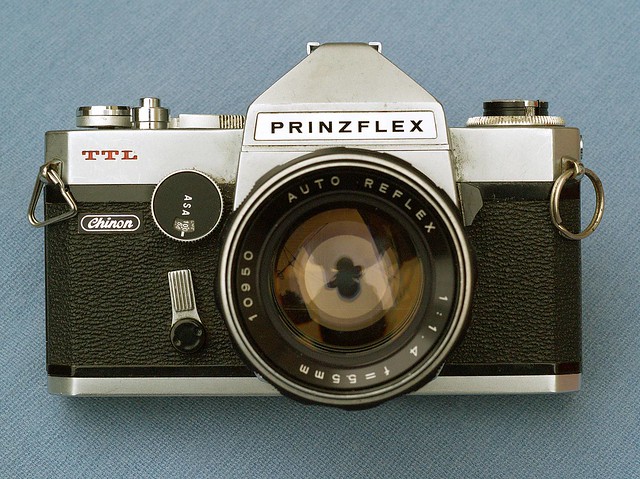
Chinon TTL Prinzflex by Peter Elgar, on Flickr
 
The thrift store gods smiled down on me again last week with a Nikon F100 with 24-120mm 3.5-5.6D lens. Folks who say they never find any thing good at the thrift stores aren't trying hard enough. Persevere, make yourself available and the goodies will appear. There are certainly dry spells but patience pays off if you don't lose heart.

This F100 is in very nice shape except the outer eyepiece part and the rubber gasket around the battery holder are MIA.
 
Last Friday at Brentwood Photographic Club I was given a Chinon TTL marked 'Prinzflex' M42 fit lens and it's a F1.4 !! The donater had fitted a replacement battery BUT it needs the now-illegal 1.35 V Mercury one so will have to test readings --- I cleaned lens -- just in time as there were some Fungus flecks and renewed the back light seal strips so back door shuts better. I also took off baseplate and lubricated all the cogs and pivots i could see with minute amount of sewing machine oil -- Now the delayed action is so QUIET you can hardly hear it !
It has shutter speeds 1 sec - 1/1000th, 'X' and 'M' flash synch plugs .
Chinon TTL Prinzflex by Peter Elgar, on Flickr

You're gonna move me with this! The Chinon TTL "Prinzflex" was (well, still is...) my father's camera, and consequently the first reflex I used. Dad also ranked at some photo contests with pictures taken with this camera. As a funny note, since the "Chinon" badge was usually covered by the neverready case, as a kid I thought that Prinzflex was the the name of the brand, and I was always astonished about never seeing ads by this make! Only much later I understood, as anticipated by others, that this is a special version of the Chinonflex TTL commissioned by and re-branded for a chain of shops. I am persuaded, although I can't prove it, that these cameras were bundled with one of those early japanese super-fast normal prime lenses, and your camera seems to confirm this. My father's is equipped with a Super Reflecta 55mm f:1,4, which only lately surfaced was made by Tomioka and sold under their "Reflecta" trademark (Tomioka made lenses also for Pentax, Mamiya and others). I believe that this Chinon dependable camera bundled with the super-fast lens made up an outstanding combo for its time at a very reasonable price.

I still like this camera very much - the peculiarity of the shutter speed control knob in front of the body, the lack of the flash hotshoe that yelds to a very clean design of the top, and so on. A very good-looking camera in my opinion. There is a close cousin of the Chinonflex which name is Ricoh Singlex TLS; I have yet to understand if this was a joint-venture, or if Ricoh purchased the patents at a point, or the other way around.

Have fun with your Chinon! if it's your first M42 universal screw-thread mount camera, you have literally a galaxy of lenses to explore and try out...

 
Last edited:
My father's is equipped with a Super Reflecta 55mm f:1,4, which only lately surfaced was made by Tomioka and sold under their "Reflecta" trademark.
That is interesting as I never heard of Reflecta taking lenses (the brand was not registered by Tomioka in Germany).
Reflecta is also the name of a german manufacturer of projection equipment, thus one will find such Reflecta lenses too.
 
I remeber the Reflecta you mentioned selling dia projector lenses well into the '80s. I completely ignore if there is a link between Reflecta Germany and Tomioka, or if at a point Reflecta Germany outsourced to Tomioka a batch of taking lenses to be sold under their brand name, or if the homonymy is merely coincidental. Anyway, if you perform a search with "Tomioka Super Reflecta" as keywords you will easily see that this lens design and craftmanship is attributed to Tomioka.
 
Last edited:
German Reflecta started in the 60s with trading projection accessories, but only went into projector manufacture when they took over the Agfa camera/projector plant in Portugal in 1984, so there should be no connection to Tomioka at all.
 
Agree, I also believe there is no connection. Lenses attributed to Tomioka were first engraved "Auto Reflecta" and later "Super Reflecta"; I don't even clearly understand if it was intended to be a fictitious brand or the name of the lens design (like "Tessar" etc.).
 
Have picked up a pair or original Canon F-1s (one with a WLF!) and a Contax T. Can't wait to use 'em.
 
Photrio.com contains affiliate links to products. We may receive a commission for purchases made through these links.
To read our full affiliate disclosure statement please click Here.

PHOTRIO PARTNERS EQUALLY FUNDING OUR COMMUNITY:


Ilford ADOX Freestyle Photographic Stearman Press Weldon Color Lab Blue Moon Camera & Machine
Top Bottom