• Welcome to Photrio!
    Registration is fast and free. Join today to unlock search, see fewer ads, and access all forum features.
    Click here to sign up

what is the last thing you developed or printed

Recent Classifieds

Forum statistics

Threads
202,825
Messages
2,846,027
Members
101,548
Latest member
Underexposed
Recent bookmarks
0
Status
Not open for further replies.
Please show us!

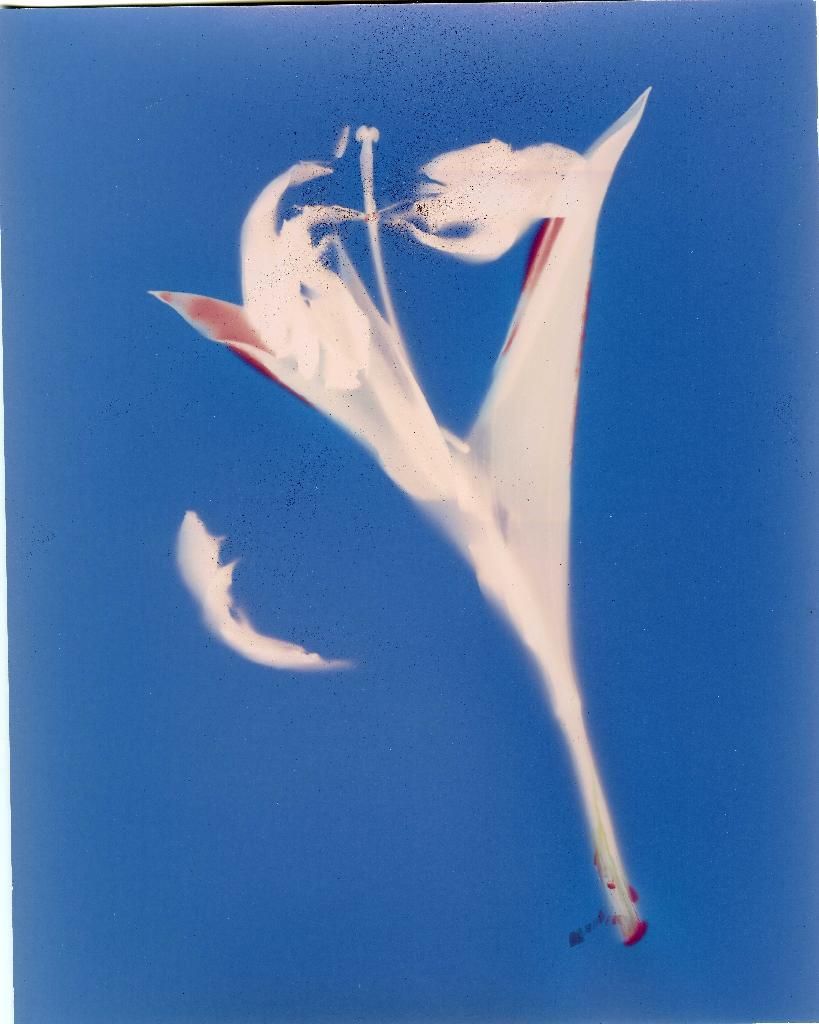
Well here's a straight scan of the lumen...the lith was unremarkable but I'll post it later. It's sitting in a tray of water waiting for me to decide if its worth washing.
lumen.jpg


This is on ...crap, I forgot. Its either Bergger CB warmtone or J&C's rebadged polywarmtone. Exposure a few hours, give or take a few thousand seconds. Unfixed. Already faded and dying, along with my aching heart
 
Last edited:
This will not preserve your lovely color, but it will preserve a different color than straight fixing. So it's an option to play with but still does not solve the problem that lumen prints change when they touch fixer. Dip in 0.6% solution of sodium thiocyanate for 20 seconds, then rinse in water, then fix in normal fixer. This was recommended by William Jolly to preserve the colors in chromoskedasic prints. I hoped it would preserve color in lumen prints, but what it does is change the color.... which might still be nice or better than nothing. I actually got the sodium thiocyanate to see what will happen with salt prints but haven't tried that yet.
 
Herr. Moersch uses the chromoskedasic stabiliser without a thiosulfate fix aftewards, and his lumens look exquisite. But then his prints always do :smile:

Formula here (there was a url link here which no longer exists)
 
I read those threads about thiocyanate before making my first lumen but didn't want to wait to get some. I underestimated how amazingl it would look and now I wish I had. :cry: With anthotypes I just shoot a 4x5 color negative of it and print it in RA-4. Problem solved, and I can also enlarge it. I just need a (much) better setup for making negative copies. But I think I'll try the thiocyanate before investing too much in the copying method, maybe it'll be entirely satisfactory.

And I checked a digital image I shot and the blue is a bit exaggerated in the scan I posted. But I have much better things to do than learn fauxtoshop. I should probably get a colonoscopy, for example.
 
spent the morning faffing about making some cyanotypes and toning them in (ordinary) tea. The paper stains too much for my taste, but I've also tried some "Ayurvedic Detox Tea" that's been gathering dust on a shelf since 2006 and that seems to produce interesting soft coloured tones (especially midtones) without staining the paper. Don't think you can buy it any more though. Tastes vile, tones great.
 
Thanks for that link pdeeh, I never saw that thread before. I should make a clarification: Like Moersch, Jolly recommended the sodium thiocyanate instead of thiosulfate fixer. I noted that after the ( lesser ) color change in sodium thiocyanate, the color did not change much more in regular fixer, but I only tried it one time with only one kind of paper.
 
Last developed rolls are portraits of my lovely wife and some pictures of London. All shots on Tmax-100 and developed on Rodinal 1+50. Lenses used: Hasselblad 150mm + 21mm extension ring for the portrait, 80mm for the cityscape.

Portrait: https://www.flickr.com/photos/hekoru/24523189513/in/dateposted-public/
Millenium bridge: https://www.flickr.com/photos/hekoru/25180575185/in/dateposted-public/

Welcome to APUG

I see that you understand that square is the perfect format.
 
Thanks for that link pdeeh, I never saw that thread before. I should make a clarification: Like Moersch, Jolly recommended the sodium thiocyanate instead of thiosulfate fixer. I noted that after the ( lesser ) color change in sodium thiocyanate, the color did not change much more in regular fixer, but I only tried it one time with only one kind of paper.

Is there an advantage of sodium over ammonium thiocyanate?
 
in the thiosulfates, the advantage of ammonium over sodium is speed (hence rapid fixers are ammonium thiosulfate based).

whether you can generalise from that to the thiocyanates I have no idea, so it might be worth posting a query in one of the subforums where PE or Gerald Koch hang out more often
 
They say it's hip to be square:wink:

 
And Huey Lewis is definitely who I look to as the arbiter of things square or not square...:whistling:
 
Thanks for that link pdeeh, I never saw that thread before. I should make a clarification: Like Moersch, Jolly recommended the sodium thiocyanate instead of thiosulfate fixer. I noted that after the ( lesser ) color change in sodium thiocyanate, the color did not change much more in regular fixer, but I only tried it one time with only one kind of paper.

It would be nice if someone would fix half a lumen print in thiocyanate and leave the other half unfixed, then post it.
 
It would be nice if someone would fix half a lumen print in thiocyanate and leave the other half unfixed, then post it.
I'm going to be away part of the weekend, not sure I'll get to it, but I was thinking the same thing about sodium and ammonium thiocyanate.
I've got both here. I'll do it soon if nobody else does.
 
I developed two rolls of Plus-X and did some contact sheets. I realized that everything I've developed the last ~2 weeks has water spots. I guess this new darkroom has hard water. Time to start bringing a gallon of distilled water for a final rinse with photo flo.
 
Printed three images on 8x10" Adox MCC, I really like working in my kitchen darkroom. The first "warmup" image was tricky as usual, I had to work in 1/12 th stops increment to find the right tonality (at grade 5), the negative was so thin it was ridiculous! But it came out, and the following two images were easy after that first. Split-grade with below-the-lens filters is really nice.
 
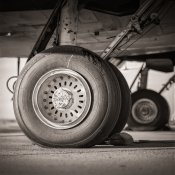
I developed two rolls of Fuji Acros 100 that are part of a series of images I'm crafting of a derelict DC-7. The airplane reposes at a small municipal airport in my home state of Arizona. Using various lenses with my Hasselblad 500C/M, I try to capture the essence of this DC-7 without taking a single photograph of the entire airframe - just tightly framed compositions of certain functional and design aspects.

I shoot the Acros at 80 and develop in HC-110 (dilution H). No prints made thus far. Just scanning the negatives to evaluate for inclusion in this project. Here is an example...

DC-7 Main Gears.jpg
 
Last edited:
I developed two rolls of Fuji Acros 100 that are part of a series of images I'm crafting of a derelict DC-7. The airplane reposes at a small municipal airport in my home state of Arizona. Using various lenses with my Hasselblad 500C/M, I try to capture the essence of this DC-7 without taking a single photograph of the entire airframe - just tightly framed compositions of certain functional and design aspects.

I shoot the Acros at 80 and develop in HC0110 (dilution H). No prints made thus far. Just scanning the negatives to evaluate for inclusion in this project. Here is an example...

Nice looking image, please print! :smile:
 
Status
Not open for further replies.
Photrio.com contains affiliate links to products. We may receive a commission for purchases made through these links.
To read our full affiliate disclosure statement please click Here.

PHOTRIO PARTNERS EQUALLY FUNDING OUR COMMUNITY:



Ilford ADOX Freestyle Photographic Stearman Press Weldon Color Lab Blue Moon Camera & Machine
Top Bottom