

• Welcome to Photrio!
    Registration is fast and free. Join today to unlock search, see fewer ads, and access all forum features.
    Click here to sign up

What is "Kodak Safety Film"?

Windows - Valencia

A
Windows - Valencia

  • 0
  • 0
  • 0
Tree of a kind

H
Tree of a kind

  • 4
  • 1
  • 25

Recent Classifieds

Forum statistics

Threads
202,808
Messages
2,845,757
Members
101,541
Latest member
ΦÆdon
Recent bookmarks
0
But looking back some years, the first thing that comes to my mind is the same degree of nonsense being told as today...


(In this case even including Ron. He stated that NC cannot be extinquished with water, but in fact water water is just the only means to be applied!)
 
Even back in 2008, the discussion took a nitrate turn and I'm not sure anyone fully explained that though "Kodak Safety Film" indicates a safe base material (acetate, I don't know if they printed it on polyester), you can look further for the type of film. There was often a number or letter code printed after it, such as Kodak Safety Film 5053 or 5063 (Tmax 400 and Tri-X resp). The Kodak Safety Film edge printing was in use at least into the 1980s and possibly later, long after nitrate film was obsolete.

Polyester film base was used by Kodak on several types of film that could experience a tough physical environment. Someone with a better memory than me will recall what it is called. Was called, I'm sure.
 
Was that "Estar"?

Legend has it that nitrate film jump-started King Vidor's directing career. He was working as a projectionist (in Corpus Christi, I think) and started a fire that burned the theatre. He and some friends left town for LA and never returned. A good story, whether true or not.
 
Was that "Estar"?

Legend has it that nitrate film jump-started King Vidor's directing career. He was working as a projectionist (in Corpus Christi, I think) and started a fire that burned the theatre. He and some friends left town for LA and never returned. A good story, whether true or not.

Estar it is. From polyester.
 
Gevaert called their Polyester base Gevar.
 
Many years ago my Father (PhD in Chem Eng) demonstrated the flammabilty of nitrate film. He tacked a length of some roll film stock perhaps 5 feet long to a board and OUTDOORS touched a match to one end. It burned up almost instanteously. Very impressive to my 12 year old self.
 
Even back in 2008, the discussion took a nitrate turn and I'm not sure anyone fully explained that though "Kodak Safety Film" indicates a safe base material (acetate, I don't know if they printed it on polyester), you can look further for the type of film. There was often a number or letter code printed after it, such as Kodak Safety Film 5053 or 5063 (Tmax 400 and Tri-X resp). The Kodak Safety Film edge printing was in use at least into the 1980s and possibly later, long after nitrate film was obsolete.

Here's a scan of a slide I took about 40 years ago. I believe it was Ektachrome 64. Is there a reference for those film type numbers?

Blue Tang
by Alan Klein, on Flickr
 
Here's a scan of a slide I took about 40 years ago. I believe it was Ektachrome 64. Is there a reference for those film type numbers?

Blue Tang by Alan Klein, on Flickr

More or less, if you google "kodak film codes" or similar, and look around, you will find some tables. Many of them are incomplete so you may have to look in more than one place. For example:

https://www.jeffreysward.com/editorials/kodakedg.htm - some are missing, such as 5063 for 35mm Tri-X.
https://industrieplus.net/dxdatabase/ - a very useful database

Typing "5031" into the DX database name search shows that it is Ektachrome 64.

Yes, Estar was Kodak's name for polyester base. Old Kodak references such as the Darkroom Dataguide list films with Estar base noted separately. Most of the Estar base films listed there were in sheet or long-roll form (like bulk 35mm or 70mm).
 
More or less, if you google "kodak film codes" or similar, and look around, you will find some tables. Many of them are incomplete so you may have to look in more than one place. For example:

https://www.jeffreysward.com/editorials/kodakedg.htm - some are missing, such as 5063 for 35mm Tri-X.
https://industrieplus.net/dxdatabase/ - a very useful database

Typing "5031" into the DX database name search shows that it is Ektachrome 64.

Yes, Estar was Kodak's name for polyester base. Old Kodak references such as the Darkroom Dataguide list films with Estar base noted separately. Most of the Estar base films listed there were in sheet or long-roll form (like bulk 35mm or 70mm).

Thanks, that was very helpful.
 
I enjoy the fact that 100 foot rolls of Ilford HP5+ (and probably others) are still edge marked as SAFETY FILM. It’s kind of cool looking on a contact sheet. No ugly bar codes!
 
I enjoy the fact that 100 foot rolls of Ilford HP5+ (and probably others) are still edge marked as SAFETY FILM. It’s kind of cool looking on a contact sheet. No ugly bar codes!

I dislike them too and I would like all films being without them.
 
I dislike them too and I would like all films being without them.

Even though it has nothing to do with the final image (contact sheets being an exception) I agree the bar codes look somehow wrong. But they’re an interesting bridge between the analog and digital eras, and that is interesting on its own. Kinda like the step before APS (remember APS? No? Good!). In any case, I’m glad Ilford continues with this anachronistic practice.
 
I presume the bar codes were for minilab purposes. Know what film was coming through, tweak the channels.

No?

Yep - and that applied even before digital.
 
Makes sense. I always figured they were for some kind of automated process.
 
The bar codes had the advantage of also working for individual prints from small strips of film - reprint orders.
The automated machine printers could read the code and change the filter settings to the matching standard.
 
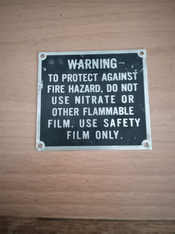
Found on an old Simplex projector, probably 1920s vintage:
 

Attachments

  • safety.jpeg
    safety.jpeg
    58.1 KB · Views: 78
Found on an old Simplex projector, probably 1920s vintage:

I worked for a company who recycled silver from old film stock, mostly X-ray films but some motion picture. We would get Nitrate films occasionally and they were treated with extreme care. The company had acquired a small competitor who had gone bust after a factory fire caused by Nitrate film spontaneously combusting, burning the wooden roof of the building. The Insurance company had refused to pay out.

The Nitrate films were stored and transported in metal chests, they had come from film archives after careful duplication, after the silver was recovered they were incinerated.

My father stored all his negatives in old metal cigarette boxes, despite the fact that they were probably all safety film.

Ian
 
Photrio.com contains affiliate links to products. We may receive a commission for purchases made through these links.
To read our full affiliate disclosure statement please click Here.

PHOTRIO PARTNERS EQUALLY FUNDING OUR COMMUNITY:


Ilford ADOX Freestyle Photographic Stearman Press Weldon Color Lab Blue Moon Camera & Machine
Top Bottom