

• Welcome to Photrio!
    Registration is fast and free. Join today to unlock search, see fewer ads, and access all forum features.
    Click here to sign up

What is "Kodak Recording Film 2475"?

Grill

H
Grill

  • 4
  • 0
  • 71
Cemetery Chapel

H
Cemetery Chapel

  • 4
  • 0
  • 97

Recent Classifieds

Forum statistics

Threads
202,789
Messages
2,845,571
Members
101,530
Latest member
FatherHenry
Recent bookmarks
0

ricardo12458

Member
Allowing Ads
Joined
May 22, 2011
Messages
106
Location
Southern US
Format
35mm
Found this in my gadget bag:

KODAK RECORDING FILM 2475, RE 135-36, expired 1971.

What is it? It is *way* older than me. All I know is that this is a 1000ASA film (from an old photography book).
 
Surviellance film, very grainy. Likely quite dead too. Try a few frames and see if you can shoot past the fogging.
 
It is...totally black!
 
I seem to remember (these days that's as good as it gets... ) shooting it in college, about 35 years ago. I may be wrong, but I recall shooting it at an EI of around 6-12, and developing it for continuous tone. I don't remember the developer, but do recall (if I'm correct) getting Tech-Pan-like results. Then again, I may be remembering something else...:confused:
 
I seem to remember (these days that's as good as it gets... ) shooting it in college, about 35 years ago. I may be wrong, but I recall shooting it at an EI of around 6-12, and developing it for continuous tone. I don't remember the developer, but do recall (if I'm correct) getting Tech-Pan-like results. Then again, I may be remembering something else...:confused:

It is completely the opposite. More like an early "super speed" film, like what would be T-Max 3200 today.
 
I used to use loads of 35mm Recording Film. I think it was discontinued well over ten years ago, after TMax 3200 had taken over on the high speed front. I always used it at 1000 ASA, (and it was ASA then) and process in HC 110. Grainy as f**k and that's why we liked it. Even better, (or worse depending your viewpoint), processing in print developer would give massive grain. Back when I started working in labs in the 80s, if a grainy effect was needed from an existing neg, a print was made and then copied onto Recording Film. It was on a very thin base so was never dried with hot air. An old client used to assist Linda McCartney and she used it a lot to get the speed and the grain. I think a lot of her shots of Hendrix are shot on it. Tonally it could be soft but tonal which is a good thing if you want to increase the grain as it then needs a higher grade when printing which makes it nice and crisp. The roll you have is well out of date but worth trying. Even maybe clip a a few frames in film and paper dev to see if it works. If you do I can see if I can find my notes for dev times. I think it was about 10 minutes in dilution B, but not sure without checking. Dektol was a lot shorter. There was also a similar emulsion in 120 called Royal X Pan but sadly, that left the scene just as I started to get into it. Hate to say but your roll is not way older than me!
 
You don't even need to shoot to test it. Just piggyback a little snip onto another roll the next time you develop film. Make sure it is emulsion side out when you put it on the reel, so the two films are base to base. My guess is that it will be black or dark gray.
 
The grain is huge and it does curl like a spring. Chances are that 40 year old film that fast will be no good however it never hurts to find out. I used a few rolls of it in the late 60's for night shots on a camp out. Hand held 1/30 @ f/2. By lantern light they came out fine for what it was used for. I think the star shots were a single grain. :laugh:
 
Think of it as Tmax 3200's dead grandfather. I used that film a few times in the early 80s and hated it, it was a loose cannon.
 
...cruising for chicks in a hospice--you're just gonna to get your heart broken....

Black humor, but great :D Well applicable for political discussions...
 
Does not this site have a credo somewhere along the lines of "That is called Grain.It is supposed to be there".?
Eric is right; it curled like a steel spring. Coated on a base Kodak never dared use for any other consumer film.
It was ,simply extraordinary stuff. I just used it like it was ,well,about 6400 asa, (yes,ASA : ISO had not been invented yet) and left it in the tank while I made,and drank,a cup of coffee.
Grain out the wazoo,but accompanied by amazing acutance.
I have a photograph,Nikkor 28/3.5 at f5.6,of a house against the first light of dawn,and the telephone line is etched against the sky as though it was drawn with an etching pen.
Years later I had occasion to use the P3200 equivalent.
It is true what they say - you can't ever go back.
 
Last edited by a moderator:
Found this in my gadget bag:

KODAK RECORDING FILM 2475, RE 135-36, expired 1971.

What is it? It is *way* older than me. All I know is that this is a 1000ASA film (from an old photography book).

PURE AWESOMENESS IS WHAT IT IS!!!!
 
I used that film to shoot photos of a photo essay of people doing street cruising in the late 70's, shot hand held under street lights. The photo editor would not use it because it was "too grainy." My argument was that given the newspaper's 80 line screen nobody would see the grain anyway and the shots were awesome given the technology of the time. This is when ASA 160 Ektachrome was called "High Speed Ektachrome."

~Steve Sloan
 
Would exposing the film at ASA 25 work? It's the slowest speed rating on my Canon AE-1. I might be able to expose "around" the fog. Do you know what the proper chemical name for the "fog-be-gone" compound is? Think it starts with a "B"......
 
Last edited by a moderator:
Benzotriazole...or potassium bromide are the ones I know off hand.

High speed films are generally flat to begin with. Add 40 years of fog and you have almost headroom to use, if any at all.

Again, I suggest piggybacking a strip on another roll that you develop before you even worry about how to rate it.
 
Coated on a base Kodak never dared use for any other consumer film.

Wasn't Technical Pan coated on this same base (ESTAR-AH) for the 35mm product?

Just noticed that several websites carry this particular discussion; how embarrassing......
 
Last edited by a moderator:
The 2475 I have in my film freezer has to be exposed at EI 200 to get through the base fog, and you have a rather compressed density range on the film.
 
2475 was named recording film because its principal use was to record oscilloscope traces of fast events or in high-speed motion picture recording. The usual developer was either D-19 for hand processing, or Kodak Versamat automatic processing for long lengths.
 
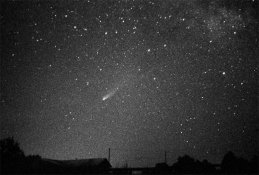
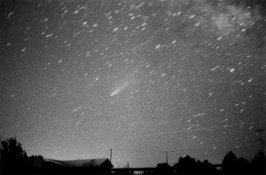
2475 (expired) versus Tri-X

Here are two images I made in 1985 during the last apparition of Halley's comet. These are about 45 sec. unguided exposures made with f/1.7 50mm lens and processed in D-19 (2475, Halley-1) and D-76 (Tri-X, Halley-2), if I recall correctly. Both images are almost full-frame, viz. scans of about 80% of the 35mm frame.

The exposures were made on a moonless night with a clear and cold New Mexico sky and no exterior lights to interfere by brightening the sky.

I believe the 2475 was about ten years out of date at that time and had been kept frozen until use. I post these here just to add interest to the discussion.
 

Attachments

  • Halley-1.jpg
    Halley-1.jpg
    125.1 KB · Views: 677
  • Halley-2.jpg
    Halley-2.jpg
    104.9 KB · Views: 1,060
Here are two images I made in 1985 during the last apparition of Halley's comet.

Eleven years before the OP was born :wink:.
 
Photrio.com contains affiliate links to products. We may receive a commission for purchases made through these links.
To read our full affiliate disclosure statement please click Here.

PHOTRIO PARTNERS EQUALLY FUNDING OUR COMMUNITY:


Ilford ADOX Freestyle Photographic Stearman Press Weldon Color Lab Blue Moon Camera & Machine
Top Bottom