• Welcome to Photrio!
    Registration is fast and free. Join today to unlock search, see fewer ads, and access all forum features.
    Click here to sign up

what causes bronzing degradation of a silver print?

Do Not Come Here

A
Do Not Come Here

  • 6
  • 3
  • 71
Heavy

H
Heavy

  • 12
  • 5
  • 117

Recent Classifieds

Forum statistics

Threads
201,923
Messages
2,832,132
Members
101,019
Latest member
ferbert72
Recent bookmarks
0

BetterSense

Member
Allowing Ads
Joined
Aug 16, 2008
Messages
3,151
Location
North Caroli
Format
35mm
+1. Same here, EDU.Ultra had some deterioration after 1 year stored in office environment. Proper processing, two bath fixing 1+4, slightly overwashed (I tend to leave my RC prints in washer for much longer than recommended), but no toning. I suspect this paper is rather susceptible to environmental pollutants - it must be toned to completion to be fully archival. Another print done on Ilford paper at the same time with same chemicals and stored right next to Arista print kept just fine.

Mine were also framed. For what it's worth, I had some prints displayed in the same office which showed similar degredation that was some kind of Mitsubishi paper I got used. I don't think I've seen any deterioration on any RC print that was not framed. I also tend to "overwash", leaving my prints in a soak tank until the end of the session, and I use film-strength rapid fixer. I do not routinely use 2-bath fixing, though, and also no toning.

Why do framed prints deteriorate more? Should we be venting our frames better?
 

ozphoto

Subscriber
Allowing Ads
Joined
Apr 2, 2006
Messages
1,920
Location
Adelaide, SA, Australia
Format
Multi Format
Do you have any prints that were not framed from the same session, my money is on there being no issue with the prints that were not framed.

RC prints in frames were an issue when I first started my business. I have never made RC prints for clients for this reason.My first business partner preferred RC over Fibre printing and when he left the company I had a bunch to redo because of this problem.

Yes Bob, I have prints from the same session that are fine - which leads me to believe that it's most probably caused by the cheap frame imports, as Simon described above.

I actually bought Sistan when I first noticed it, and used it regularly; unfortunately I no longer have any left so I'll need to investigate the other products mentioned up-thread. In the meantime, I've been toning in 1:20 Selenium for a few minutes, which. :cool:
 

ozphoto

Subscriber
Allowing Ads
Joined
Apr 2, 2006
Messages
1,920
Location
Adelaide, SA, Australia
Format
Multi Format
Ok then, ignore my post. All of the answers are in the Ctein article, which is downloadable.

PE

I'll check out the article - could make for interesting reading as you said, PE. :smile:

Edit: I'm having a hard time finding the article; anyone have a link for it???
 
Last edited by a moderator:

piu58

Member
Allowing Ads
Joined
May 29, 2006
Messages
1,545
Location
Leipzig, Germany
Format
Medium Format
Ctein wrote the book post exposure. I have the printed version. It may be downloaded as pdf:
http://ctein.com/PostExposure2ndIllustrated.pdf
Please read the section starting at p. 158.

Short version: Baryta papers have a baryt layer between paper and the photographic layer. This impractical for RC papers. Instead the resin layer is brightened with titan dioxide, TIO2. This reacts with the silver and gives the reaction you got: "Silvering out".

If we believe the manufacturers modern papers overcome this problem by a modified resin layer. RC papers of one manufacturer (foma) had the problem at least until two years ago. I lost some exhibition prints and switched to another manufacturer.

Silvering of RC papers cannot be avoided by prober fixing. It may be avoided or at least decelerated by toning or using Sistan. I fo myself make exhibition print on baryta now. Slightly more expansive, remarkably more elaborate but long time stable.
 
Last edited by a moderator:
OP
OP
polyglot

polyglot

Member
Allowing Ads
Joined
Jun 12, 2009
Messages
3,467
Location
South Australia
Format
Medium Format
I'll check out the article - could make for interesting reading as you said, PE. :smile:

Edit: I'm having a hard time finding the article; anyone have a link for it???

I believe everyone is talking about Ctein - Post Exposure.

pdeeh: I agree, it is somewhat beautiful, I'm just concerned that I'm going to end up with no picture shortly and in any case, not the one I thought I printed! If it were a proportional effect wrt silver density and archivally stable, I'd be chuffed.

Simon: thanks for replying. I'll note that none of my Ilford or Kentmere prints have suffered this fate!
 
OP
OP
polyglot

polyglot

Member
Allowing Ads
Joined
Jun 12, 2009
Messages
3,467
Location
South Australia
Format
Medium Format
Short version: Baryta papers have a baryt layer between paper and the photographic layer. This impractical for RC papers. Instead the resin layer is brightened with titan dioxide, TIO2. This reacts with the silver and gives the reaction you got: "Silvering out".

If we believe the manufacturers modern papers overcome this problem by a modified resin layer. RC papers of one manufacturer (foma) had the problem at least until two years ago. I lost some exhibition prints and switched to another manufacturer.

OK, that's now three or four of us in just this thread, with this problem with Foma RC. A pity, as I have quite a stash of it!
 

Tom1956

Member
Allowing Ads
Joined
May 6, 2013
Messages
1,989
Location
US
Format
Large Format
I had this bronzing show up just a few years after printing my Stepmother's bridal pic from 2001--the first time I ever saw it. I had printed it 20x24 on Ilford Multigrade RC. Had never seen this effect before. BTW I had selenium toned this print, inasmuch as this paper was not toner-friendly.. It bronzed in the dark areas anyway
 
Last edited by a moderator:

ozphoto

Subscriber
Allowing Ads
Joined
Apr 2, 2006
Messages
1,920
Location
Adelaide, SA, Australia
Format
Multi Format
Thanks to all of you who provided the link - it made for *extremely* interesting reading, and as I now use Selenium toner in all my prints, I'm hopeful this problem will now be behind me.

Interesting the dates that Ctein mentioned - mid 90s as that is around the time the Agfa paper I was using would have been manufactured, and it was also their Multicontrast RC.

Obviously the damaged prints are now beyond saving, however if I were to use selenium toner on the prints that are currently in storage, would I be correct in thinking they would then be perfectly ok for presentation and display?

Edit: Does anyone in AU know who the wholesaler is for (New) Sistan?
 
Last edited by a moderator:

K-G

Subscriber
Allowing Ads
Joined
Mar 29, 2006
Messages
557
Location
Goth, Sweden
Format
Multi Format
Edit: Does anyone in AU know who the wholesaler is for (New) Sistan?

The successor for Sistan is obviously Adolux Adostab . It is sold by ADOX/Fotoimpex .
I have also noted an interesting thing in my own contact sheet archive. From the late seventies and early eighties I have a mixture of contact sheets on both RC-paper and baryta paper. several of them show signs of bronzing, but it only occurs on the RC-papers. None of the baryta papers are affected. I have a feeling that the instructions for washing RC-papers were a bit optimistic when they were new on the market. Nowadays I don't use any RC-papers and about two years ago I celebrated when I finished the last RC-paper carton.

Karl-Gustaf
 

Photo Engineer

Subscriber
Allowing Ads
Joined
Apr 19, 2005
Messages
29,018
Location
Rochester, NY
Format
Multi Format
I know that modern EK RC papers and some others contain antibronzing agents which appear to work. Quite a lot of R&D went into making it work AAMOF.

PE
 

DREW WILEY

Member
Allowing Ads
Joined
Jul 14, 2011
Messages
14,875
Format
8x10 Format
I've always loved the way certain antique poorly-fixed silver prints have differentially (though unintentionally) bronzed or otherwise discolored
over the decades. Nowadays we can have our cake and eat it too, doing that kind of thing split-toning, while improving permanence at the
same time.
 

DREW WILEY

Member
Allowing Ads
Joined
Jul 14, 2011
Messages
14,875
Format
8x10 Format
(I probably did misuse that term. "bronzing" ... was obviously referring to a hue rather than sheen effect)
 

pdeeh

Member
Allowing Ads
Joined
Jun 8, 2012
Messages
4,770
Location
UK
Format
Multi Format
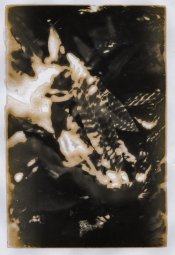
This all piqued my interest and I did a few searches for other APUG threads on the subject, and there are quite a few. A couple mentioned a test IPI developed that involved exposing a print to Hydrogen peroxide fumes, and being of the "I wonder what would happen if ..." persuasion, found a (very) scrap print on RC and taped it over a tray in which I had laid a sheet of paper moistened with 6% peroxide. I left it, wrapped in a plastic bag, for a few days, and this is what came out of the bag today.

Please note that this is not intended as any sort of controlled test, plus the print was probably neither fixed not washed properly, so no conclusions are being drawn! But I thought it might interest one or two of the contributors.
 

Attachments

  • 20140708_2479-H2O2-RC-bronzing--1.jpg
    20140708_2479-H2O2-RC-bronzing--1.jpg
    334.6 KB · Views: 150
OP
OP
polyglot

polyglot

Member
Allowing Ads
Joined
Jun 12, 2009
Messages
3,467
Location
South Australia
Format
Medium Format
Without knowing the original image, that effect does look quite similar. And that's as you would expect: it seems that this effect is due to oxidation of silver freeing up Ag+ ions to migrate through the emulsion. Once freed, they either get reduced by some sulfide in the air (producing the bronze look) or they make it to the surface of the emulsion and reduce to metallic silver (producing the mirror look).

Any oxidising agent should be capable of liberating Ag+ ions, and peroxide certainly is a good oxidiser! I suspect that H2O2 fumes might also cause rapid damage to FB prints - any unprotected (no toning, no sistan) silver print in an oxidising environment like that is going to suffer badly. You can see plenty of degraded FB prints that have silvered out, the conservators believe due to exposure to oxisiders including high moisture content in the air.

The supposition behind what I've been reading (and have heard back from the conservators that I emailed) is that RC prints are unusually vulnerable because the TiO2 brightener can act as an oxidiser when exposed to light, as can (perhaps) fumes released from the coatings on the paper. So while a framed FB print will be in a nice clean environment, an RC print itself produces one or two different oxidisers that can liberate silver ions for migration, and that can start occurring within a few months if the print is behind glass, trapping the fumes. I suspect that manufacturers like Ilford have perhaps solved this problem with their papers, as the recent (2005+) reports seem to concern only Foma RC papers and, anecdotally, all my Ilford & Kentmere prints are fine.
 

removed account4

Subscriber
Allowing Ads
Joined
Jun 21, 2003
Messages
29,832
Format
Hybrid
This all piqued my interest and I did a few searches for other APUG threads on the subject, and there are quite a few. A couple mentioned a test IPI developed that involved exposing a print to Hydrogen peroxide fumes, and being of the "I wonder what would happen if ..." persuasion, found a (very) scrap print on RC and taped it over a tray in which I had laid a sheet of paper moistened with 6% peroxide. I left it, wrapped in a plastic bag, for a few days, and this is what came out of the bag today.

Please note that this is not intended as any sort of controlled test, plus the print was probably neither fixed not washed properly, so no conclusions are being drawn! But I thought it might interest one or two of the contributors.

i love how old polaroid b/w images do / did this. i looked forward to watching them change :smile:
 

DREW WILEY

Member
Allowing Ads
Joined
Jul 14, 2011
Messages
14,875
Format
8x10 Format
The whole RC question is interesting, and firm answers seem hard to come by. I never use RC papers myself except for short-term commercial
work. Some examples of these have been put in portfolios and still seem fine. But all my personal work, and anything intended for display, has
always been done on fiber-based paper. I should probably donate some prints to people on the "bad side of the tracks", namely, upwind from
the oil refinery, where sulfur dioxide leaks are still frequent. Maybe that would replicate some of the effects I've seen on 19th C prints, at least if I failed to tone mine. Certain otherwise boring old prints have become magnificent due to random color and sheen changes, including "bronzing". Whether they've tarnished to completion, or will deteriorate even more, is something I'll probably never know. Copper-toned prints
certainly discolor quickly, just like a penny.
 
Photrio.com contains affiliate links to products. We may receive a commission for purchases made through these links.
To read our full affiliate disclosure statement please click Here.

PHOTRIO PARTNERS EQUALLY FUNDING OUR COMMUNITY:



Ilford ADOX Freestyle Photographic Stearman Press Weldon Color Lab Blue Moon Camera & Machine
Top Bottom