• Welcome to Photrio!
    Registration is fast and free. Join today to unlock search, see fewer ads, and access all forum features.
    Click here to sign up

*Very* Thin Pan F -- Help

Fold

H
Fold

  • 0
  • 0
  • 8
Procession (2)

Procession (2)

  • 2
  • 0
  • 19

Recent Classifieds

Forum statistics

Threads
202,925
Messages
2,847,669
Members
101,539
Latest member
disami
Recent bookmarks
0
Unfortunately no, as in the case of Pan F, the edge markings are always faint (I assume because of the relative weakness in latent image retention discussed here). The existence of a dark black leader should at least rule out any gross developer failure.

I develop 120 Pan F in D76 at 1:1 for 14.5 minutes and have not found them faint.
 
Hit these negs with some pretty strong selenium toner for a good while. Can be done in room light. This will build up what ever silver is left there and not hurt anything. It may save your negs for you. Ansel loved this as a contrast builder for those negs that went flat on him. Give it a try it may save the day for you.
Logan
 
I think it's Door Number 1 or 3, frankly. Contaminated developer would explain faint edge markings. And not having used a camera since March sends up alarm bells for me.

FWIW, I use Pan F+ a fair amount, and it's consistently been a solid performer for me. I simply use Rodinal, or very occasionally DD-X. I usually expose at EI-40 and tack on 15% or so extra development time. Never had a bad roll yet.

Don't give up on a terrific film. I'd shoot a test roll (maybe colour) through the camera, and thoroughly scrub your tanks and mixing utensils/cylinders. And, of course, best of luck!


Well,

If the OP really wants to get to the bottom of this problem, only one variable should be changed every time a film is processed.

If a different film developed as expected, then the developer is likely fine.

If the negative is really faint, one or more of four things happened, and we eliminated the developer, so that really makes it three things:

1. The camera does not expose the film correctly. Maybe the automatic settings in the camera doesn't work below ISO 100? I don't know. Just thinking out loud.

2. The film was laying around too long and its latent image did not retain its strength in the developing process. I think we can not say for certain that this is true, because if there were months between the first and the last frame being exposed, then the problem should be worst on the first frame, and least bad on the last frame.

3. Somehow the developer got contaminated prior to, or during the process, or something else happened that drastically decreased its activity.

I don't know what else it could be. If it were me, I'd put another roll of Pan-F+ in the same camera, but shoot the roll quickly and develop immediately.

The whole latent image thing is weird, considering I have developed film that was exposed in the 1960's that still came out OK. I can't believe that a couple of months will make that much difference!

 
I've shot a ton of Pan-F over the years. Edge markings don't tell you anything with this film. They are always faint, except when they are not. I do know that this film does not like under exposure. It's hard to know with an automatic camera like this exactly what the exposure was, that is what I would look at first. It's possible that the exposure was 2 or more stops under, that would be pretty much a disaster with Pan-F. I would try a new roll, cut it in two, shoot one half in the same camera and the other in a manual camera that you trust, and then process the two together as quickly as possible.
On the bright side you figured out how ambrotypes work. :smile:
 
I've shot a ton of Pan-F over the years. Edge markings don't tell you anything with this film. They are always faint, except when they are not.:smile:

Why should edge markings tell you nothing about this film when they tell you so much with other films?
 
Why should edge markings tell you nothing about this film when they tell you so much with other films?

I don't know. I've never seen any correlation with thin edge markings and thin images with Pan-F. Looks like many people report the same. I've wondered about it too.
 
As promised...
img581.jpg
 
I can confirm really good contrast negatives and thin edge markings compared with say Delta. It worried me at first too, now I just ignore. One film edge markings were so faint as to be almost unreadable. Negs were fine.

From contacts on a dusty scanner......

Image1.jpg
 
Last edited by a moderator:
Hit these negs with some pretty strong selenium toner for a good while. Can be done in room light. This will build up what ever silver is left there and not hurt anything. It may save your negs for you. Ansel loved this as a contrast builder for those negs that went flat on him. Give it a try it may save the day for you.
Logan

Won't create shadow detail that isn't there. It'll just turn developed silver to silver selenide - increasing contrast.
 
I have been using Pan F plus for about one year now and my developers of choice are ID-11 and Rodinal in 1+1 and 1+50 dilutions respectively. Never had any problem exposing it at ISO 50. Negatives were always perfect, good density and contrast. Pan F tends to have deep blacks and lovely dark greys I really like. My habit is to expose and develop the roll within 2 days maximum. The edge markings are always very faint, which tells this is one of the worst films regarding latent image stability. So what I can recommend based on my experience is to expose normally and develop promptly.
 
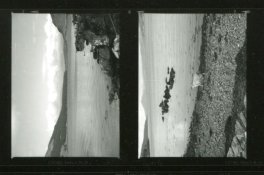
Thanks again, everyone. I posted a sample of the negative above. Today I'm going to blow through a roll of Neopan 100 (120) and develop more or less identically so that I can decisively rule out the developer, containers/tanks, etc.

I wonder about heat. I took the camera with me to South Louisiana in July. I was careful, but I'm sure it did get some heat exposure. Never left it in the car overnight or anything like that, but still, I had it with me on some hot days.

The only other strange thing I can think of that I did with this film was to tape on a false leader. But I've always done that with this camera, as the T5 wastefully auto-advances past three or four frames.
 
From your first post:

The exposed leader of the film developed black, as I would expect. It's the darkest part of the whole strip. The factory edge markings, however, are very faint, which I found odd.

From your most recent post:

The only other strange thing I can think of that I did with this film was to tape on a false leader. But I've always done that with this camera, as the T5 wastefully auto-advances past three or four frames.

These two posts together confuse me.
 
These two posts together confuse me.

Sorry for the confusion. I made a square cut on the Pan F right at the end of the tongue, taped a longer leader to it and then rewound the slack into the caseette prior to loading the camera. In the darkroom, I separated the leader from the film prior to loading the reel. But the remaining width of exposed film that sits outside the cassette (four sprocket holes or so in length) was preserved and developed.
 
I wonder about heat. I took the camera with me to South Louisiana in July. I was careful, but I'm sure it did get some heat exposure. Never left it in the car overnight or anything like that, but still, I had it with me on some hot days.

Given the season I actually wondered if the film might have been exposed to heat/humidity. I would say the plot thickens... Heat will speed up the loss of latent image and Pan F seems to be a film that is rather sensitive in that regard. However, do check your equipment for peace of mind.
 
I'll pitch in on the edge markings issue: I've shot about a half dozen rolls of Pan F+ in 35mm (no 120) and the edge markings have tended to be very thin, enough so that I noticed it as being unusual. From memory, it seems the density has been variable too with some rolls having denser markings than others.

I've never observed this phenomenon occur with Tri-X, Acros 100, HP5+, FP4+, Arista Premium 400 or Delta 400 in either 35mm or 120. Just Pan F+.

Didn't have any other problems with those rolls but I don't think any of them spent too long between first exposure and development.
 
I'll pitch in on the edge markings issue: I've shot about a half dozen rolls of Pan F+ in 35mm (no 120) and the edge markings have tended to be very thin, enough so that I noticed it as being unusual. From memory, it seems the density has been variable too with some rolls having denser markings than others.

I've never observed this phenomenon occur with Tri-X, Acros 100, HP5+, FP4+, Arista Premium 400 or Delta 400 in either 35mm or 120. Just Pan F+.

Didn't have any other problems with those rolls but I don't think any of them spent too long between first exposure and development.

Interesting and perhaps we should ask the manufacturers of Pan F why this is the case?
 
Ruling out the developer and, pretty confidently, accidental contamination. I shot a roll of Neopan 100 today and developed in Perceptol 1+1 for 15 minutes; it came out beautifully. I used the same tank, reels and containers and didn't do anything with them beyond giving them a cursory rinse.
 
Ruling out the developer and, pretty confidently, accidental contamination. I shot a roll of Neopan 100 today and developed in Perceptol 1+1 for 15 minutes; it came out beautifully. I used the same tank, reels and containers and didn't do anything with them beyond giving them a cursory rinse.

So, camera, operator, and film remains. What's next?
 
Well, it's a mystery I guess. Could it be that a small piece of that tape, from the leader job you did, might have found its way onto the film canister? It could have blocked the contact from making contact? If it did default to ISO100 that would be about a stop and a half off then. Maybe it threw it into a higher ISO DX code? Heck, I'm going to bed 'cause I'm getting tired just thinking about it. JohnW
 
Just shoot another roll of PanF and process in the stupidest developer you have known to work: preferably D-76 or XTOL. Sure it may have latent image keeping issues but its not going to disappear in a month no matter how much Internet hype says so.
 
I have read the thread.

Firstly PAN F + has no issues or QC's outstanding anywhere in the world, latent image stability is a progressive phenomenon, please see our full TI sheet on PAN F+ and if you kept it in camera for three months after exposure this process would have started ( as it would with ALL films ) but for the image to completely disappear....no, not at all, nothing anywhere near it.. so my conclusion is some other issue is affecting this 'process'.

You can send the film to us for examination if you wish, we are very happy to look at it.

Firstly, it would be good to know the batch number then I can identify the date the film was made, I am presuming the film was 'in date'?

Edge signing : Edge signing is done when the film is being cassetted, depending on which finishing route was used ( we have several ) the signing can be dome electronically or optically ( rare ) and some variation in density can occur, but its minimal. 120 is done optically.

Simon ILFORD Photo / HARMAN technology Limited
 
I have read the thread.

Firstly PAN F + has no issues or QC's outstanding anywhere in the world, latent image stability is a progressive phenomenon, please see our full TI sheet on PAN F+ and if you kept it in camera for three months after exposure this process would have started ( as it would with ALL films ) but for the image to completely disappear....no, not at all, nothing anywhere near it.. so my conclusion is some other issue is affecting this 'process'.

You can send the film to us for examination if you wish, we are very happy to look at it.

Firstly, it would be good to know the batch number then I can identify the date the film was made, I am presuming the film was 'in date'?

Edge signing : Edge signing is done when the film is being cassetted, depending on which finishing route was used ( we have several ) the signing can be dome electronically or optically ( rare ) and some variation in density can occur, but its minimal. 120 is done optically.

Simon ILFORD Photo / HARMAN technology Limited

Thanks Simon, but how do you account for the thin edge markings that so many on this thread experience?
 
So, camera, operator, and film remains. What's next?
The operator is a lost cause. Next is the camera. Like I said, I was halfway through a second roll in the same camera when this happened. My plan is to finish off that roll quickly (this week), shooting scenes similar to those on the first half of the roll (in terms of lighting), then clipping and developing the last half. Halfway through shooting this last half of the film, I'm going to drop a brand new battery in the camera.

You can send the film to us for examination if you wish, we are very happy to look at it.

Firstly, it would be good to know the batch number then I can identify the date the film was made, I am presuming the film was 'in date'?
Thanks for responding, Simon. It's good to know that Ilford cares. I'll take you up in the offer to inspect the negative if I'm able to rule out the camera. Meantime, where can I find the batch number? I have the film (of course) and the cassette, but not the paper packaging. The film was purchased new in spring of 2012 and had a 2014 expiration date. It was freezer kept before using.
 
As a lighter note since latent images are involved.... A number of years ago we took some snapshots of one of our son's high school graduation with color film in a generic point and shoot camera. Four years later rather than lugging serious equipment to his college graduation we grabbed the point and shoot camera that happened to have some film in it along with an extra roll. As you might have guessed we had his high school and college graduation pictures on the same roll. The film was processed and printed at a one hour drug store facility near the school. All the pictures came out just fine.

http://www.jeffreyglasser.com/
 
I do know that this film does not like under exposure. It's hard to know with an automatic camera like this exactly what the exposure was, that is what I would look at first. It's possible that the exposure was 2 or more stops under, that would be pretty much a disaster with Pan-F.

This is my experience as well. Learned that becuase I needed to stop action and intentionally shot a couple frames 1-2 stops under. Completely unsalvageable.
 
Photrio.com contains affiliate links to products. We may receive a commission for purchases made through these links.
To read our full affiliate disclosure statement please click Here.

PHOTRIO PARTNERS EQUALLY FUNDING OUR COMMUNITY:


Ilford ADOX Freestyle Photographic Stearman Press Weldon Color Lab Blue Moon Camera & Machine
Top Bottom