

• Welcome to Photrio!
    Registration is fast and free. Join today to unlock search, see fewer ads, and access all forum features.
    Click here to sign up

Use of highly diluted (34g/L or less) plain fixer with film as one-shot

Forum statistics

Threads
201,650
Messages
2,827,932
Members
100,868
Latest member
Nidici
Recent bookmarks
1

lamerko

Member
Allowing Ads
Joined
Oct 27, 2022
Messages
784
Location
Bulgaria
Format
Multi Format
it's not the total amount that is the problem, but the concentration.

ie, you can use 1 Tab of Tetenal Superfix in 150ml of water (about 1:10 concentration) and it will work with 2 films, but you certainly can't use 1 Tab in 15liters of water (1:1000 concentration) no matter how long you fix, despite the total amount of thiosulfate being the same.

obviously this is an extreme example, but at some point it will fail, and without prper validation it's much better to stay on the safe side.

I completely agree. But in this case we have a specific concentration which I believe (I haven’t tested it, but that’s easy to do) will be reactive enough to work. However, this raises some questions - how long it will take for the two fixing stages to pass; how long it will take to wash out the residual silver and sulfates from the emulsion; and whether the risk of incomplete fixing and the unacceptably long processing time are worth it at all.
As a matter of fact, if the normal dilution of stock concentrates is 1:4, then for E-6 and for photographic paper it is 1:9. This is not about single-use processing. The reason for this dilution in E-6 is probably as a measure to protect the dyes. This brings us to a concentration of around 90 ml of 60% ammonium thiosulfate, which should be comparable to about 90 g of sodium thiosulfate crystals. An additional dilution by a factor of 2.5 would increase the fixing time far beyond what is acceptable, but it should still work. If I’m not mistaken, in the past people even experimented with seawater. Sodium chloride is a much weaker solvent, but in the end, after several days, it should also do some kind of job - if there is any emulsion left by then :smile:
Sodium thiosulfate is cheap and easy to obtain, but without accelerators it works slowly, has lower capacity, and in general is more annoying to dissolve. Personally, I wouldn’t use it unless I had no other option.
I make my own fixer for ECN-2/C-41 - I have 60% ammonium thiosulfate, and mixing a neutral-pH formula is quick and easy.
 

dokko

Member
Allowing Ads
Joined
Oct 4, 2023
Messages
388
Location
Berlin
Format
Medium Format
However, this raises some questions - how long it will take for the two fixing stages to pass; how long it will take to wash out the residual silver and sulfates from the emulsion; and whether the risk of incomplete fixing and the unacceptably long processing time are worth it at all.

the answer to these is quite easy:
simply not worth it :smile:

as Rudeofus wrote, the keeping properties of neutral or alkali based fixers is so long that even the working solutions are keeping up extremely long.

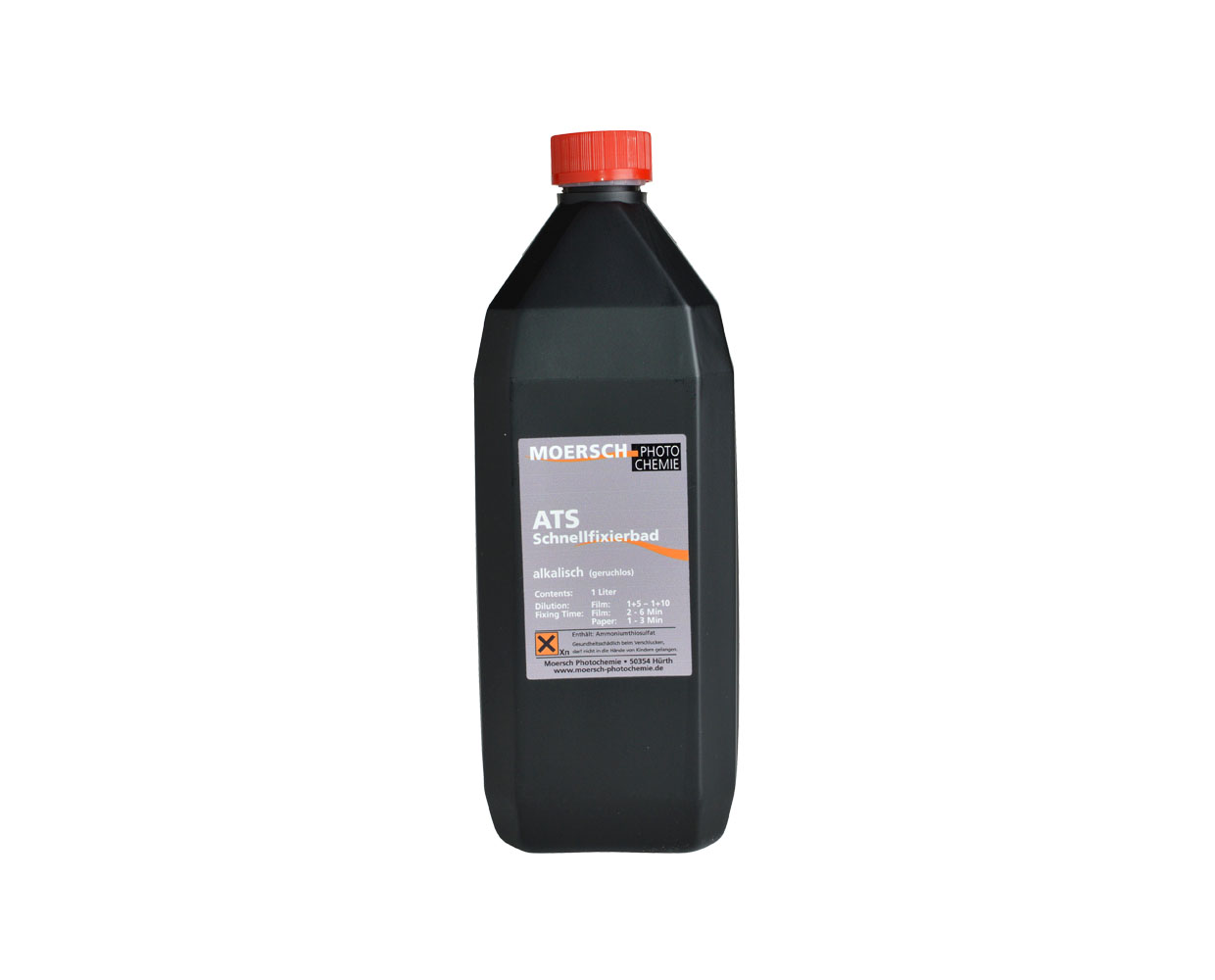
I use the Moersch ATS. info from:

Shelf life for closed bottle of stock | at least 10 years

Shelf life for opened bottle of stock | about 5-8 years

Shelf life for working solution | 1+5 in a bottle 2-3 years

Capacity for 1 liter of working solution | 1+5 1 liter 12 films (about 2 g silver per liter fix) - more films are possible with longer fixing times (not recommended) // fixing time papers: 1-2 minutes at 1+5 . 6 liters capacity 2-4m2


so even with very infrequent use where you only do a roll every couple of months, on bottle keeps you stocked for at least 5 years.
so for 15euro per 5 years I have a solution that is faster, most likely more archival, more friendly to the environment (properly discarding the spent fixer), and saves me to mix powder every time I want to process a roll (faster and safer to my health).

obviously this won't convince gealto2, but I had to mention it anyway.
 

Rudeofus

Member
Joined
Aug 13, 2009
Messages
5,119
Location
EU
Format
Medium Format
If I’m not mistaken, in the past people even experimented with seawater. Sodium chloride is a much weaker solvent, but in the end, after several days, it should also do some kind of job - if there is any emulsion left by then
I am quite optimistic about the emulsion surviving a few days in some solution, but I am less than sure about the sea water used as fixer. People used brine near the concentration limit to fix Silver Chloride solution. Some others experimented with modern emulsions (aka bromoiodide) and barely cleared the film after many days and at least one change of brine. I am not aware of any retained silver tests ever being done in these experiments.

I keep hearing "but it did clear my film" and "the negs are just fine after 10 years": if you keep your negs in a dark place, they will take many decades to turn brown, even if you don't fix at all. That's how that stash of photo paper of mine stays pristine in its box. I do have framed prints, though, which show visible browning after a few years. If you keep your negatives like this and only scan them once (and then maybe once more after a hard disk crash), then almost any amount of fixing will do.
 

Raghu Kuvempunagar

Member
Allowing Ads
Joined
Jul 28, 2016
Messages
3,069
Location
India
Format
Multi Format
I keep hearing "but it did clear my film" and "the negs are just fine after 10 years": if you keep your negs in a dark place, they will take many decades to turn brown, even if you don't fix at all. That's how that stash of photo paper of mine stays pristine in its box. I do have framed prints, though, which show visible browning after a few years. If you keep your negatives like this and only scan them once (and then maybe once more after a hard disk crash), then almost any amount of fixing will do.

OP uses their negatives to make alt-prints that require substantially longer exposure (to UV light) than your darkroom enlargements. If they have not observed any degradation, let's respect their experience even if we might not want to take their path.
 
OP
OP

gealto2

Member
Allowing Ads
Joined
Dec 7, 2025
Messages
91
Location
Peoria, IL, USA
Format
Multi Format
OP uses their negatives to make alt-prints that require substantially longer exposure (to UV light) than your darkroom enlargements. If they have not observed any degradation, let's respect their experience even if we might not want to take their path.
Yes, that's correct, although my enlarged negatives are on ortho litho films also fixed in dilute plain hypo. This film clears in under 30 seconds and I can guarantee has no silver iodide. I fix in trays for about ten minutes in my darkroom. Similarly, xray film fuji hru clears in about a minute. Both these films have no hard scratch resistant layers on top of them like camera films, so fix very quickly in dilute fixer. I have ortho litho enlarged negatives from 30 years ago that spent hours in the Arizona sun while printing that show no degradation. One of my tests I used for camera film fixing about ten years ago was to put the negatives in a ziplock bag exposed to the northern sky for a few weeks,
 
Joined
Sep 10, 2002
Messages
3,665
Location
Eugene, Oregon
Format
4x5 Format
... I am less than sure about the sea water used as fixer.
I think the whole myth of seawater being a fixing agent is a misunderstanding of the story about using seawater to wash film and prints leading to the use of modern wash-aids.

As I understand the story, navy photographers didn't have lots of fresh (i.e., drinking) water available shipboard to use to wash their film and prints. They therefore used seawater instead for the bulk of the washing, using only a bit of fresh water at the end. Some chemist among them noticed that using seawater actually speeded up the washing by promoting ion exchange. That led Kodak and others to incorporate a wash aid (Hypo Clearing Agent) into the wash sequence. Seawater, however, was never the fixer.

Doremus
 
OP
OP

gealto2

Member
Allowing Ads
Joined
Dec 7, 2025
Messages
91
Location
Peoria, IL, USA
Format
Multi Format
I think the whole myth of seawater being a fixing agent is a misunderstanding of the story about using seawater to wash film and prints leading to the use of modern wash-aids.

Doremus
My memory was that sodium chloride had been used as fixer during the Fox Talbot era, before even wet collodian. I know that potassium cyanide is an excellent fixer that was used in the early days but likely not popular today with the environmentalists. I also recall ammonium hydroxide being used as fixer, although sure about the dating of that. Just remembering history a bit, or trying to. Most ships during ww2 era had desalinization equipment of some sort as I recall.
 

MattKing

Moderator
Moderator
Allowing Ads
Joined
Apr 24, 2005
Messages
55,045
Location
Delta, BC Canada
Format
Medium Format
My memory was that sodium chloride had been used as fixer during the Fox Talbot era,

You are older than I thought :smile:.
IIRC, sodium chloride/sea water isn't actually a fixer, but it can serve to stabilize the exposed and developed silver salts - essentially slow significantly their deterioration.
If you don't have fixer, but you do have sea water, one option is to stabilize the image with the sea water and then, once fixer is available, attend to fixing those images.
I have no idea what appropriate fixing times might be in that circumstance. And I would definitely use that fixer one shot!
 
Photrio.com contains affiliate links to products. We may receive a commission for purchases made through these links.
To read our full affiliate disclosure statement please click Here.

PHOTRIO PARTNERS EQUALLY FUNDING OUR COMMUNITY:


Ilford ADOX Freestyle Photographic Stearman Press Weldon Color Lab Blue Moon Camera & Machine
Top Bottom