
Trying Lith for the first time

Old friends

D
Old friends

  • 1
  • 1
  • 80
Palm Tree

A
Palm Tree

  • 0
  • 1
  • 134

Recent Classifieds

Forum statistics

Threads
200,997
Messages
2,817,393
Members
100,479
Latest member
康佳民
Recent bookmarks
0

ic-racer

Member
Joined
Feb 25, 2007
Messages
16,686
Location
USA
Format
Multi Format
I have put on some Lith printing workshops. This is a syllabus for one of them.


Guillaume Zuili

Subscriber
Allowing Ads
Joined
Aug 3, 2005
Messages
2,996
Location
Los Angeles
Format
Multi Format
I have put on some Lith printing workshops. This is a syllabus for one of them.


Perfect syllabus you said it all.
Few years back I got a 10 sheets 8x10 kodalith paper box. Amazing stuff.
But my favorite of all, another kodak paper, is Opal. Insanely beautiful.
 

bedrof

Member
Allowing Ads
Joined
Mar 1, 2018
Messages
317
Location
Russia, Moscow
Format
Medium Format
Do you have any Fortezo and Bromofort tips? I think I had an available couple big boxes of the latter. Didn't experiment much as these appear to be slow (very high contrast, no color), within the limited parameters I have tested. IIRC, used to do a lot of 10A+10B+980ml Moersch Easylith; hot, and for just a few (3-4) prints.
Managed to try a few scavenged sheets of Polywarmtone and oh, that is a beautiful paper in Lith for portraiture.

Fortezo (white package) starts in Moersh lith with no extra efforts. Older Bromofort (yellow package) wants water bath before developer and a stronger and warmer solution (sometimes I make new dev midway). Bromofort in white packages though rather hard to find, didn't resist to lith in any considerable way. It takes 5-7 min in standard dilution of Moersh lith to a snatch point.
 
OP
OP
Bill Burk

Bill Burk

Subscriber
Allowing Ads
Joined
Feb 9, 2010
Messages
9,441
Format
4x5 Format
Having a mix of fun and fury.

I have reduced my developer to Moesrch 15ml A 15ml B and 375ml water. I get two 11x14 out. First print comes out with almost normal Silver Gelatin tonality but with some pronounced grain. About 8 minutes.

Second print gets the “Lith” high contrast super grainy effect in about 10 minutes.

Third doesn’t develop much at all in 30 minutes.

Using Kodabromide F3 11x14 SW.

Kodabromide F4 11x14 SW didn’t “Lith” but came out with a faint creamy color. (Maybe it was the third print?) - Going to give F4 another chance because I have a nearly full 250 sheet box of it and if it works I will have a good supply.
 

Raghu Kuvempunagar

Member
Allowing Ads
Joined
Jul 28, 2016
Messages
2,973
Location
India
Format
Multi Format
Having a mix of fun and fury.

I have reduced my developer to Moesrch 15ml A 15ml B and 375ml water. I get two 11x14 out. First print comes out with almost normal Silver Gelatin tonality but with some pronounced grain. About 8 minutes.

Second print gets the “Lith” high contrast super grainy effect in about 10 minutes.

Third doesn’t develop much at all in 30 minutes.

Using Kodabromide F3 11x14 SW.

Kodabromide F4 11x14 SW didn’t “Lith” but came out with a faint creamy color. (Maybe it was the third print?) - Going to give F4 another chance because I have a nearly full 250 sheet box of it and if it works I will have a good supply.

Just curious. Is there a reason why you're not taking Second Pass Lith route as it is supposed to work with all papers and gives you more control as the first pass print's characteristics circumscribe what the lith development in the second pass can do?
 
OP
OP
Bill Burk

Bill Burk

Subscriber
Allowing Ads
Joined
Feb 9, 2010
Messages
9,441
Format
4x5 Format
Just curious. Is there a reason why you're not taking Second Pass Lith route as it is supposed to work with all papers and gives you more control as the first pass print's characteristics circumscribe what the lith development in the second pass can do?

Still new to this, when I am disappointed with a particular print, the thought of bleach/redevelop certainly occurs to me.

But just now I got it to work and will say Kodabromide F4 SW is going to be my favorite. The second print is the one I can count on. In one development bath it comes out with warm gold background highlights and black shadows while paper borders remain white.
 

ic-racer

Member
Joined
Feb 25, 2007
Messages
16,686
Location
USA
Format
Multi Format
Some of my favorite Lith prints came from Minox negatives. Unfortunately the Hungarian paper on which these were made is long gone.

Extra Minox 1.jpg
Extra Minox 4.jpg
 
OP
OP
Bill Burk

Bill Burk

Subscriber
Allowing Ads
Joined
Feb 9, 2010
Messages
9,441
Format
4x5 Format
Cool museum shot. That’s kind of the color I get with F4. F3 comes out neutral gray.
 
OP
OP
Bill Burk

Bill Burk

Subscriber
Allowing Ads
Joined
Feb 9, 2010
Messages
9,441
Format
4x5 Format
First Result. Can you believe it???? OK this is literally print number 2 because the first one has serious issues because of the ridges in my tray.

But right off the bat! Just hit it with two minutes exposure for an illumination level that would have normally been 32 seconds.

I used 2 minutes exposure for all subsequent prints to date. Wild that print exposure time is "meaningless" when you do Lith printing.

Story time: While catching up on development backlog I went against my principles from APUG and scanned as I was cutting up developed film to put in pages.

When I got to some of my pictures, I hated how they looked with normal treatment, so I jammed up the contrast. I really liked the amped up contrast.

But when I tried to get that contrast in the darkroom, I was left feeling the same as when I was scanning. They lacked oomph.

I told some of the rest of the story earlier. But... This was one of the negatives that really needed the contrast treatment.

Before I did the sailboat, I looked through my recent scans and I got to this one and "chimped".


2025-09-09-0003.jpg

I
 
Last edited:
OP
OP
Bill Burk

Bill Burk

Subscriber
Allowing Ads
Joined
Feb 9, 2010
Messages
9,441
Format
4x5 Format
2025-09-09-0006.jpeg


11x14 Kodabromide F4 Single Weight.

2 minutes exposure, second print in Moersch 15ml A + 15ml B + 375ml water, about 8 1/2 minutes. KRST 1:20 ( but the selenium toning didn’t change the tone much, it came out of the fix like this).
 

jimjm

Subscriber
Allowing Ads
Joined
May 2, 2007
Messages
1,239
Location
San Diego CA
Format
Multi Format
View attachment 407130

11x14 Kodabromide F4 Single Weight.

2 minutes exposure, second print in Moersch 15ml A + 15ml B + 375ml water, about 8 1/2 minutes. KRST 1:20 ( but the selenium toning didn’t change the tone much, it came out of the fix like this).

This looks great Bill! It has much more of a "vintage" look than your straight print. Often, I've found that Lith just adds a different mood to a print. It seems to work really well with some negatives, but not so much with others. Some of my favorites have been images that never worked for me as straight prints but took on a different character with Lith. This has given new life to a lot of negatives that I never felt really excited about.
You've gotten plenty of great technical advice here from others, but my 2 cents is that longer exposures will generally provide a greater density and range of tones in the mids before the shadows start to get too dense. Many papers will also be more colorful with longer times. Toning can also have a great impact on the final print color.

These two were printed on Fomatone 131 paper with Fotospeed LD20 developer (sadly discontinued).
First image was not toned, but the second was toned with selenium to give a cooler look.

Ghosts II_sm_new.jpg


Ghosts I_sm_new.jpg
 
OP
OP
Bill Burk

Bill Burk

Subscriber
Allowing Ads
Joined
Feb 9, 2010
Messages
9,441
Format
4x5 Format
Thanks jimjm

That’s quite a scene!

How strong was the selenium? I hardly see any difference with KRST 1:20
 

mshchem

Subscriber
Allowing Ads
Joined
Nov 26, 2007
Messages
15,585
Location
Iowa City, Iowa USA
Format
Medium Format
P.S. I routinely use KRST at 1+3, especially with cold tone papers. 1+3 is way too strong (well it's harder to control) with warmer papers like Fomatone. 😊
 

Dwayne Martin

Member
Allowing Ads
Joined
Mar 23, 2014
Messages
268
Location
SW Florida
Format
4x5 Format
I also use the one shot method except I take it a step further by priming a big batch of developer in a big tray, usually about 2000 ml. (Maybe that’s not a big batch for some of you but it’s enough for me to make 3 or 4 prints in an evening). Depending on the paper I plan to print I will add a certain amount of old brown to the mix. Some papers need a lot of bromide and some will barely tolerate it without pepper fog. I also throw in a sheet of some junk paper like some old fogged RC. Then I let it rock for a while. I use a laboratory tray rocker (also heated) so that does the work for me while I do other things like set up the enlarger. When you’re printing long expired hard to find papers, the name of the game is not to waste a sheet if you can so getting the developer seasoned like that gets you past the first one or two not so interesting prints. Once I have it ready I pour it back into the pitcher, switch to a smaller tray and start making prints with about 600ml per print, give or take. Assuming I have my exposure time just right and I don’t have to adjust it, I can make multiple nearly identical prints without wasting valuable paper.

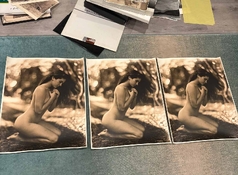
Here is an example, 3 sheets of 16x20 Ektalure made with one batch of developer.
 

Attachments

  • IMG_2498.jpeg
    IMG_2498.jpeg
    186.2 KB · Views: 34

Reginald S

Member
Joined
Feb 12, 2022
Messages
63
Location
Germany
Format
Large Format
I have reduced my developer to .. 375ml water. I get two 11x14 out. First print comes out with almost normal Silver Gelatin tonality but with some pronounced grain. About 8 minutes.

Second print gets the “Lith” high contrast super grainy effect in about 10 minutes.

Third doesn’t develop much at all in 30 minutes.


Lith developer wast fast, especially tiny amounts in tiny solutions. So your regardings are typical.
As said by Dwayne better use a two or liter bath which will lead to more consistency.
Plus a better learning curve, which will save the money later.


""I used 2 minutes exposure for all subsequent prints to date. Wild that print exposure time is "meaningless" when you do Lith printing.""

I always make a normal print, then giving 2x or 4x exposure to the Lith exposure.

But: This print of approx. 24x30cm took 480seconds for an unbelieveable sloth of paper,Fomatone 532, still missing dense in the highlights:

DSC02076a.jpg
 

Elmarc

Member
Allowing Ads
Joined
Feb 23, 2022
Messages
193
Location
Eu
Format
Analog

This is absolutely beautiful. Congratulations. Has inspired me to look into lith printing again. My only concern was/is wasting materials through trial and error.
 

jimjm

Subscriber
Allowing Ads
Joined
May 2, 2007
Messages
1,239
Location
San Diego CA
Format
Multi Format
This is absolutely beautiful. Congratulations. Has inspired me to look into lith printing again. My only concern was/is wasting materials through trial and error.

Thanks! With practice, the materials waste can be minimized but sometimes the results can be magical and this makes it worth the effort and time for me.
 
Photrio.com contains affiliate links to products. We may receive a commission for purchases made through these links.
To read our full affiliate disclosure statement please click Here.

PHOTRIO PARTNERS EQUALLY FUNDING OUR COMMUNITY:



Ilford ADOX Freestyle Photographic Stearman Press Weldon Color Lab Blue Moon Camera & Machine
Top Bottom