• Welcome to Photrio!
    Registration is fast and free. Join today to unlock search, see fewer ads, and access all forum features.
    Click here to sign up

Tri-X 400 vs T-MAX 400

Somewhere...

D
Somewhere...

  • 2
  • 1
  • 63
Iriana

H
Iriana

  • 6
  • 1
  • 123

Recent Classifieds

Forum statistics

Threads
202,740
Messages
2,844,935
Members
101,493
Latest member
aekatz
Recent bookmarks
0
Over what years, Harry? Digi photography is an adolescent medium that doesn't even know what it is half the time. I was in full throttle with TMax well before that kind of thing was remotely either affordable or practical by the public. Most of the time the "digi look" is just overdone, corny, crude, half-baked, amateur whatever. What does this thread legitimately have in common with that? Highlight roll-off ?????? Not if you have a decent light meter and know how to use it, along with an appropriate development regimen. That kind of problem happens when people overexpose the film because they don't trust its native curve to do what it's engineered to actually do. So, no, I wasn't trying to imply you have that problem personally; and I do recognize that TMax films aren't the best choice for casual snapshooters who rely on the voodoo of careless "latitude" instead of actual metering. And what I have also discovered is that a lot of the current digi generation doesn't even know what a real light meter is. So when they decide to switch to real film - and quite a few do, at least in this area - TMax drives them nuts. But these are a pair of films so versatile in terms of gamma and fully analog curve tweaking that they can be made to resemble quite a variety of other films, but not necessarily visa versa.

I started on Tmax and I use it for so-called 'snapshots'. I've never had an issue with it.

Tmax-100, D-76 1:1 and no problems. Meter? What meter? Sunny 16 and the film handles it fine. Oh, I'm sure I can squeeze something more out of it but it handles ballpark just fine.

h721w60.jpg
 
I've been following this thread and many contributions (Drew) are very interesting.
HP5 is a fantastic film that has pardoned many sins when shooting unmetered, and has been easy to print. It's my 120 ISO 400 staple of choice. Delta 100 for when there is more light, another reason for me to have stuck with Ilford films is that they are very well priced in Europe and usually an Euro or so below Kodak options; Which is significant under my current low budget.
But on the corner TMX and TMY are looking attractive for 35mm on which I do like finer grained alternatives.
I was given a couple rolls of 1996 TMax 100 which in a P&S brought good results, with some lower contrast due to age, but printed fantastic using higher grades. That's all so far, but I am taking a short holiday next month and 35mm TMX/TMY are quite well priced at the local retailer. Visiting family, where I left a Nikon F90, so it can be shot with the luxury of the late 90s matrix metering wonders.

As of the "digital looking" discussion. As far I know, traditional Pan films tend to have some excessive sensitivity to blue, whereas the T-Grain films have a different spectral response. I've noticed how in Acros the skies look as if a Yellow filter were used.
 
Today I shot Tri-X because I wanted 36 exposures. I used a yellow filter and set the camera at 400. During the day I was happy with the choice.

This afternoon my son wanted to work on a photo project as the sun went down.

I took off the yellow filter. I could hear some shots had too slow a shutter speed so I told him to take it again but hold real still...

Will be interesting to see how it comes out. I had TMY-2 but only 24-exp rolls.

So I hope this illustrates how much I care about the difference. Enough to buy my favorite even though I prefer 36-exp. But not enough that I would risk running out of film at an inopportune time.
 
I happen to like 24-exp cassettes because they're easier to spool on the reel. And I mainly use 35mm just for casual scouting purposes, and only print 35mm a couple days a year. But a few really exceptional if intentionally small prints do happen.
 
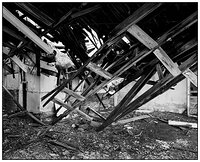
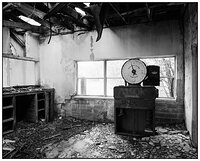
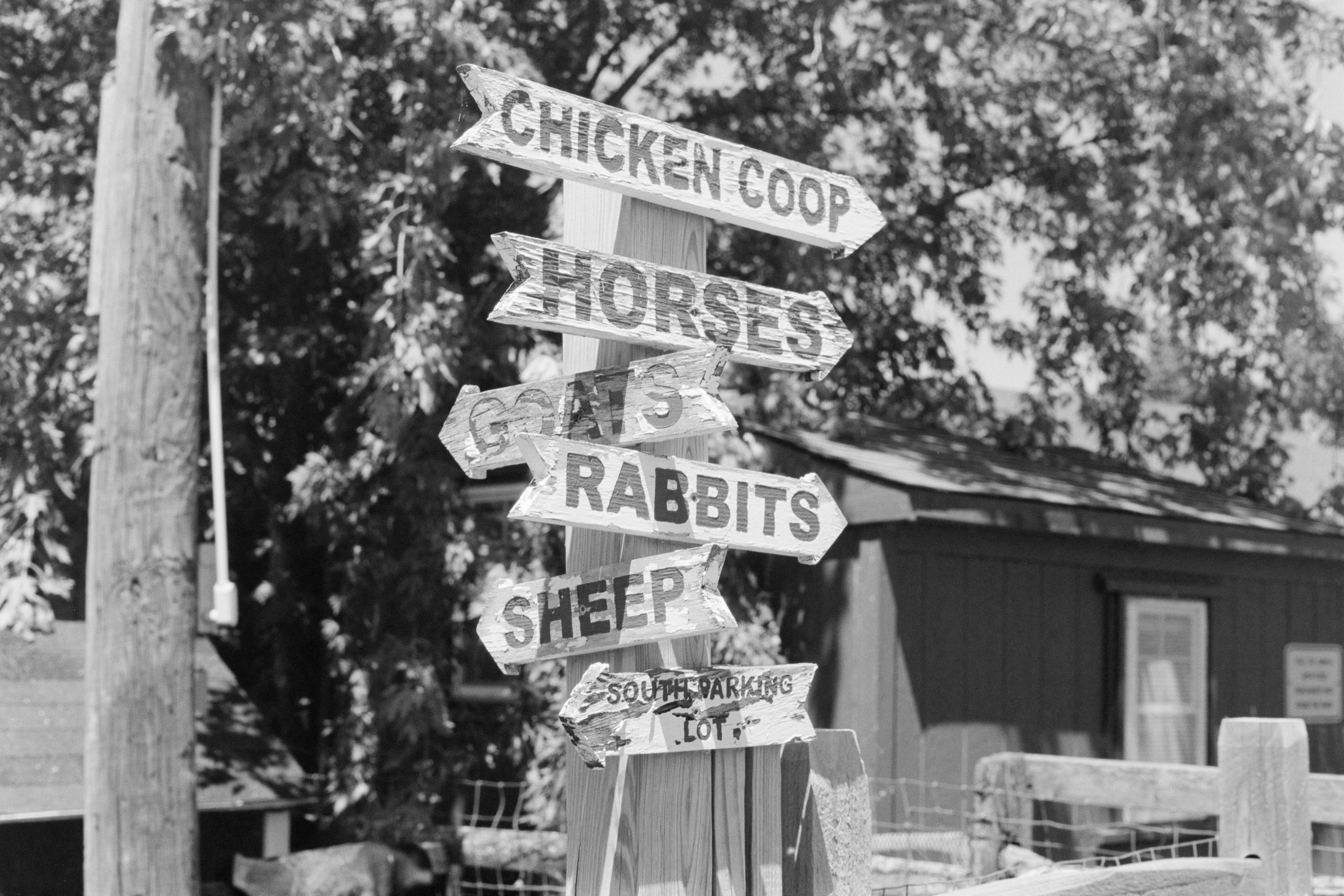
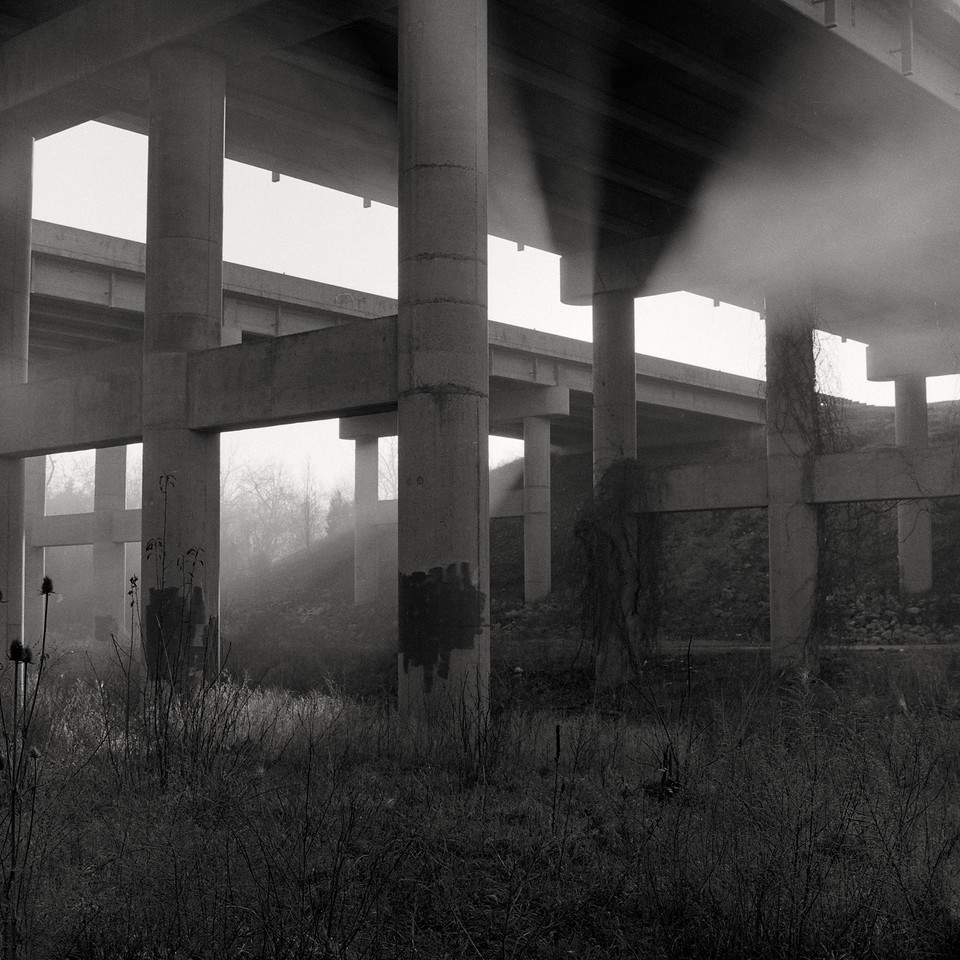
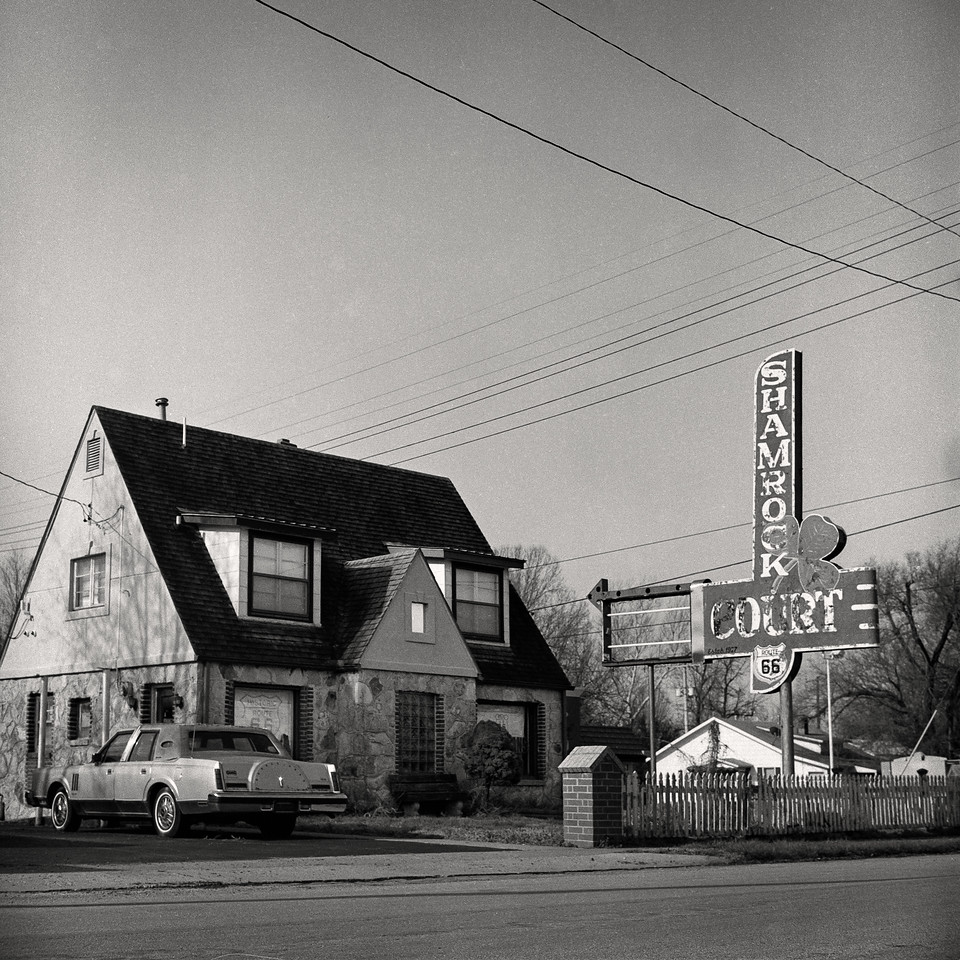
I do have a couple of recent examples of the 400-speed versions of each, but not direct comparisons. Different subject, different light. And all have been post processed from copies of the negatives, so it's hard to say how much of the film's essential character survives. But for what it's worth:

These top two are Tri-X exposed at EI 250, and developed in R09 Rodinal One Shot @ 1+25:
camera_scan-Japanese_maple-X2.jpg

camera_scan-fountain-X2.jpg


The next two are T-Max 400 exposed at EI 250 and developed in R09 Rodinal One Shot @ 1+50:
highway_bridges-4969-X2.jpg

shamrock_motel-4970-X2.jpg
 
The first two seem to have too much burned out highlights. The whites are clipped. The fourth seems the best and most natural. Nicer tones; better contrast. I agree with scanning, there are so many variables, it's hard to pin down comparisons unless you use the same post processing settings and scan procedures. ALso, should be the same shots with the same lighting. That just throws more variables making comparisons harder.
 
The first two seem to have too much burned out highlights. The whites are clipped. The fourth seems the best and most natural. Nicer tones; better contrast. I agree with scanning, there are so many variables, it's hard to pin down comparisons unless you use the same post processing settings and scan procedures. ALso, should be the same shots with the same lighting. That just throws more variables making comparisons harder.

Thanks for the feedback. While I have been practicing photography since the early 1970s I never claimed to be very good at it. Most of my experience has been with color slides, so I am relatively new to exposing and processing b&w film. And I am still experimenting with various methods of preparing my film images for presentation on forums like this one. If any highlights were lost, it was most likely in the digital capture / post-processing stage.

One test I have not yet done is to compare a scanned darkroom print to the results I get from "scanning" the negative (actually, I photograph the negs with a digital camera). I'm guessing the scanned print will need less post-processing and therefore will be more representative of the filmy characteristics of the negative, compared to starting with a scan of the negative.

I do apologize for even bringing up the words "scan" and "digital" in this analog form, but the OP asked for examples, and if our examples are to be be viewed online, they must be digitized. And having been digitized, all comparisons of online examples are less than ideal.
 
Love Tri-X. Love TMX too.But heck I love HP5 and FP4 just as much!
If you are careful with you processing, TMX and TMY are unbeatable. Tiny grain, huge dynamic range, no rolloff of the high values. I used Panatomic exclusively until it was discontinued and resisted the tabular films for years. But Kodak reformulated them and their tendency to have a strongly upswept curve was reduced (with careful processing). Nowadays (and this may be blasphemy to some) I don't miss Panatomic-X or Verichrome Pan. I'm 64, shot my first roll in 1965, and I still get a huge charge out of looking at the film as soon as it exits the processing!
But Kodachrome, that one I miss....
I miss Verichrome Pan a lot....
 
Love Tri-X. Love TMX too.But heck I love HP5 and FP4 just as much!
If you are careful with you processing, TMX and TMY are unbeatable. Tiny grain, huge dynamic range, no rolloff of the high values. I used Panatomic exclusively until it was discontinued and resisted the tabular films for years. But Kodak reformulated them and their tendency to have a strongly upswept curve was reduced (with careful processing). Nowadays (and this may be blasphemy to some) I don't miss Panatomic-X or Verichrome Pan. I'm 64, shot my first roll in 1965, and I still get a huge charge out of looking at the film as soon as it exits the processing!
But Kodachrome, that one I miss....

Curious about your definition of "careful processing"

By that do you mean accurate control of temperature and time, and following Kodak's processing instructions exactly, as given <here> <here> and <here>?

Or something else?
 
Last edited:
Ortho films and Orthopan are quite different. True ortho can't see red at all; but orthopan is in fact panchromatic, but with distinctly reduced red sensitivity.
 
Here are two contact prints of 35mm done by a prolab. Not sure what developer, probably XTOL. The lef one is Tmax 400 and the right one is TriX 400. The right TriX seems lighter than flat scan I did of the film. Is the contact light because the print wasn't printed right or because of the negatives or developing?
Scan.jpg
 
Ortho films and Orthopan are quite different. True ortho can't see red at all; but orthopan is in fact panchromatic, but with distinctly reduced red sensitivity.
Adox chs 100 II - but it has not been available for a while...
 
Here are two contact prints of 35mm done by a prolab. Not sure what developer, probably XTOL. The lef one is Tmax 400 and the right one is TriX 400. The right TriX seems lighter than flat scan I did of the film. Is the contact light because the print wasn't printed right or because of the negatives or developing?
View attachment 232763
I recall reading that T-Max negatives are to be thinner than Tri-X and print equally well. IDK if it is, I will have my second try around TMX soon and will see.
Of course, when the source of that quote is needed I can't find it for the sake of it. A quick google shows some anecdotical mentionin of that. https://www.rangefinderforum.com/forums/showthread.php?t=155084
 
I haven't used Tri-X for a while, but until recently I was shooting both T-Max 400 and Plus-X regularly. I have/am transitioning over to using T-Max 100 and T-Max 400 as my two films, but T-Max 400 is certainly most used.
Good negatives in both of Plus-X and T-Max 400 look a little bit different if all you are doing is inspecting them visually.
I've had pretty good success printing minimally exposed T-Max 400 negatives. My personal preference tends toward negatives with acceptable exposure, rather than generous exposure.
I expect the lab has a standard procedure for contacts that isn't fine tuned for each film. If you were doing your own contacts, you might very well adjust exposure slightly when you switched between them.

I've shown this a few times before. This is from a T-Max negative that is positively ghostly it looks so thin:
leaves2.jpg
 
I haven't used Tri-X for a while, but until recently I was shooting both T-Max 400 and Plus-X regularly. I have/am transitioning over to using T-Max 100 and T-Max 400 as my two films, but T-Max 400 is certainly most used.
Good negatives in both of Plus-X and T-Max 400 look a little bit different if all you are doing is inspecting them visually.
I've had pretty good success printing minimally exposed T-Max 400 negatives. My personal preference tends toward negatives with acceptable exposure, rather than generous exposure.
I expect the lab has a standard procedure for contacts that isn't fine tuned for each film. If you were doing your own contacts, you might very well adjust exposure slightly when you switched between them.

I've shown this a few times before. This is from a T-Max negative that is positively ghostly it looks so thin:
View attachment 232793

Tmax400 is the bomb for smaller formats!
 
Here are two contact prints of 35mm done by a prolab. Not sure what developer, probably XTOL. The lef one is Tmax 400 and the right one is TriX 400. The right TriX seems lighter than flat scan I did of the film. Is the contact light because the print wasn't printed right or because of the negatives or developing?
View attachment 232763
You didn’t bracket the family shots but outdoors shots of the buildings you did
 
TMAX 400 is a designer grain film. 30 years ago when it was first released, the film amazed a lot of photographers including me. However, I prefer the look of Tri-X. It's probably just me because I'm used to older Tri-X. TMAX grain looks too smooth.
 
You didn’t bracket the family shots but outdoors shots of the buildings you did
Sorry Bill. I should have mentioned I was referring to the rebate area, not the actual shots. It's lighter there with the TriX.
 
Sorry Bill. I should have mentioned I was referring to the rebate area, not the actual shots. It's lighter there with the TriX.
Oh, no worries. That's probably not a real difference. Adrian Bacon is studying fog that he sees increases with increasing pH (as the developer is more active when the developer is more alkaline), that would appear exactly like that under controlled contact printing conditions. It's possible the difference between your two contact prints is fog, but probably not. The lab probably just casually created contact prints for you without being too careful to control exposure.
 
Are yellow orange and red filters different between Tmax and TriX due to the films characteristics?
Yes.
The T-Max has slightly less yellow blue sensitivity. Some who typically use a yellow filter with Tri-X find it unnecessary to use a yellow filter with T-Max.
 
Last edited by a moderator:
Photrio.com contains affiliate links to products. We may receive a commission for purchases made through these links.
To read our full affiliate disclosure statement please click Here.

PHOTRIO PARTNERS EQUALLY FUNDING OUR COMMUNITY:


Ilford ADOX Freestyle Photographic Stearman Press Weldon Color Lab Blue Moon Camera & Machine
Top Bottom