
• Welcome to Photrio!
    Registration is fast and free. Join today to unlock search, see fewer ads, and access all forum features.
    Click here to sign up

Tmax-400/35mm with XTOL: Getting thinner negatives than before?

PenStocks

A
PenStocks

  • 1
  • 0
  • 26
Landed Here

H
Landed Here

  • 4
  • 3
  • 44

Recent Classifieds

Forum statistics

Threads
201,832
Messages
2,830,858
Members
100,976
Latest member
Gorrunyo
Recent bookmarks
0
Joined
Jan 21, 2003
Messages
15,715
Location
Switzerland
Format
Multi Format
... but, if pre-soaking the film does the job, then it seems logical that something being removed in the pre-soak is what is adversely affecting the Xtol.

I agree 100% with your entire post, except where you assume that the anti-halation coating is the only thing that washes away in the pre-wash. I have no way to prove that you're wrong, but just thought that assumption was a little too bold. No harm meant; I just like being the devil's advocate.

The line quoted above is exactly the issue. "Something that gets washed away in the pre-soak affects ascorbate developers negatively". So the fast and easy cure is to always pre-soak TMY-2 prior to developing it. A more viable long-term solution is for Kodak to test the combination and come up with a fix where the film does not have to be pre-soaked prior to developing, which will require careful laboratory work, analysis, and problem solving.

- Thomas
 

Tim Gray

Member
Allowing Ads
Joined
Sep 2, 2006
Messages
1,882
Location
OH
Format
35mm
I know that the Tri-X I develop has lately got a new anti-halation coating, one that comes out dark blue in the pre-soak water. Perhaps Kodak has re-formulated the anti-halation coating for TMY as well, and that is killing Xtol somehow. I can't think of anything else that gets removed with the pre-soak.

The only change I've seen in the last year or so with Kodak's B&W films is that the 35mm Tri-X canister has different graphics. It used to be green text on a gray background at one spot; now it's black text on a gray background.

Who knows if other changes have been made. And who knows what is causing your dark blue water - it's not necessarily anti-halation dyes/coatings.
 

pentaxuser

Member
Allowing Ads
Joined
May 9, 2005
Messages
20,339
Location
Daventry, No
Format
35mm
I await with interest Kodak's reply to the OP. I know Kodak is having major financial problems but to assume that it has changed TMY which has had an adverse effect on its own product Xtol without any testing and Kodak's lab cannot now be relied upon is I suspect baseless assumptions.

pentaxuser
 

palec

Member
Allowing Ads
Joined
Apr 15, 2007
Messages
71
Location
Auckland
Format
Multi Format
This problem catched my attention, because I recently bought a pack of TMax 400-2 films in 135 format, by coincidence the same batch as Mark - 0166, and I usually develop in Xtol.
I had an older TMY2 batch in camera, don't know exactly which one, so I decided to run a simple comparison.
There are few differences to Mark's steps, however. I exposed both films at EI 200, because that's how the first film has been exposed from start.
I developed at 23 °C, because that's my room temperature.
And I used 4 months old Xtol stock (250ml in Jobo tank for two reels).

I did some snapshots of the process just for record.

_0010012.jpg


_0010013.jpg
_0010014.jpg


There is a new cassette printing and code with batch 0166 (right), two colours instead of four and barcode is 310804 instead of 210804.

I developed at 23 °C for 5:30 minutes with 4 inversions every minute.

_0010018.jpg
_0010019.jpg

_0010020.jpg
_0010021.jpg


In both cases used Xtol ended with slight yellow tint (left before, right after, batch 0166 bottom row).

Well, most important things, the results. I cannot tell them apart and I don't see anything wrong with any of them.

_0010024.jpg


I don't have a densitometer, but the films look ok (same) to me, the labels are not faint.
12 frames are shots of grey card (blank, zone 0-10), batch 0166 (right).

Larger photos are available at picassa album: http://tinyurl.com/tmy2b0166

I'm curious about findings of others.
 
Joined
Sep 10, 2002
Messages
3,675
Location
Eugene, Oregon
Format
4x5 Format
Palec,

Now for the $64,000 question .......... Did you pre-soak? Please let us know, since that is the crux of the matter. The real test would have been to duplicate the one you just did, but do one with and one without the pre-soak.

And, thanks for following up on the, taking the initiative and doing the test. Just let us know about the pre-soak, okay?

Best,

Doremus

www.DoremusScudder.com
 
OP
OP

albada

Member
Allowing Ads
Joined
Apr 10, 2008
Messages
2,177
Location
Escondido, C
Format
35mm RF
I don't have a densitometer, but the films look ok (same) to me, the labels are not faint.
12 frames are shots of grey card (blank, zone 0-10), batch 0166 (right).

Palec, thank you for doing this test!
A question: Did you develop the entire roll, all 36 frames?
If so: could you repeat the same test, but add a 5-minute pre-wash before development?

Thanks,

Mark Overton
 

palec

Member
Allowing Ads
Joined
Apr 15, 2007
Messages
71
Location
Auckland
Format
Multi Format
Doremus, Mark,
I did not presoak the films and both have been full length 36 exp films.
 
Joined
Jan 21, 2003
Messages
15,715
Location
Switzerland
Format
Multi Format
Doremus, Mark,
I did not presoak the films and both have been full length 36 exp films.

Two words: monkey wrench. :smile:

So, now we have two people with roughly the same process, no presoak, one works, the other does not.

The difference? Heck if I know. Palec, was the Jobo Tank you used for a Jobo base as well, with continuous agitation? Or did you agitate intermittently?
 

palec

Member
Allowing Ads
Joined
Apr 15, 2007
Messages
71
Location
Auckland
Format
Multi Format
Palec, was the Jobo Tank you used for a Jobo base as well, with continuous agitation? Or did you agitate intermittently?

Thomas,
it was developed by hand, agitation by inversion, 30 seconds initially followed by 4 inversions every minute.

I can develop another batch 0166 roll with presoak when I'll finish it.
 
OP
OP

albada

Member
Allowing Ads
Joined
Apr 10, 2008
Messages
2,177
Location
Escondido, C
Format
35mm RF
Folks,

I have one unopened roll remaining from my failing brick. I'd like to mail it to one of you in the USA, so you can expose and develop it in XTOL, and let us know the results. I'll even include a dollar bill in the box to pay for your XTOL, so it'll cost you nothing but some time to do this test.

If it fails, then there was a glitch in Kodak's production.
If it succeeds, then I'm doing something wrong.

Anyone up for this?

Mark Overton
 
Joined
Jan 21, 2003
Messages
15,715
Location
Switzerland
Format
Multi Format
I can do it, Mark, if you agree to me sending the film back to you for analysis.
 
OP
OP

albada

Member
Allowing Ads
Joined
Apr 10, 2008
Messages
2,177
Location
Escondido, C
Format
35mm RF
Mark, I think Thomas is the perfect person for the task! JohnW

Michael R, I appreciate your offer, but I guess I'll stay within the USA so the shipping will be faster.
Thomas, thanks for your willingness to do this. I'll PM you for details.

BTW, my new order of TMY2 arrives from B&H on Fri or Sat, and that'll be an interesting test.

Mark Overton
 

palec

Member
Allowing Ads
Joined
Apr 15, 2007
Messages
71
Location
Auckland
Format
Multi Format
Meanwhile I finished the roll and developed with the same procedure as in my post #29, but now with 5 minute filtered water presoak.

The results are now supporting Mark's findings that presoaking current TMax 400 leads to higher density (even in shadows).

As before I documented the process and added the photos to album (photos 9 – 13):
http://tinyurl.com/tmy2b0166

I will just comment, that water came out pink after presoaking and Xtol stock less yellow after developing.

Here is comparison:
_0010032.jpg

12 frames - blank, zones 0 – 10. Left without presoak, right with presoak.
Judging by eye, presoaking film leads to nearly one stop more difference even in Zone 0 when developed in Xtol Stock.
Edge printings have higher density, too.

Frames exposed at EI 200 now look overexposed, which means, presoaking is good to achieve true film speed in this combination.

I'm curious about Thomas' findings.
 

Tim Gray

Member
Allowing Ads
Joined
Sep 2, 2006
Messages
1,882
Location
OH
Format
35mm
The results are now supporting Mark's findings that presoaking current TMax 400 leads to higher density (even in shadows).

Interesting. However, it hasn't been ruled out that older TMY with a presoak would also have higher density. In other words, is there some difference between batch 0166 and older TMY?

Is there something about presoaking that allows the developer to act faster?
 

pentaxuser

Member
Allowing Ads
Joined
May 9, 2005
Messages
20,339
Location
Daventry, No
Format
35mm
So pre-soaking with same dev time etc i.e. everything exactly the same except for pre-soak leads to higher density negs?

Things get more and more curious. I'd have thought that a pre-soak with all other things being equal might lead to less dense negs for same dev time due to slight dilution. In a long thread on pre-soaking I can't recall even one comment on it producing denser negs

I do agree that your pre-soak negs do look to be denser.

I wonder what the explanation can be and what Kodak's comments would be?

pentaxuser
 

sandermarijn

Member
Allowing Ads
Joined
Oct 19, 2005
Messages
704
Location
Leiden, Neth
Format
35mm
Ralph Lambrecht & Chris Woodhouse, WBMII, p. 200, on pre-soak:

"... the subsequent development bath is either absorbed more slowly, extending the development time, or the wet emulsion promotes the diffusion of some chemicals, reducing the development time."
 

palec

Member
Allowing Ads
Joined
Apr 15, 2007
Messages
71
Location
Auckland
Format
Multi Format
Interesting. However, it hasn't been ruled out that older TMY with a presoak would also have higher density. In other words, is there some difference between batch 0166 and older TMY?

Maybe there is no difference, I don't have exact batch number, but I recall that the expiration was about 2013. Could be it was the same formulation.
 

Tim Gray

Member
Allowing Ads
Joined
Sep 2, 2006
Messages
1,882
Location
OH
Format
35mm
Maybe there is no difference, I don't have exact batch number, but I recall that the expiration was about 2013. Could be it was the same formulation.

That could be true. But with no pre-wash, your negatives came out fine, correct? As in, they came out like they always do.

It's more important to me that older and newer TMY comes out the same when processed the same than it is that TMY comes out the same with or with out a prewash.
 

MattKing

Moderator
Moderator
Allowing Ads
Joined
Apr 24, 2005
Messages
55,191
Location
Delta, BC Canada
Format
Medium Format
Does the pre-soak affect the ph of the developer that follows?

Do the anti-halation dies (and anything else that washes away with the pre-soak) affect the ph of the developer?
 
Joined
Jan 21, 2003
Messages
15,715
Location
Switzerland
Format
Multi Format
Does the pre-soak affect the ph of the developer that follows?

Do the anti-halation dies (and anything else that washes away with the pre-soak) affect the ph of the developer?

Or, perhaps even the pH of the wash water? Side by side check with 'normal' roll of film should be interesting.
 
OP
OP

albada

Member
Allowing Ads
Joined
Apr 10, 2008
Messages
2,177
Location
Escondido, C
Format
35mm RF
Judging by eye, presoaking film leads to nearly one stop more difference even in Zone 0 when developed in Xtol Stock.
Edge printings have higher density, too.

Yes, that matches my findings exactly. BTW, thank you Palec for running these tests. With film at US$6.50 per roll, those three tests you ran are expensive.

Summary of my past posts: I found that with batch 0166, XTOL pours out yellowish and negatives are about one stop thinner than normal. But over 5 months ago, XTOL poured out almost clear and neg's had normal density. A prewash makes 0166 behave like my old TMY2.

Today, I mailed my last roll of 0166 to Thomas, so in a few days we'll hear his independent test of this film.

EDIT: No response yet from Kodak.

Mark Overton
 
Last edited by a moderator:
OP
OP

albada

Member
Allowing Ads
Joined
Apr 10, 2008
Messages
2,177
Location
Escondido, C
Format
35mm RF
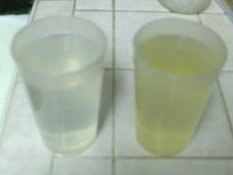
A new order of Tmax-400/35mm arrived from B&H today, and it's also from batch 0166. As before, it pours out yellow. Below, I attached photos of XTOL that's fresh (left) and used (right) so you'll know what this yellow colouration looks like. The two photos are with and without flash:

XtolYellow1.jpg - XtolYellow2.jpg

HOWEVER, edge-marking density and image-density look higher than before. I compared it to a prior roll by holding it over the light-table. It's drying, so I haven't run it through the densitometer, but to my eye, the densities are acceptable and would not cause complaints.

And no word from Kodak.

EDIT:
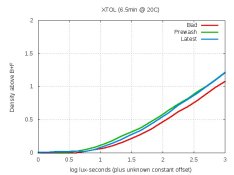
The roll is now dry, and I measured it on the densitometer. Here are the graphs of a failing roll, a roll with pre-wash, and the latest roll:

tt.jpg

On the right-side of the graph, the pre-washed and latest rolls have the same densities, and both are above the failing roll (red line).
An interesting observation: The pre-washed roll has slightly higher speed, because its toe is higher. I suspect this is also true in Palec's tests, where the thin areas were noticeably denser in his pictures.

Mark Overton
 
Last edited by a moderator:
Photrio.com contains affiliate links to products. We may receive a commission for purchases made through these links.
To read our full affiliate disclosure statement please click Here.

PHOTRIO PARTNERS EQUALLY FUNDING OUR COMMUNITY:


Ilford ADOX Freestyle Photographic Stearman Press Weldon Color Lab Blue Moon Camera & Machine
Top Bottom