• Welcome to Photrio!
    Registration is fast and free. Join today to unlock search, see fewer ads, and access all forum features.
    Click here to sign up

The Toner Thread

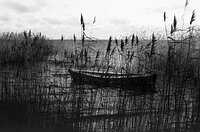
At the Lagoon

A
At the Lagoon

  • 6
  • 4
  • 57
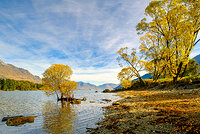
Afternoon Calm II

D
Afternoon Calm II

  • 3
  • 3
  • 46

Forum statistics

Threads
203,512
Messages
2,855,798
Members
101,879
Latest member
SawmillMurray
Recent bookmarks
0
Thank you. So which toners are best at boosting contrast in prints, please?

Use of a bleach and redevelop toner - such as sepia toner - can give you a result which appears to increase the range of tones - because the bleaching part tends to lighten the highlights slightly. It is for that reason that the instructions for that type of toner recommend that prints be slightly darker than normal, before toning is done.
However, at least some of the affect is subjective and a matter of perception - warm tones in a print seem to differentiate themselves differently in prints.
I like using brown toner. It doesn't tend to lighten the prints, but the change of tone changes how they appear.
 
Thank you. So which toners are best at boosting contrast in prints, please?

All, or none.

A real contrast boost is easier to achieve by other means - altering the negative (e.g. developing longer, intensifying) or altering the print itself (e.g. print at a higher grade).

Subtle contrast 'boosts' can be obtained with for instance selenium or gold toning, but these are rather subtle effects. Bleaching can be used to lighten highlights, which will also boost contrast - by clipping the higher values and leaving the shadows more or less unaffected.

In all instances of questions like these, it helps to be as specific as possible, because as long as the question remains generic, answers in totally different directions (even opposite ones) could still apply, and that generally means you're not quite out of the woods yet.
 
All, or none.

A real contrast boost is easier to achieve by other means - altering the negative (e.g. developing longer, intensifying) or altering the print itself (e.g. print at a higher grade).

Subtle contrast 'boosts' can be obtained with for instance selenium or gold toning, but these are rather subtle effects. Bleaching can be used to lighten highlights, which will also boost contrast - by clipping the higher values and leaving the shadows more or less unaffected.

In all instances of questions like these, it helps to be as specific as possible, because as long as the question remains generic, answers in totally different directions (even opposite ones) could still apply, and that generally means you're not quite out of the woods yet.

Thank you - this is possibly what I was searching for. I found it on the Internet:-

"Selenium Toner SLT20, being a true selenium toner, will add contrast to the image."

Emphasis mine.

 
How do you plan to combine solarization and toning?

I haven't trialled this yet, am still setting up a system of ventilation for my home-darkroom.

The idea would be to briefly expose a developing print to light, during development.

The resulting solarised image would then be toned, then and there; or dried, then toned later.

Possibly several toning episodes might be employed, using different toners.
 
I haven't trialled this yet, am still setting up a system of ventilation for my home-darkroom.

The idea would be to briefly expose a developing print to light, during development.

The resulting solarised image would then be toned, then and there; or dried, then toned later.

Possibly several toning episodes might be employed, using different toners.

Sounds like a plan. Do share the final results if you can - it should be interesting. That reminds me, if you want another candidate for direct sulfide toning, try out Kala Namak (something you can buy at an Indian grocery store or Amazon, etc.) Check out this thread:


:Niranjan.
 
Sounds like a plan. Do share the final results if you can - it should be interesting. That reminds me, if you want another candidate for direct sulfide toning, try out Kala Namak (something you can buy at an Indian grocery store or Amazon, etc.) Check out this thread:


:Niranjan.

Thank you - black salt - sounds intriguing.

Am just trying out the ventilation set-up now, so far so good. I will still need to put up shelving for enlarger & sort the baths, so I wouldn't be expecting results until summer 2023 at the earliest.

The current darkroom preparation is so that I can process b/w slide film, so it's all 'in camera', apart from the lamp-exposure part, no prints as such.
 
I apologize for reviving an old thread again, but lately, I've been on a quest to achieve a specific warm tone that I've always liked. I noticed this thread has been brought back to life a few times, so I hope it's okay to add my questions here.

I recently experimented with selenium toning, trying different dilutions and times on test strips, hoping to get warmer tones on Ilford FB WT paper. However, all I’m getting are darker shadows. I have to leave the prints in the toner for a long time to achieve any color change, and it ends up turning reddish-purple, which I don’t like, and by that point, the image becomes very contrasty, which I guess I could compensate for by reducing exposure time or using a lower contrast filter, but still, it’s not the look I’m after.

I’m looking for something closer to what I believe is a gold-toned print, although I’ve never tried gold toning myself. While researching, I came across a photographer whose tones I love, and he mentioned using gold chloride ammonium cyanothionate for toning, but he didn’t specify a product. They have a very warm and somewhat subtle blue split tone. I’ve found several products available here in the EU, some of which seem to have similar characteristics, like Tetenal Gold Toner, but it doesn’t mention ammonium cyanothionate.

So, I’d appreciate it if someone could explain to a rookie like me how to get or make gold chloride ammonium cyanothionate toner. Is there a specific product for this, or does it require mixing multiple chemicals? Any guidance would be greatly appreciated!
 
how to get or make gold chloride ammonium cyanothionate toner

Get: https://www.moersch-photochemie.de/en/product/mt9-goldtoner-kit/
Make: E.g. here https://www.lloydgodman.net/tech/tech/Enlarging/archive38.html

Is there a specific product for this, or does it require mixing multiple chemicals?

It's just two chemicals - gold chloride and thiocyanate (can be potassium, sodium or ammonium; IDK if there's any difference in the color this will yield - I suspect not).

Gold chloride is kind of expensive (duh).
 
Get: https://www.moersch-photochemie.de/en/product/mt9-goldtoner-kit/
Make: E.g. here https://www.lloydgodman.net/tech/tech/Enlarging/archive38.html


It's just two chemicals - gold chloride and thiocyanate (can be potassium, sodium or ammonium; IDK if there's any difference in the color this will yield - I suspect not).

Gold chloride is kind of expensive (duh).

Huh, that was easy! (for you).

I'll purchase MT9 to test and see if it’s what I’m looking for (it should be). I'm just a bit puzzled because the Moersch page you sent doesn’t specify if this toner is for silver gelatin prints. It does mention lith prints, though, so I hope it's okay:

"Gold toner for Vandyke, Kallitypie, Lobotypie, Argyrotypie, Albumen, Salzdruck, and Lithprints."
 
Huh, that was easy! (for you).

Well, it may have been because I know the stuff is called 'thiocyanate' (those chemical names huh!); this makes searching a little easier. And I knew I had read gold thiocyante formulas before when I first looked into gold toning, but I settled for thiourea-gold toner instead.

I'm just a bit puzzled because the Moersch page you sent doesn’t specify if this toner is for silver gelatin prints.

He included the applications it's mostly used for, but it should work on any silver image. I suspect Moersch positions his toner mostly for these alt. processes for reasons of market segmentation; there are other gold toners on the market that are more specifically targeted at silver gelatin (e.g. gold protective toner; various brands sell such a product).
 
Got it! I ordered the toner and can’t wait to try it. Thanks so much!
 
Wouldn't gold toner move the print more towards colder than warmer - at least that is what my understanding is.

:Niranjan

I’ve seen many examples where gold-toned images actually appear cold. So I’m not sure what makes them warm, except sepia. I don't like sepia.
 
Split toning is most effective with a warmtone paper like Ilford MGWT. After development and fixing, rinse each of your prints and put them in a holding tray of plain water. Then if you tone them with gold chloride, the lower values will get increasingly blue-black. Then after that, a simple sulfide toner equivalent to Kodak Brown Toner will warm the higher values. The point is not to overdo it; you have to rapidly rinse off each print in clean water well short of your desired effect, because the highlights will keep on shifting up to a certain point during the wash cycle. It takes some practice to get things right.

For this kind of application, gold chloride is actually quite economical to use. I use the old GP-1 formula but at 1/4 strength. You need very little of it per session (it won't keep once the A&B components are mixed); and you only need enough working solution to barely cover the emulsion when the tray is rocked. You can try anwhere from 30 seconds to several minutes, depending on the look you want.

Kodak Brown Toner is no longer available, but you can make your own from inexpensive metal worker's liver of sulphur chunks, ground up and dissolved. Again, it takes very little per session, and highly diluted. The other active ingredient is sodium carbonate.
 
Just received Tim Rudman's Toning Book, so hopefully, I'll figure out a thing or two in the next few days.
 
Questions for y'all. If you could introduce one toning to a group of college art students, which one would you go for? Caveat, it has to be usable indoors and relatively non-toxic to handle and dispose of.
 
Odorless sepia (thiourea based). Not necessarily non-toxic, but it's safe enough to handle as long as people wear gloves or at least don't put their bare hands into the toner.
 
I just started with toning my prints - learned a lot from this thread, thank you everybody for sharing your findings!

As with most threads on here though this one started more than a decade ago - back when there still were a lot more options 💁‍♂️

I thought it would be nice to have some sort of "state of the union", covering the papers and toners etc. available today.

There's also the thread on the latest MGRC paper from Ilford @johnnywalker started a couple years ago - sadly this didn't really receive a lot of feedback,
and also as I'm interested in the current fiber based versions as well I thought continuing the chat in this general "toning" thread would be appropriate.

I'm very curious to hear (and see!) what people are doing these days 🙂


Before all the shops here raised their prices after Ilford's recent price hike (raising 20-25% here in Germany) I got packets of the MGRC in glossy, satin, and pearl - and just toned them using Kodak's Rapid Selenium Toner (1:19, for five minutes) the other day.
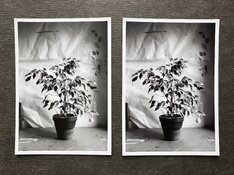
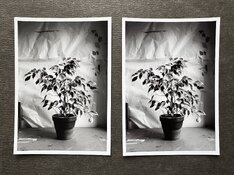
IMG_6554.jpegIMG_6553.jpegIMG_6552.jpeg

..you can't really see the difference between the three finishes well in those pics - posting them here to show that, to my eyes, all three tone very much the same 🙃


And here's the same negative, printed on Ilford FB warmtone (bit of a skewed comparison I know, alas the warmtone is the only fiber based paper I have right now).
Also in KRST 1:19 for 5 mins -
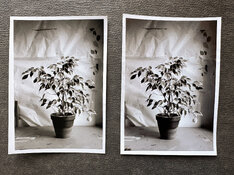
IMG_6572.jpg

Pardon the wonky borders (and wonky prints in general), but those are literally my first FB prints ever, and I'm having a hell of a time having the (badly curved) paper lay flat in my easel (and of course dry flat) 😀 ..more to the point though - you can see that the selenium toning is comparable to that of the RC paper, in regards to color shift and dmax increase.

As a sidenote the FB was printed with exactly double the time, and half a grade higher than the RC (so 7 seconds with a MG3 filter, instead of 3.5s with a 2.5)

 
Last edited:
I think they're lovely!
the selenium toning is comparable to that of the RC paper, in regards to color shift and dmax increase.
It might be the image or it might be that I'm more sensitive to what selenium toner does, but I see a distinct difference between the warmtone print that's selenium-toned, and the RC prints with the same toning. The warmtone has toned considerably more, which is also to be expected.
 
Photrio.com contains affiliate links to products. We may receive a commission for purchases made through these links.
To read our full affiliate disclosure statement please click Here.

PHOTRIO PARTNERS EQUALLY FUNDING OUR COMMUNITY:


Ilford ADOX Freestyle Photographic Stearman Press Weldon Color Lab Blue Moon Camera & Machine
Top Bottom