• Welcome to Photrio!
    Registration is fast and free. Join today to unlock search, see fewer ads, and access all forum features.
    Click here to sign up

The Fish Gelatin process - first CMYK prints

Recent Classifieds

Forum statistics

Threads
202,256
Messages
2,838,007
Members
101,228
Latest member
xlq
Recent bookmarks
0

bernard_L

Member
Allowing Ads
Joined
Feb 17, 2008
Messages
2,150
Format
Multi Format
My second fish gelatin print:
View attachment 399210

Summer Memories​
The technical discussion is above my head.
But. While this image definitely does not have true colors, I like them a lot. Something between Technicolor and soviet-era color magazines.
Congratulations. Hope you can reproduce the exact process leading to this.
 

PGum

Subscriber
Joined
Mar 26, 2009
Messages
69
Location
Toronto
Format
Multi Format
Would a FAC substitute like the one used in Mike Ware's Simple Cyanotype be useful in processes such as this? The substitute has some Ammonium Nitrate in it though.

I believe I did apply Ware’s SC formula to FG/CHIBA as I did make some up a few years back, but no notes. The difference must not have been too great however! It might be different for you as all things alt often are!
 

joho

Member
Allowing Ads
Joined
May 13, 2011
Messages
226
Format
Large Format
Color wise my trials more classic with out PS

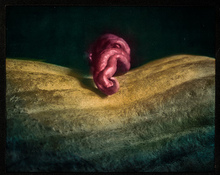
Here is work experimental, from an exhibition MHDEN AGAN it is PS-[free] based on a monotype - Lithographic [type] process.
1a is a bromo-oil
1aa based on a monotype - Lithographic [type] process

ooops typo...on photo [exhibition]
 

Attachments

  • From exhebition MHDEN-AGAN_phosgraphy__1a.JPG
    From exhebition MHDEN-AGAN_phosgraphy__1a.JPG
    82.7 KB · Views: 105
  • From exhebition MHDEN-AGAN_phosgraphy__1aa.JPG
    From exhebition MHDEN-AGAN_phosgraphy__1aa.JPG
    204.5 KB · Views: 95

Carnie Bob

Member
Allowing Ads
Joined
Nov 5, 2023
Messages
489
Location
Toronto , Ont Canada
Format
4x5 Format
Bob, wouldn't the dichromate in the gum layer harm the silver? Are you going to gold tone the POP print before the gum layer?

thanks for this observation - at this point I have had no issues with the AD harming the Pd layer or Cyanotype layer, I will watch out for this possible problem, are you suggesting that
the AD would hurt, I have not done this yet btw.
I have seen hand coloured with pigment over salt prints which are magnificant, but not sure how a silver layer on paper will react to the AD component in my multiple gum overs.
I can do commercial bw matt print and try putting gum over top , this would be critical for me to understand before I go down the wormhole of gum over silver.
 

Raghu Kuvempunagar

Member
Allowing Ads
Joined
Jul 28, 2016
Messages
3,163
Location
India
Format
Multi Format
thanks for this observation - at this point I have had no issues with the AD harming the Pd layer or Cyanotype layer, I will watch out for this possible problem, are you suggesting that
the AD would hurt, I have not done this yet btw.
I have seen hand coloured with pigment over salt prints which are magnificant, but not sure how a silver layer on paper will react to the AD component in my multiple gum overs.
I can do commercial bw matt print and try putting gum over top , this would be critical for me to understand before I go down the wormhole of gum over silver.

Bob, Dichromate bleach is widely used in B&W reversal processing to remove all the metallic silver after the first development, something I am very familiar with. Dichromate is a strong oxidising agent and it oxidises metallic silver to soluble silver salt in acidic media. Hence, I was curious to know if dichromate in the gum layer wouldn't eat up some of the silver in the POP layer potentially in the highlights and if that is OK. Gold toning will obviously make the print more resistant to oxidation by Dichromate.
 

joho

Member
Allowing Ads
Joined
May 13, 2011
Messages
226
Format
Large Format
just a note Dichromate is not a bleach , it turns the black silver into charged negative ions - so one add or remove to reorder the developed silver compound.
as in to intensify development...
 

koraks

Moderator
Moderator
Joined
Nov 29, 2018
Messages
27,688
Location
Europe
Format
Multi Format
it turns the black silver into charged negative ions

That'd be something. Negative silver ions. I figure you could pretty well get a Nobel prize for that.
But more to the point - you're right that dichromate requires a strong acid in order to act as a bleach. We generally use hydrochloric acid to make a rehalogenating bleach (for intensification) or sulfuric acid to make a stripping bleach (no redevelopment possible).

I just did a very quick and small test, and the acidity of an aged gum bichromate solution is not enough to make dichromate into a silver bleach. A drop of 1% dichromate solution mixed with a drop of aged gum does nothing to a strip of developed silver film. I see no bleach action after a few minutes. So I would expect that gum over silver gelatin should work without bleaching the silver image.
 
OP
OP
Dan Pavel

Dan Pavel

Member
Joined
Sep 11, 2017
Messages
248
Location
Constanta, Romania
Format
Multi Format
But. While this image definitely does not have true colors, I like them a lot. Something between Technicolor and soviet-era color magazines.
Congratulations. Hope you can reproduce the exact process leading to this.
Color wise my trials more classic with out PS
How colors are reproduced is an interesting discussion. Due to the specific pigments and the particularities of the process I don't think that a perfect color reproduction is possible. However, if the process is carefully respected a certain intended look could be obtained with reasonable repeatability.
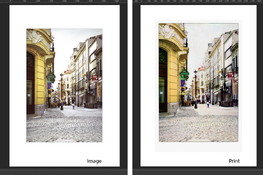
Here are screen captures of the intended image and of scans of the prints:

Bucuresti.jpgScara.jpg
 
Last edited:

bernard_L

Member
Allowing Ads
Joined
Feb 17, 2008
Messages
2,150
Format
Multi Format
For the first image, the print is remarkably (for such a custom process) similar to the source; maybe moire saturated colors.
For the second, the print has a character of its own: desaturated colors for the building, and a cyan shift for sea+sky; these two give it (IMO) its characteristic period look.

Curious to know how long it takes you to produce one print, not counting the initial R&D of the process.
 

Carnie Bob

Member
Allowing Ads
Joined
Nov 5, 2023
Messages
489
Location
Toronto , Ont Canada
Format
4x5 Format
That'd be something. Negative silver ions. I figure you could pretty well get a Nobel prize for that.
But more to the point - you're right that dichromate requires a strong acid in order to act as a bleach. We generally use hydrochloric acid to make a rehalogenating bleach (for intensification) or sulfuric acid to make a stripping bleach (no redevelopment possible).

I just did a very quick and small test, and the acidity of an aged gum bichromate solution is not enough to make dichromate into a silver bleach. A drop of 1% dichromate solution mixed with a drop of aged gum does nothing to a strip of developed silver film. I see no bleach action after a few minutes. So I would expect that gum over silver gelatin should work without bleaching the silver image.

Interesting ,
 

Carnie Bob

Member
Allowing Ads
Joined
Nov 5, 2023
Messages
489
Location
Toronto , Ont Canada
Format
4x5 Format
How colors are reproduced is an interesting discussion. Due to the specific pigments and the particularities of the process I don't think that a perfect color reproduction is possible. However, if the process is carefully respected a certain intended look could be obtained with reasonable repeatability.
Here are screen captures of the intended image and of scans of the prints:

View attachment 399442View attachment 399441

You are getting the same kind of results that I. see with gum over palladium and gum over cyanotype.
 
OP
OP
Dan Pavel

Dan Pavel

Member
Joined
Sep 11, 2017
Messages
248
Location
Constanta, Romania
Format
Multi Format
Curious to know how long it takes you to produce one print, not counting the initial R&D of the process.
It goes completely into water and developing solutions 9 times for 15-40 min. and it must completely dry after each immersion. Add to this 11 wet layers of emulsions that must, each of them, dry. Then add processing times, exposures times, time to make the emulsions and apply them and the result is a quite long time.
The paper must support such an aggression and therefore a thicker paper is used, with a longer drying time.

If I am lucky and everything goes as intended it takes me about a week to complete 1 print.
 
Last edited:
OP
OP
Dan Pavel

Dan Pavel

Member
Joined
Sep 11, 2017
Messages
248
Location
Constanta, Romania
Format
Multi Format
Someone on flickr have just offered to purchase the "Summer Memories" print. I make my prints out of pure passion and give them as presents to family and friends. I have no idea what would be a fair price to ask. I would be very grateful if you could advise me.
 

koraks

Moderator
Moderator
Joined
Nov 29, 2018
Messages
27,688
Location
Europe
Format
Multi Format
I have no idea what would be a fair price to ask.

If I am lucky and everything goes as intended it takes me about a week to complete 1 print.
Let's assume a 40-hour work week. Pick your hourly rate. Then add the R&D investment. Then add another margin for the sheer artistic value of a hand-crafted item. So north of $1k.
 

koraks

Moderator
Moderator
Joined
Nov 29, 2018
Messages
27,688
Location
Europe
Format
Multi Format
You're welcome. It's of course arbitrary, but what I wanted to do here is (1) create a first data point you could take into consideration and (2) hopefully stimulate you to avoid the trap of too much modesty. In reality, a cost-based approach to pricing is tricky and I doubt it really makes sense for art, so there's a massive pitfall there to begin with. If you value art on the basis of factorial cost, arguably you're not actually valuing it but in fact treating it as a commodity. So there's in my view a rather fundamental issue underlying your question - i.e. how you view your own work: as a craft, or as art. In case of the latter, the price setting may have to be based on entirely different lines of reasoning than my simplistic approach of "cost price plus". You may have to look instead at what other, comparable (go break your teeth on that one!) works of art sell for, what your standing as an artist are, how this particular work fits in your oeuvre, how that oeuvre has developed and is anticipated to develop, etc. etc. In the end, the potential price range would be quite massive, which automatically brings the question whether it's not entirely arbitrary to begin with. I think ultimately that's the case, and I would be tempted to consider a couple of possible price points and 'try them on for size', until you hit a number that seems to make sense to you.

Also: careful with hagglers.

 

Carnie Bob

Member
Allowing Ads
Joined
Nov 5, 2023
Messages
489
Location
Toronto , Ont Canada
Format
4x5 Format
You're welcome. It's of course arbitrary, but what I wanted to do here is (1) create a first data point you could take into consideration and (2) hopefully stimulate you to avoid the trap of too much modesty. In reality, a cost-based approach to pricing is tricky and I doubt it really makes sense for art, so there's a massive pitfall there to begin with. If you value art on the basis of factorial cost, arguably you're not actually valuing it but in fact treating it as a commodity. So there's in my view a rather fundamental issue underlying your question - i.e. how you view your own work: as a craft, or as art. In case of the latter, the price setting may have to be based on entirely different lines of reasoning than my simplistic approach of "cost price plus". You may have to look instead at what other, comparable (go break your teeth on that one!) works of art sell for, what your standing as an artist are, how this particular work fits in your oeuvre, how that oeuvre has developed and is anticipated to develop, etc. etc. In the end, the potential price range would be quite massive, which automatically brings the question whether it's not entirely arbitrary to begin with. I think ultimately that's the case, and I would be tempted to consider a couple of possible price points and 'try them on for size', until you hit a number that seems to make sense to you.

Also: careful with hagglers.
Probably the most asked questions of myself and my gallery, how much do I price my work. There are a lot of variables , as described.
 

Jon O'Ricky

Member
Joined
Feb 15, 2026
Messages
3
Location
N Kingstown RI/Swindon UK
Format
Multi Format
I have noticed a particularity of the RGB to CMYK conversion in PS: not all of a neutral tone is translated into the black channel and some of it is made of a mix C, M and Y. This has very little impact in the shadows and mid-tones of a print but makes the highlights very sensible to any tiny color misbalance. That's why I try now in PS to treat the highlights different in my new print and increase the K part of the highlights while decreasing the CMY part. But that's a work in progress...

To pick up on part of an old thread...
I was reading this as I prepare for a similar process using beef gelatine and was just reading the late Katherine Thayer's fascinating notes on gum dichromate printing. I live in the UK where environmental toxins are becoming sensibly shunned and harder to get, so a ferric gelatine process is more interesting than dichromate. She says, like you, that the photoshop CMYK conversion is flawed, and that it was designed for a particular print process and that a better method is inversion of RGB to negative, then splitting the channels. The negatives become Red>Cyan, G>Magenta and Blue > Yellow which gives a pure conversion. Maybe you've already established a sound method but maybe this information will help to simplify it?
 

imgprojts

Member
Allowing Ads
Joined
May 24, 2024
Messages
195
Location
Seattle WA
Format
Multi Format
To pick up on part of an old thread...
I was reading this as I prepare for a similar process using beef gelatine and was just reading the late Katherine Thayer's fascinating notes on gum dichromate printing. I live in the UK where environmental toxins are becoming sensibly shunned and harder to get, so a ferric gelatine process is more interesting than dichromate. She says, like you, that the photoshop CMYK conversion is flawed, and that it was designed for a particular print process and that a better method is inversion of RGB to negative, then splitting the channels. The negatives become Red>Cyan, G>Magenta and Blue > Yellow which gives a pure conversion. Maybe you've already established a sound method but maybe this information will help to simplify it?

Very much agreed, I was waiting for the Gimp3 release because it would work with CMYK. And when I was finally ready to make separations and started using it for CMYK I knew something was weird right away. The automatically separated channels don't seem to add to an RGB image. Then I tried inverting by color layer and that came up with a totally weird bug where the inversions were not even close to CMYK. Taking those color inversions and making gray negatives gave me very light shades. Then I tried Krita and got decent CMYK separations but I was still not fully convinced. However ImageJ with its klunky user interface was able to open my tiff files, separate to RGB, invert, then colorize the inverted colors to gray 16bit or higher. I opened a bug at Gimp and they promptly came back explaining how their CMYK separations were correct.

Since you bring up ferric gelatine, I'll mention that I've been looking to use vegan producs only. I've had some success with PVA as a gum substitute. However I've been thinking about gelatin substitutes. The best substitutes that I can find to try so far as Kappa Carrageenan and Iota Carrageenan. Both are seaweed extracted anionic polysaccharides meaning that they will interact with metal ions of various kinds. Someone already tested this for lamda carrageenan, but lamda doesnt gel, its more like gum. I think Iota is the way to go because it forms a flexible gel whereas kappa forms a gel but becomes brittle when dry. How about that? A naturally functionalized gel already available and ready to go for ferric sensitazion! Sounds like too good to be true, but i'll test it.

here is a comparison between gelatin, Agar and Carrageenan that might be interesting to look at


Both need to be heated to about 79 °C / 175 °F or higher to fully hydrate and they set at 40C. Iota melts at 45C to 50C while Kappa melts at 60 to 80C. Maybe a mix between the two would give the best results.
 
Last edited:

koraks

Moderator
Moderator
Joined
Nov 29, 2018
Messages
27,688
Location
Europe
Format
Multi Format
I'll mention that I've been looking to use vegan producs only.

The third one is probably the most interesting read.

She says, like you, that the photoshop CMYK conversion is flawed, and that it was designed for a particular print process
There's many ways to split an image into CMYK. The main issue is that many people who do color gum don't actually use a CMYK process, but instead work with a CMY process. This is a carry-over from the old days when you'd do separations from indeed RGB, optionally in-camera. With inkjet negatives, nothing stops you from doing actual CMYK and at that point it becomes a question of how you want to treat the K channel. There's a couple of ways to do this and it would be useful to read a very brief primer on the different concepts that touch this, e.g.:
AFAIK there are ways in Photoshop or otherwise elsewhere in the Adobe ecosystem to manage CMYK. The GIMP approach (through the 'Separate' plugin as GIMP has no native CMY/CMYK support) has always been a default setting with no control.

If you want to do some form of color management for digital negatives for a process like gum printing, hands-down the best read would be Calvin Grier's series on calibration: https://thewetprint.com/resources/ It's not free, but IMO it's well worth the modest investment.
 

Jon O'Ricky

Member
Joined
Feb 15, 2026
Messages
3
Location
N Kingstown RI/Swindon UK
Format
Multi Format
There's many ways to split an image into CMYK. The main issue is that many people who do color gum don't actually use a CMYK process,

Thank you greatly for all the links, it can be hard to track down good information on the process.
I haven't investigated all the options in Photoshop but I'm sure there are plenty and I haven't used Gimp in forever :smile:
There's many ways to split an image into CMYK. The main issue is that many people who do color gum don't actually use a CMYK process, but instead work with a CMY process. This is a carry-over from the old days when you'd do separations from indeed RGB, optionally in-camera. With inkjet negatives, nothing stops you from doing actual CMYK and at that point it becomes a question of how you want to treat the K channel.

If you want to do some form of color management for digital negatives for a process like gum printing, hands-down the best read would be Calvin Grier's series on calibration: https://thewetprint.com/resources/ It's not free, but IMO it's well worth the modest investment.

Thank you greatly for the references and recommendation on Calvin Grier. The process looks very flexible while being demanding so I need to figure out what I want to achieve with it. I thought I'd start with three or four layer once i get the process and calibrations sorted.
 

Jon O'Ricky

Member
Joined
Feb 15, 2026
Messages
3
Location
N Kingstown RI/Swindon UK
Format
Multi Format
Very much agreed, I was waiting for the Gimp3 release because it would work with CMYK. And when I was finally ready to make separations and started using it for CMYK I knew something was weird right away. The automatically separated channels don't seem to add to an RGB image. Then I tried inverting by color layer and that came up with a totally weird bug where the inversions were not even close to CMYK. Taking those color inversions and making gray negatives gave me very light shades. Then I tried Krita and got decent CMYK separations but I was still not fully convinced. However ImageJ with its klunky user interface was able to open my tiff files, separate to RGB, invert, then colorize the inverted colors to gray 16bit or higher. I opened a bug at Gimp and they promptly came back explaining how their CMYK separations were correct.

Since you bring up ferric gelatine, I'll mention that I've been looking to use vegan producs only. I've had some success with PVA as a gum substitute. However I've been thinking about gelatin substitutes. The best substitutes that I can find to try so far as Kappa Carrageenan and Iota Carrageenan. Both are seaweed extracted anionic polysaccharides meaning that they will interact with metal ions of various kinds. Someone already tested this for lamda carrageenan, but lamda doesnt gel, its more like gum. I think Iota is the way to go because it forms a flexible gel whereas kappa forms a gel but becomes brittle when dry. How about that? A naturally functionalized gel already available and ready to go for ferric sensitazion! Sounds like too good to be true, but i'll test it.

here is a comparison between gelatin, Agar and Carrageenan that might be interesting to look at


Both need to be heated to about 79 °C / 175 °F or higher to fully hydrate and they set at 40C. Iota melts at 45C to 50C while Kappa melts at 60 to 80C. Maybe a mix between the two would give the best results.

Have you seen Habib Saidane's Gum arabic/CMC video? I don't know how good it is but I had a brief try with it and while it did work, it's tricky getting the CMC properly broken up. I also wonder why the CMC is needed as gum alone works well with dichromate.
 

imgprojts

Member
Allowing Ads
Joined
May 24, 2024
Messages
195
Location
Seattle WA
Format
Multi Format
Have you seen Habib Saidane's Gum arabic/CMC video? I don't know how good it is but I

Yeah I've been experimenting with all sorts of combinations. FAC+CMC is OK but FAO+PVA is so much better. Both CMC and PVA alone or combined seem to work as basecoating and clear layer between colors. Without the coating in between layers I get muddied and stained white. The whole PVA thing has been narrowing down to a super simple formula: ~20%FAO based on the rest of the solids. So if you have 10g of PVA add .2g of FAO ferric ammonium oxalate sensitizer. the pigment amount is usually very tiny anyway. I'm using PVA 4488, 44 is viscosity 44 mPa·s and 88 is hydrolysis %. I think other PVAs should work too. I'm just a beginner printer and haven't had much luck in a good show level print :smile: but at the hands of an expert maybe this can be taken much further. FAO is a consistent molecule and PVA too given the number 4488 or whatever, so there could be less guessing overall for beginners. the formula works great at just making a cyanotype: https://vid.northbound.online/w/m1p71dHukvwU1Hdcw6ShDk it makes it super simple to clear without any additional chemicals past a quick spray or bath in room temp hydrogen peroxide. in fact there is no heating required or wanted as in Habib's because if you heat PVA in citric acid it esterizes and hardens (which puzzled me for weeks and months). The SBQ process looks great though, but I've been invested in just ferric since it seems to work OK and its simple and cheap. I can't even find a decent size SBQ bottle, its always a tiny vial sized micro bottle for $$$$.
 

cliveh

Subscriber
Allowing Ads
Joined
Oct 9, 2010
Messages
7,833
Format
35mm RF
I have never heard of a fish gelatin process, but about an hour ago I had a meal of smoked Haddok that had exactly the same colour of the stone building in the left of your picture. If you used octopus, would it have the same colour as their ink?
 

Raghu Kuvempunagar

Member
Allowing Ads
Joined
Jul 28, 2016
Messages
3,163
Location
India
Format
Multi Format
I believe I did apply Ware’s SC formula to FG/CHIBA as I did make some up a few years back, but no notes. The difference must not have been too great however! It might be different for you as all things alt often are!

Thanks! I'll give it a try when I get a chance. I somehow missed reading this the last time.
 
Photrio.com contains affiliate links to products. We may receive a commission for purchases made through these links.
To read our full affiliate disclosure statement please click Here.

PHOTRIO PARTNERS EQUALLY FUNDING OUR COMMUNITY:


Ilford ADOX Freestyle Photographic Stearman Press Weldon Color Lab Blue Moon Camera & Machine
Top Bottom