
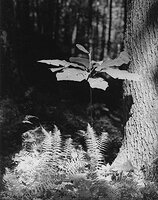
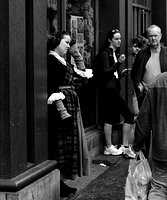
Most of my experimentation has been inspired by Habib Saidane with his various videos on CMC+Gum. But I actually started all this from the work of Halvor BJORNGARD and Hiroyuki KOBAYASHI. They published 3 papers that I know of detailing the Chiba system. I'm going to call this thing PVA-Chiba. PVA here is Polyvinyl Alcohol, not Acetate. I think it needs a name so others can refer to it.
I found gum arabic to be maybe conflictuos because its based on a specific type of tree thats in momoculture at a specific country mostly. That didn't ring well with me. But when I saw how clear and useful CMC was, and how cheap is it to make, i decided to figure out away to base a chiba variant on that. Thats how I landed at the videos from Habib. Well this morning I started thinking about all this and how long my exposures were compared to New Cyanotype. 15minutes per is actually not bad at all. But ok I got some todbits...
Due to the lack of a good way to measure power absoroption by the chemical I started just observing what I could.
1) CMC and PVA are practically transparent to UV. If you place a uv lamp over a piece of thin glass over a fluotescent screen, the sheet will glow. Placing a drop or coating of PVA or CMC on the glass seems to give the same level of glow at the screen. Surpricingly tge very yellow Rivoflabin RF also seems to be mostly transparent. RF reduces light just slightly when in the mixture. It itself glows.
2)TEOA and FAC and FAO all 3 absorb UV strongly and make a shadow on the screen.
I was able to successfully harden PVA using the RF+TEOA system as well as by adding EMA and also by just adding miniscule amounts of 3D printing resin to just PVA. Similarly I sucessfully hardened PVA using the simple ferric salt inhibition method. Ferric and boric Inhibition is very interesting by the way. The way those are supposed to work is by mixing a complex salt like FAC or FAO into a hardenable binder like PVA. Once mixed you add either boric acid or Ferric Cloride. When you expose either of these mixes, the UV distroys or changes the complex salt FAC or FAO, which then lets the simple boric or ferric salt polymerize PVA by reduction to ferrous. I think inhibition is more sensitive but it may be another year or fumbling chrmicals in bathroom sink.
Once I found that PVA is hardenable and available in pure form on amazon, non toxic and non conflict, it just made sense to try. In my Chiba PVA recipe I ended up reducing the CMC to a bare minimum. I went with 5% PVA and 2% CMC. I use 2 parts PVA and 1 part CMC to 1 part FAO and 1 part or variable color. Thats a super simple formula that my old brain can remember.
Anyway going back to the Chiba papers They recomend a 0.5 ratio by dry weight of FAC to Gelatine or binder. So im realizing that im using way too much ferric ammonium oxalate. I'm going to dilute some and see how much is needed to make the emulsion completely opaque to UV. According to the paper, less sensitizer will allow deeper penetration but will result in a weaker cure. So that makes sense.
I think that's a good thing to mess around with today on my end of year minication.
Oh and again, both CMC and PVA are super cheap. The only problem is mixing the 2%CMC and 5%PVA. The two compounds will fight you tooth and nail. The best way to get these two things to mix is as follows: Add a known quantity of water to a jar, get the corresponding powder amount in a small container. Pour some of the measured water into a mixing container and slowly add the powder into it. Mix, add more, mix, add more. Eventually its thick like frozen honey. Now add water and mix until you added all the water. This, for a 300 to 500ml jar size takes a good hour and you still end up with a ton of undissolved powder. Keep your sanity. Put it in the microwave until it begins to boil. Be absolutely sure to not spill this stuff in your microwave or you will loose your freaking mind. Then add a spoon full of sodium benzoate to prevent mold, screw the lid and walk away for a day or a week. Just dont think about it. When you come back you'll have perfectly clear solutions to use. Even in very thick solutions the air bubbles out. Heating helps that. If you dont add a preservative it will mold up within a week or two. With sodium benzoate (which is also very cheap) it will probably last more than a year. My original CMC is still clear and I just barely finished my first PVA bottle.
I found gum arabic to be maybe conflictuos because its based on a specific type of tree thats in momoculture at a specific country mostly. That didn't ring well with me. But when I saw how clear and useful CMC was, and how cheap is it to make, i decided to figure out away to base a chiba variant on that. Thats how I landed at the videos from Habib. Well this morning I started thinking about all this and how long my exposures were compared to New Cyanotype. 15minutes per is actually not bad at all. But ok I got some todbits...
Due to the lack of a good way to measure power absoroption by the chemical I started just observing what I could.
1) CMC and PVA are practically transparent to UV. If you place a uv lamp over a piece of thin glass over a fluotescent screen, the sheet will glow. Placing a drop or coating of PVA or CMC on the glass seems to give the same level of glow at the screen. Surpricingly tge very yellow Rivoflabin RF also seems to be mostly transparent. RF reduces light just slightly when in the mixture. It itself glows.
2)TEOA and FAC and FAO all 3 absorb UV strongly and make a shadow on the screen.
I was able to successfully harden PVA using the RF+TEOA system as well as by adding EMA and also by just adding miniscule amounts of 3D printing resin to just PVA. Similarly I sucessfully hardened PVA using the simple ferric salt inhibition method. Ferric and boric Inhibition is very interesting by the way. The way those are supposed to work is by mixing a complex salt like FAC or FAO into a hardenable binder like PVA. Once mixed you add either boric acid or Ferric Cloride. When you expose either of these mixes, the UV distroys or changes the complex salt FAC or FAO, which then lets the simple boric or ferric salt polymerize PVA by reduction to ferrous. I think inhibition is more sensitive but it may be another year or fumbling chrmicals in bathroom sink.
Once I found that PVA is hardenable and available in pure form on amazon, non toxic and non conflict, it just made sense to try. In my Chiba PVA recipe I ended up reducing the CMC to a bare minimum. I went with 5% PVA and 2% CMC. I use 2 parts PVA and 1 part CMC to 1 part FAO and 1 part or variable color. Thats a super simple formula that my old brain can remember.
Anyway going back to the Chiba papers They recomend a 0.5 ratio by dry weight of FAC to Gelatine or binder. So im realizing that im using way too much ferric ammonium oxalate. I'm going to dilute some and see how much is needed to make the emulsion completely opaque to UV. According to the paper, less sensitizer will allow deeper penetration but will result in a weaker cure. So that makes sense.
I think that's a good thing to mess around with today on my end of year minication.
Oh and again, both CMC and PVA are super cheap. The only problem is mixing the 2%CMC and 5%PVA. The two compounds will fight you tooth and nail. The best way to get these two things to mix is as follows: Add a known quantity of water to a jar, get the corresponding powder amount in a small container. Pour some of the measured water into a mixing container and slowly add the powder into it. Mix, add more, mix, add more. Eventually its thick like frozen honey. Now add water and mix until you added all the water. This, for a 300 to 500ml jar size takes a good hour and you still end up with a ton of undissolved powder. Keep your sanity. Put it in the microwave until it begins to boil. Be absolutely sure to not spill this stuff in your microwave or you will loose your freaking mind. Then add a spoon full of sodium benzoate to prevent mold, screw the lid and walk away for a day or a week. Just dont think about it. When you come back you'll have perfectly clear solutions to use. Even in very thick solutions the air bubbles out. Heating helps that. If you dont add a preservative it will mold up within a week or two. With sodium benzoate (which is also very cheap) it will probably last more than a year. My original CMC is still clear and I just barely finished my first PVA bottle.


