
-
Welcome to Photrio!Registration is fast and free. Join today to unlock search, see fewer ads, and access all forum features.Click here to sign up
You are using an out of date browser. It may not display this or other websites correctly.
You should upgrade or use an alternative browser.
You should upgrade or use an alternative browser.
Same film, same developer, very different results?
-
A
- Thread starter Evan_Mathis
- Start date


Recent Classifieds
-
For Sale Fuji GW670 III
- Started by campy51
-
For Sale Hasselblad X Pan w/ 45mm/f4 Lens
- Started by eftones
-
For Sale 6 antique French pneumatic shutters _ Guerry
- Started by Manual Camera
-
For Sale Voigtländer Nokton Classic 35mm/1.4 with Leica M-mount
- Started by Klaus Mähring
-
For Sale Voigtländer Bessa R2 Special Edition Olive Green
- Started by Klaus Mähring
Forum statistics

julio1fer
Member
Maybe you already said it before, but I am a bit confused. You did meter at ISO 100 with both cameras. Did you also get the exact same aperture and shutter speed in both cameras?
OP
OP

Evan_Mathis
Member
Maybe you already said it before, but I am a bit confused. You did meter at ISO 100 with both cameras. Did you also get the exact same aperture and shutter speed in both cameras?
that's a super valid question and the answer is no... I meter normal with aperture priority targeting +5 from the smallest fstop because I find aperture to be more reliable than shutter speed. then i work my way up to +4 from normal by increasing shutter speed once i hit the widest aperture.
For the 50mm Sekor C it tops out at f32, going to 4.5 so I'm metering for normal at f5.6
For the Voightlander, it only goes to f22, so I'm metering for normal at f4.

It's using a 10 stop wedge starting with B+F then -4 to +5 reading an 18% grey card.
I meant is it getting its results from a spot of the negative or an overall take on the negative.
I don't see a 3-4 stop difference between the negatives you showed.
PyrocatHD is a bit too compensating to be a good choice for a testing developer. It's very difficult to overdevelop with it.

Correct me if I'm wrong .....
@Evan_Mathis is exposing film to a number of different light levels and then developing that film.
After that, @Evan_Mathis is measuring film densities and plotting the results.
After that @Evan_Mathis is analyzing the plotted result and, based on the analysis, coming to a conclusion about what EI to use going forward to obtain a desired result.
@Evan_Mathis is exposing film to a number of different light levels and then developing that film.
After that, @Evan_Mathis is measuring film densities and plotting the results.
After that @Evan_Mathis is analyzing the plotted result and, based on the analysis, coming to a conclusion about what EI to use going forward to obtain a desired result.
pentaxuser
Member
I think he's talking about the EI based on his interpretation of the results, not the speed the film was shot at. It would be pretty hard to purposely shoot film at an odd EI like 91 or 27 anyway.
OK but I wonder how one can even decide that the negatives look like they were shot at such strange numbers?
pentaxuser
OP
OP
Evan_Mathis
Member
I meant is it getting its results from a spot of the negative or an overall take on the negative.
I don't see a 3-4 stop difference between the negatives you showed.
PyrocatHD is a bit too compensating to be a good choice for a testing developer. It's very difficult to overdevelop with it.
I'm metering and taking the densitometer reading from the center of the grey card.
I can show you the whole strip of negatives... there's no information on the first 3 exposures of the 120 Acros wedge test. I'm only starting to get information at what should be zone 4.
OP
OP
Evan_Mathis
Member
Also, an RB67 was used with a 50mm lens to take rather close images of whatever that is in the 120 film. The bellows would be extended enough to need compensation.
yeah at the focal rage i was at i normally compensate about 1/2 stop, which would have been expected.
I'm going to run the next batch with a bigger grey card to take that variable away.
OP
OP
Evan_Mathis
Member
Correct me if I'm wrong .....
@Evan_Mathis is exposing film to a number of different light levels and then developing that film.
After that, @Evan_Mathis is measuring film densities and plotting the results.
After that @Evan_Mathis is analyzing the plotted result and, based on the analysis, coming to a conclusion about what EI to use going forward to obtain a desired result.
This is what I'm doing. I'm also testing the logging and charting app that I've got in beta so that I can compare different combinations of film, developer and processing to document their effects on the negative characteristics.
julio1fer
Member
that's a super valid question and the answer is no... I meter normal with aperture priority targeting +5 from the smallest fstop because I find aperture to be more reliable than shutter speed. then i work my way up to +4 from normal by increasing shutter speed once i hit the widest aperture.
For the 50mm Sekor C it tops out at f32, going to 4.5 so I'm metering for normal at f5.6
For the Voightlander, it only goes to f22, so I'm metering for normal at f4.
My guess is that from some unknown reason you got an incorrect exposure in the 35mm camera. That would explain the “strange“ density curve. At first sight I would discard film issues.

Stephen Benskin
Member
The rollercoaster of a film curve can't be from the film or development. There an issue with the exposure data. For the tests to mean anything, the data has to be reliable.
Last edited:
OP
OP
Evan_Mathis
Member
The rollercoaster of a film curve can't be from the film or development. There an issue with the exposure data. For the results to mean anything, the data has to be reliable.
Ha, you're absolutely right, and I think I've found the issue: there was a bit of packing styrofoam on the underside of the densitometer reader lens. I was trying to figure out why my readings were so inconsistent. I discovered it when I went to read the calibration wedge that came with it, and * that * was inconsistent and checked the underside of the reader and there it was.
Stephen Benskin
Member
Ha, you're absolutely right, and I think I've found the issue: there was a bit of packing styrofoam on the underside of the densitometer reader lens. I was trying to figure out why my readings were so inconsistent. I discovered it when I went to read the calibration wedge that came with it, and * that * was inconsistent and checked the underside of the reader and there it was.
View attachment 416291
I'm interested in seeing the revised curves.
OP
OP
Evan_Mathis
Member
I went and re-read all of the previous grey card exposures shown before. it seems like the 35mm was affected more, probably because of how small the grey card is in the neg. Note to self to use a larger grey card for the next tests, as I think that's having some affect because the border on the card might be tripping up the densitometer reading. The only 120 here is the yellow graph line, the one that's really under exposed with an EI of 27

OP
OP
Evan_Mathis
Member
For reference you can see here how close the grey card is to the reader on the densitomoeter, because that's as close as the 40mm Nokton can get and stay in focus with a 4x6 Calibrite grey card.
I literally just picked up a 35mm to be able to do these sorts of comparisons so there are still some bugs on that side my process.
The app actually works really well, but I'm still working out the inputs. I'm sharing here and willing to take the heat on things that I;m still working out, so thank you all.

I literally just picked up a 35mm to be able to do these sorts of comparisons so there are still some bugs on that side my process.
The app actually works really well, but I'm still working out the inputs. I'm sharing here and willing to take the heat on things that I;m still working out, so thank you all.
mshchem
Subscriber
You know that this is supposed to be fun, right?
mshchem
Subscriber
Paint a wall 18% reflectance, color is your choice 

foc
Subscriber
For reference you can see here how close the grey card is to the reader on the densitomoeter, because that's as close as the 40mm Nokton can get and stay in focus with a 4x6 Calibrite grey card.
I literally just picked up a 35mm to be able to do these sorts of comparisons so there are still some bugs on that side my process.
The app actually works really well, but I'm still working out the inputs. I'm sharing here and willing to take the heat on things that I;m still working out, so thank you all.
View attachment 416293
Just out of interest, when reading the negative on the densitometer, is the emulsion facing away or towards the reading sensor?
OP
OP
Evan_Mathis
Member
Just out of interest, when reading the negative on the densitometer, is the emulsion facing away or towards the reading sensor?
The manufacturer recommends emulsion toward the sensor, so that's what I do.
OP
OP
Evan_Mathis
Member
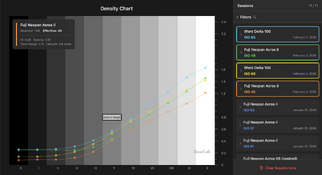
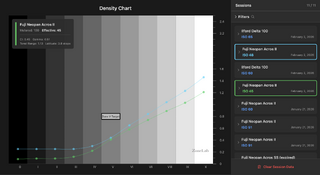
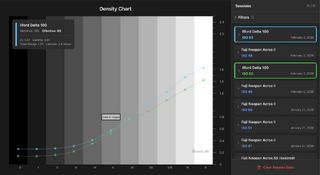
OK an update. A larger grey card made a big difference.
A couple of quick notes: I did process all of these together in the same tank for the same length of time.
The Massive Dev Chart recommends18min for Acros II, and 16min for Delta 100 in PyrocatHD when shot at box, which accounts for the slightly higher EI on the Delta 100.
This is a fresh batch of Pyrocat mixed 2 weeks ago in Glycol, so the strength should be fine.
The difference in CI and Gamma are likely because the 40mm Voightlander Nokton 1.2 is a higher contrast lens by nature than the 127mm Sekor C (I wanted to have a closer comparison in focal length for this follow up) and that's reflected in the CI and Gamma.
But, I'm still (much more consistently) 1 stop under on both, and with a very flat toe, so I might be under developing by about 30%.
That's what this whole process is for tho...
The first image below is all of the films together. The second is just the Acros on both the Mamiya RB (green) and the Leica (blue) the third is the Delta 100 on the Mamiya (green) and the Leica (blue)
A couple of quick notes: I did process all of these together in the same tank for the same length of time.
The Massive Dev Chart recommends18min for Acros II, and 16min for Delta 100 in PyrocatHD when shot at box, which accounts for the slightly higher EI on the Delta 100.
This is a fresh batch of Pyrocat mixed 2 weeks ago in Glycol, so the strength should be fine.
The difference in CI and Gamma are likely because the 40mm Voightlander Nokton 1.2 is a higher contrast lens by nature than the 127mm Sekor C (I wanted to have a closer comparison in focal length for this follow up) and that's reflected in the CI and Gamma.
But, I'm still (much more consistently) 1 stop under on both, and with a very flat toe, so I might be under developing by about 30%.
That's what this whole process is for tho...
The first image below is all of the films together. The second is just the Acros on both the Mamiya RB (green) and the Leica (blue) the third is the Delta 100 on the Mamiya (green) and the Leica (blue)
Attachments
OP
OP
Evan_Mathis
Member
Next version will be a comparison to a more bog standard developer, probably D76
| Photrio.com contains affiliate links to products. We may receive a commission for purchases made through these links. To read our full affiliate disclosure statement please click Here. |
PHOTRIO PARTNERS EQUALLY FUNDING OUR COMMUNITY:  |