• Welcome to Photrio!
    Registration is fast and free. Join today to unlock search, see fewer ads, and access all forum features.
    Click here to sign up

Red filter in enlarger throwing off sharpness

Greens

A
Greens

  • 6
  • 1
  • 37
Cyanotype stereo card

A
Cyanotype stereo card

  • 2
  • 0
  • 43

Forum statistics

Threads
203,134
Messages
2,850,366
Members
101,691
Latest member
Kajo
Recent bookmarks
0
I have a durst m301 and I noticed I can focus sharply with the red filter in place and it'll be tack sharp under the grain focuser... But when I move the red filter away I'll have to refocus to get it sharp on the paper...

Has anybody ran into this problem as well??? I think I'll just focus without a red filter on a piece of paper that will be the "sacrificial lamb" then turn off the lamp and switching out the paper then expose it... Any other suggestions??
**********
Just focus normally on a junk piece of the paper you are using.
 
I had a Wild autofocus enlarger which I used for many years. The lens has such a small C of C that you had to adjust the plane of focus to compensate for paper thickness. FB paper you could expose wet (and flat) if the vacuum easel would not pull it down.
 
thanks guys.. this was my very first time printing... i was disappointed in the sharpness... but i think the second go around will be money!!!... now i just gotta find time to set up my darkroom again and do more prints!!
 
I never used the filter.

I took one piece of paper and developed it without exposing it. I put it on my easel and traced the outline of the image area with a Sharpie marker. I did that for each of the favorite print sizes that I like to make.

So, now, when I want to make a print I can put that piece of paper on the easel and quickly move the blades to the size I want and I don't have to fuss. Then I can focus on that same piece of paper. The ink outlines also help me be sure I am composing to the print size I want. If my easel blades aren't set right it will show up immediately, even in the dark.

When I am ready, I put my special piece of paper away then get out a fresh piece to make my print with.

BTW: My Saunders easel is all black so I need something to focus on or I can't see the image.
***********
Paint the easel.
 
I can see the difference in the grain focuser between having the paper under the grain focuser and not, and that's enough to convince me that given all the trouble we go to to avoid other very slight errors and sources of image degradation, like the difference between using an APO lens and an otherwise adequate modern 6-element lens, or choosing one film developer over another, or the possibility (suggested by Ctein in Post-Exposure if I remember correctly) that multigrade paper tends to be slightly less sharp than graded paper perhaps due to the difference in the spectral sensitivity of the paper depending on the contrast grade and that of human vision, that there is no reason to introduce an easily avoidable source of error by focusing without a focus sheet under the grain focuser.

************
I agree. But, then, I've always done it that way. A variable (no matter how small) is eliminated. And easily.
 
While I very much respect Ralph et al, I completely agree with David and John. Perhaps we're just being anal but I always try to eliminate every variable possible and this is one case where it doesn't cost anything to be precise.
Now to the subject of focusing; I just bought a Magnasight image focuser and am absolutely stunned to find that after carefully focusing with the Magnasight, when I double check with my 25X grain focuser, nine times out of ten the focus was spot on and the tenth was so close as to be almost negligible and the focuser is so convenient to use when making large prints that I could kick myself for waiting so long to buy one. The pain from that old rotater cuff injury is now a thing of the past and I am no longer even considering the electric focuser for my 45VXL or my 23CllXL. "Too soon old, too late smart"
Denise Libby
 
Placing a piece of paper under the grain focuser to compensate for the missing paper thickness is theoretically correct

I'm not sure if this is true. If I were making grain focusers I would build them so they were already compensated for the average paper thickness.

I always focus with a scrap piece of paper under the grain focuser. Why bother with something that has the precision of a grain focuser and not compensate for the thickness of the paper?

As above.... If the manufacturer has already compensated for the paper you may be making it worse, not better.

This subject comes up regularly but no one hase ever managed to state what any of the grain focuser instruction leaflets say (I bought mine second hand without instructions).

In the same section of Gene Nocon's book where he writes about viewing through a blue filter, he also suggests not wasting paper by putting it under the focuser. He is a much better darkroom printer than I will ever be so I took his advice.


Styeve.
 
The red filter isn't for focusing!...

Correct.

...You should focus using the light that will be used for making the enlargement - including any variable contrast filters that you want to use...

You should focus without filters, any filters, not even VC filters. Focus without VC filters and bring them back into the light path for the exposure. Patrick Gainer published a nice article where he proved that the mistake made this way is significant smaller than the chromatic aberration of the eyes, cause by VC filters.
 
BIZARRE. I NEVER heard that before... nor noticed it (which isn't to say that it's not happening)... interesting...

Sparky

No need to worry, all papers have sharpness and resolution way beyond the capabilities of our eyes to see the difference.
 
I'm not sure if this is true. If I were making grain focusers I would build them so they were already compensated for the average paper thickness.


As above.... If the manufacturer has already compensated for the paper you may be making it worse, not better.

This subject comes up regularly but no one hase ever managed to state what any of the grain focuser instruction leaflets say (I bought mine second hand without instructions).

In the same section of Gene Nocon's book where he writes about viewing through a blue filter, he also suggests not wasting paper by putting it under the focuser. He is a much better darkroom printer than I will ever be so I took his advice.


Styeve.


Steve

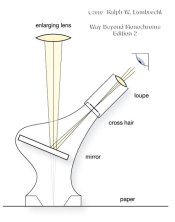
Manufacturers of focusing aids make no assumption about unknown paper or whatever thicknesses. The focus plane is always the bottom of your focusing aid. Whatever you set the focusing aid down on, that's the focusing plane. Please, see the file attached.
 

Attachments

  • FocusingAid.jpg
    FocusingAid.jpg
    30.2 KB · Views: 152
We don't like it when facts get in the way of our opinions.

I think you'd be pretty hard pressed to distinguish one from the other. Opinions become facts only when you respect the apparent authority. And that's a fact.
 
Manufacturers of focusing aids make no assumption about unknown paper or whatever thicknesses. The focus plane is always the bottom of your focusing aid. Whatever you set the focusing aid down on, that's the focusing plane. Please, see the file attached.

That's fair enough but I have never seen any data from a manufacturer to back this up. If we knew for sure one way or another our opinions could become fact (or fiction!).


Steve.
 
I have used the "Blue Filter" as suggested by Gene Nocon in his book - found it was actually easier to focus when I had it fitted on my old focus finder, but didn't replace when I bought my Omega.

I usually focus wide open with white light and then stop down to my selected f-stop. Sometimes I'll re-check the focus, but more foten than not I don't bother.

Never focussed with the red filter in place - only use that if I need to recheck where I need to burn or doge, otherwise it's out of the way.
 
As facts go, DOF tables are a bit squishy, since they may only be calculated on the basis of subjective assumptions about acceptable sharpness, which rely on further assumptions about viewing distance, normal human vision, the resolution of the film/paper, etc. When the DOF scale on my lens tells me that everything I want to be in focus will be acceptably sharp at f:8, chances are I'll really need f:11 for f:16 for it to look acceptably sharp to me.

Maybe I'm a bit unsure as to how one calculates DOF for an enlarger, since the print isn't going to be enlarged beyond its own size, and the DOF formulas used for camera lenses depend on assumptions about the enlargement of the negative. I've noticed that the CoC values in Ralph's table are the same as those normally used for computing DOF for camera lenses, but I'm not sure this makes sense for enlarging. The implications are that an 8x10" print from a 35mm neg needs to be sharper than an 8x10" print from a 4x5" negative, and that an acceptably sharp 8x10" print should have the same resolution as an acceptably sharp 16x20" print. It may not even make sense to call the depth on the paper side "Depth of Field," if we regard an enlarger as a camera that makes an image of the negative (arguably the "field" side) on the paper (arguably the "focus" side), but that's a matter of semantics and convention, because I think we agree on the geometry. It would seem to me that the value for acceptable circle of confusion when computing DOF for enlarging should be based on the print size rather than the negative size.

Even if we accept this table, what does it mean to say that the DOF for a 35mm negative projected to 16x20" at f:4 is 53mm? Do I really believe that I could focus the negative with a grain focuser, and then put a book that was about an inch thick under the easel, and the print would be acceptably sharp? Perhaps it would be within the resolution of the paper at normal viewing distances for 16x20" prints, but I don't believe that I couldn't tell the difference with a grain focuser, and possibly by looking at the print at closer than normal viewing distances.

I've certainly used the DOF at the enlarging easel to correct converging lines by tilting the easel and stopping the lens down with an enlarger that doesn't allow for Scheimpflug correction, but even then I see it as a tradeoff, where I'm sacrificing a little sharpness for the sake of the overall composition.

 
That's fair enough but I have never seen any data from a manufacturer to back this up. If we knew for sure one way or another our opinions could become fact (or fiction!).


Steve.

Steve

Ask the person who made the claim that the paper is included to prove it to you.
 
I think you'd be pretty hard pressed to distinguish one from the other. Opinions become facts only when you respect the apparent authority. And that's a fact.

I use mathematics, which is one of the 'authorities' I respect.
 
Maybe I'm a bit unsure as to how one calculates DOF for an enlarger, since the print isn't going to be enlarged beyond its own size, and the DOF formulas used for camera lenses depend on assumptions about the enlargement of the negative.

I'm not sure either but I would work on the principle of the enlarger being a macro camera with the projected negative as the subject and the paper in place of the film with an image size greater than the subject size.


Steve.
 
Ask the person who made the claim that the paper is included to prove it to you.

No one made that claim, it's just an assumption. People also assume it isn't included but I have seen no facts to back up either assumption.


Steve.
 
No one made that claim, it's just an assumption. People also assume it isn't included but I have seen no facts to back up either assumption.


Steve.

Paper thickness is not a constant value, so it would be impossible to compensate for it in the design of the grain focuser without adding a separate calibration adjustment for it.
 
Photrio.com contains affiliate links to products. We may receive a commission for purchases made through these links.
To read our full affiliate disclosure statement please click Here.

PHOTRIO PARTNERS EQUALLY FUNDING OUR COMMUNITY:


Ilford ADOX Freestyle Photographic Stearman Press Weldon Color Lab Blue Moon Camera & Machine
Top Bottom