• Welcome to Photrio!
    Registration is fast and free. Join today to unlock search, see fewer ads, and access all forum features.
    Click here to sign up

Pushing Ektachrome

Forum statistics

Threads
203,116
Messages
2,849,992
Members
101,676
Latest member
stasney
Recent bookmarks
0

loccdor

Subscriber
Joined
Jan 12, 2024
Messages
3,367
Location
USA
Format
Multi Format
As variety in slide films gets harder to find, has anyone tried pushing the new Ektachrome E100 a stop or two? What sort of results can you expect? I've heard E-6 is a little better for pushes than C-41.

Thank you
 
I have no experience with pushed Ektachrome, but with Velvia 50. The contrast will increase. The tolerance against wrong exposure will become smaller. Maybe the black will become less deep.
 
I used to push Ektachrome 400 to 1600 EI you do increase contrast and lose Dmax, but it was often the only way I could shoot at rock concerts. Both Kodak & Fuji introduced special higher speed E6 films, these needed push processing to achieve their box speeds, but the emulsions were adjusted to give normal contrast and Dmax. They were the first films to be discontinued.

Ian
 
I have pushed the old Ektachrome and high speed ektachrome a stop, on rare occasion 2 stops, as already noted by Ian Grant, loss of dmax and increased contrast was only justified as a last resort. Not sure how close the current version is the 70s 80s vintage, I would shoot a test roll.
 
Development tolerances are tighter on current chrome films, including Ektachrome. Don't expect them to be like old Ektachrome 64. You can probably get away with up to a 1 stop push, but it will obviously be more contrasty with shadow detail loss.
 
I bracket everything with current slide films. Doesn't take much, 1/3rd of a stop, to ruin a shot. Test and test!
 
I bracket everything with current slide films. Doesn't take much, 1/3rd of a stop, to ruin a shot. Test and test!

I've done that with medium for roll film. But with 4x5 sheet film, I haven't bracketed except when I think the readings were difficult to determine.
 
Bracketing isn't always realistic, especially with the slower operation of sheet film and its greater expense. Lighting can shift quickly. And if you happen to shoot 8x10 chrome film, do you really want to shell out nearly $50 (factoring processing too) for a spare shot? I never did bracket, even back when I shot Kodachrome as a teenager barely able to afford film then. And I almost never got a bad exposure.
 
On a few occasions when a freelancer I bracketed when shooting outdoor fashion, I will have to day that my Weston Master 6 with inversion cone was spot on, very few times did a +1/2 or - 1/2 stop made a difference, with either side or negative films of the day.
 
Well, those days are gone. Half a stop off can be catastrophic with current chrome film unless the lighting is rather soft. Color neg film is more forgiving; but I don't recommend tempting that stereotype with a high performance rather contrasty CN film like Ektar.

All I had as a kid was a clip-on averaging CDs meter for my Pentax H1. I simply got very familiar with that particular meter and the mountain and desert light I routinely encountered. But for the past 45 yrs I've used handheld Pentax spot meters for everything.

One could of course get away with a bit of exposure error for a slide show which would have been unacceptable for magazine or print repro purposes. I shot Kodachrome slides as well as pre-E6 Agfachrome 50, which was even more contrasty! But when I got into 4x5 work a decade later, the predominant pro product was Ektachrome 64, which had more latitude. That ended with the Fujichrome revolution, and particularly with Velvia later on. Current Ektachrome 100 has about the same contrast level as Fuji Provia.
 
Last edited:
I found that the metering in my Elan 7E is good enough to get the exposure right on 90% of the shots with unpushed E100. I do incident metering when possible for the manual cameras, or reflective metering when necessary. There are only a handful of examples of people pushing this film online, and there is more drop off in quality than I expected at 200, but less than I expected when people do a crazy 800! I'm currently testing some expired Sensia 400 and I'll see how usable that is. Thank you all for the feedback and ideas.
 
Bracketing isn't always realistic, especially with the slower operation of sheet film and its greater expense. Lighting can shift quickly. And if you happen to shoot 8x10 chrome film, do you really want to shell out nearly $50 (factoring processing too) for a spare shot? I never did bracket, even back when I shot Kodachrome as a teenager barely able to afford film then. And I almost never got a bad exposure.

Nikon F5, I have zero reason to shoot LF Ektachrome, I bracket mf when possible.
 
I use Provia 100f, and often push it up to one stop with no significant degradation (in my opinion, no densitometric data). I never bracket either, it's just not economic with 120 film and I feel Provia 100f has reasonable latitude for a transparency film. I'm making stereo 6x6cm slides, so can compensate under/over-exposure to some extent by adjusting the brightness of the backlight in the viewer.
 
I use Provia 100f, and often push it up to one stop with no significant degradation (in my opinion, no densitometric data). I never bracket either, it's just not economic with 120 film and I feel Provia 100f has reasonable latitude for a transparency film. I'm making stereo 6x6cm slides, so can compensate under/over-exposure to some extent by adjusting the brightness of the backlight in the viewer.

But adjusting the viewer for each picture seems annoying.
 
But adjusting the viewer for each picture seems annoying.

Not really, it's just turning a knob. Since each slide is loaded manually, the whole viewing process is slow anyway and something to enjoy. But of course it's no substitute for exposing and processing properly! By the way, MF stereo slides are stunning, even taken by a non-talented photographer like me ... digital displays do not begin to compare (yet).
 
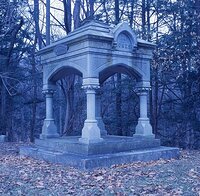
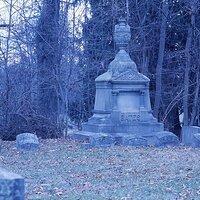
Have any of you guys actually pushed E100 more than a stop? I have, and it pushes incredibly well. I almost exclusively shoot it at 400 or 800, and at 400 there's no noticeable change. At 800 it does get cooler and grain is noticeably larger, but at 400 the grain was still invisible to my eyes and contrast and colors were normal. The first image was done at 800 on 11 year expired E100G. It was quite magenta before color correction, but modern E100 looks fairly normal. The second image was on modern E100 shot at 400 (though also slightly expired) and genuinely looks like normal E100.

EDIT: I do see why people would assume E100 wouldn't push well beyond a stop. I pushed Provia to 400 once, thinking it'd behave similarly the E100. To give you an idea of how that went, the rebate was brown. On my 400/800 E100 the rebate stays "black," just slightly less opaque.
 

Attachments

  • finalhope.jpg
    finalhope.jpg
    805.5 KB · Views: 188
  • alvis_lower_res2.jpg
    alvis_lower_res2.jpg
    568.4 KB · Views: 183
Last edited:
Have any of you guys actually pushed E100 more than a stop? I have, and it pushes incredibly well. I almost exclusively shoot it at 400 or 800, and at 400 there's no noticeable change. At 800 it does get cooler and grain is noticeably larger, but at 400 the grain was still invisible to my eyes and contrast and colors were normal. The first image was done at 800 on 11 year expired E100G. It was quite magenta before color correction, but modern E100 looks fairly normal. The second image was on modern E100 shot at 400 (though also slightly expired) and genuinely looks like normal E100.

That's excellent. What First Developer times @38deg do you use when you expose at ISO 400 and 800 (and with what sort of agitation)?
 
That's excellent. What First Developer times @38deg do you use when you expose at ISO 400 and 800 (and with what sort of agitation)?

So uh... I'm not very good at actually following directions. I normally develop my E6 at anywhere between 99 F and 107 F (37 to 41.5 C), and I rarely adjust my developing times to what the kit actually says for the number of rolls I've developed. My 14th roll on my 8 roll kit was done at 6 minutes and 30 seconds, just like the first, and just like the first it was perfect. When I did it at 800, I distinctly remember developing it for 13 minutes. I know the temperature varied quite a bit during that time, because I don't have a sous vide and my "water bath" is a 170 F (76 C) pot of water on the stove. When I did it at 400, I probably did around 10 minutes. This was months ago and the way I develop my film would horrify a lot of people here (I dry with a hair dryer...).
 
I haven't tried 1600 yet, but I am tempted to try an 8 exposure roll at 1600 on Monday. Figuring out a 4 stop developing time will be very interesting though.

Another thing: E100 handles underexposure pretty well. I had started off a roll intending to shoot at 800, but later decided to shoot at box because I really hate developing film for 13 minutes. The handful of shots at 800 were still recoverable. They didn't look particularly great, but I'm sure a more talented person could've recovered them better.
 
Well this shows that E6 processing is tolerant! I think many of us struggle to maintain temperatures. Just for reference, for Provia 100f, I tend to give 2-3 mins extra for pushing one stop, and I've only pushed 2 stops for a single roll (came out fine) and I probably gave 5-6 mins extra. I find, for my methodology, that Provia 100f needs closer to 8mins for "normal" ISO100 exposures, not the 6-7mins in the (Bellini) E6 instructions.
 
Have any of you guys actually pushed E100 more than a stop? I have, and it pushes incredibly well. I almost exclusively shoot it at 400 or 800, and at 400 there's no noticeable change. At 800 it does get cooler and grain is noticeably larger, but at 400 the grain was still invisible to my eyes and contrast and colors were normal. The first image was done at 800 on 11 year expired E100G. It was quite magenta before color correction, but modern E100 looks fairly normal. The second image was on modern E100 shot at 400 (though also slightly expired) and genuinely looks like normal E100.

EDIT: I do see why people would assume E100 wouldn't push well beyond a stop. I pushed Provia to 400 once, thinking it'd behave similarly the E100. To give you an idea of how that went, the rebate was brown. On my 400/800 E100 the rebate stays "black," just slightly less opaque.

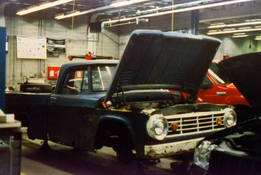
The blacks are clipped and show no details.
 
The blacks are clipped and show no details.
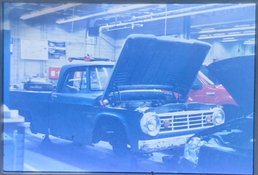
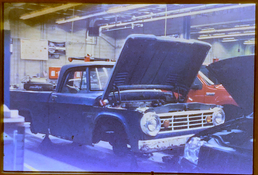
On the truck one, that's a result of my color correction. I have the original slide somewhere (only god knows where though) and it did have a reasonable level of detail, but film 11 years post expiry needed some work. I've attached a phone photo of the slide from when I had just developed it. If you look at the rear of the truck in the photo of the slide, you can see a more detail even in the phone photo. I also attached a slightly color corrected version of that image. As soon as I finish off the roll in my Nikkormat FTN, I'll develop a roll of modern E100 at 800. I have no idea how many photos are left (frame counter is broken) but I have to be close. At the end of the day, there are downsides to pushing E100 to 800 (400 has no downsides that I've found yet) like mild color shifts and a bit more contrast, but it's worth it to be able to shoot handheld indoors. It's not major enough to be very noticeable unless you're specifically looking for flaws.
 

Attachments

  • IMG_1923-3.jpg
    IMG_1923-3.jpg
    445.1 KB · Views: 108
  • IMG_1923-4.jpg
    IMG_1923-4.jpg
    644.8 KB · Views: 117
Last edited:
MILD (????) color shifts? Not very noticeable???
 
Photrio.com contains affiliate links to products. We may receive a commission for purchases made through these links.
To read our full affiliate disclosure statement please click Here.

PHOTRIO PARTNERS EQUALLY FUNDING OUR COMMUNITY:



Ilford ADOX Freestyle Photographic Stearman Press Weldon Color Lab Blue Moon Camera & Machine
Top Bottom