• Welcome to Photrio!
    Registration is fast and free. Join today to unlock search, see fewer ads, and access all forum features.
    Click here to sign up

Portraits with TLR

Puddle

Puddle

  • 2
  • 2
  • 65

Recent Classifieds

Forum statistics

Threads
202,728
Messages
2,844,710
Members
101,487
Latest member
Bmattei
Recent bookmarks
0
As you can see in the examples the recipe for distortion-free portraiture is in the distance to the subject not in the lens used. Rule of thumb says, you need to have ten times the the depth of your subject for a natural looking reproduction. For a portrait that is the 15 cm or 6" ear to nosetip multiplied by ten. The fl of your lens then determines the size of the subject on the negative.
Rules, schmules. Any lens, any depth of focus. Usually I like it when the eyes are in focus, nothing else really matters.
 
I made many nice portraits with my simple Rolleicord, a handheld meter and even the stock focusing screen. I think if you just practice you’ll get the hang of it. Crop to get closer if you need too.
Also, you mention the Rick Oleson screen- they’re great, I have several. However, depending on who did the installation, it may not be properly calibrated to the film plane. Rick describes the procedure in the install instructions.
 
Last edited:
While I've done some medium format portraits before, I feel that in many cases it's overkill and found that 35mm works better. Unless you want every tiny wrinkle on someone's face, which usually is not desired. Often people will shoot portraits wide open to further soften the harsh details.

The 35mm format also gives you more tries to get it right, something that helps a lot when your subject is trying lots of different poses or emotions.
 
The advantage of a TLR is two-fold in my mind. First, once you have focused and roughly composed the subject, you are able to look up from the camera and engage the subject directly, instead of being hidden behind it in the case of a SLR. Of course, that goes for any camera with a waist-level finder or a large-format camera, too. The second is the larger MF negative offers cropping options that might not be feasible with 35mm.
 
I did some wandering through my archives to confirm that I have very little of my portraiture digitized, and most that In do have in digital form isn't shot using a TLR.
So I don't have a lot of examples that are easily shared.
But I've had a fair amount of experience with doing this, and a lot was satisfyingly successful.
My favorite approach mirrors what the LF photographers do.
- Have the camera on a tripod.
- Position your subject where they are comfortable and aren't particularly likely to move around a lot.
- Use the viewfinder with the camera raised as high as is both comfortable to use and practical as you can - sometimes it is helpful to have a small stool or riser for you to stand on behind the camera. You want to try and avoid the dreaded "navel eye view" of your subject.
- After the subject is in a comfortable position, refine the framing and focus on the subject's eyes using the viewfinder.
- Then, look up and make direct eye contact with your subject, without the camera in the way. If the subject is reasonably stationary, you can choose the moment to release the shutter based on the subject's expression, level of engagement, twinkle in the eye, etc.
FWIW, it is fairly easy to note where the subject is in relation to focusing distance when the focus is set, and to refrain from releasing the shutter except when the subject's eyes are the right distance away.
Apparently that was how Yousuf Karsh apparently worked, and I took my lead from him :smile:.
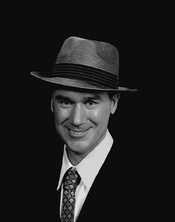
This was actually taken using that method with an RB67 and a WLF - an SLR, but there are lots of similarities:
fedora-47b-2011-11-25a.jpg
 
There is one Rollie TLR portraitist that I know of and he is from my hometown. Check out Milton Rogavin https://miltonrogovin.com/ He did environmental portraits in poor and working class neighborhoods and some of his work is really stunning plus he has an incredible back story.
 
I use TLRs for portraits all the time. Just so happens the subjects are shorter than me so its easier. If not I stand on a chair or have the subject sit on a chair. You really need to slow down and focus, then check again and again. Get your face right up to that loupe and confirm. Stop down as far as you can, with medium format you'll still get nice depth of field.

Or you back off and do full body portraits.
 
They make a great prop for self-portraits :smile:.
Pre-focused Mamiya 645 Pro, using the self timer.
View attachment 410391

I used that C330 to shoot weddings, including lots of portraits. That 135mm lens was great for the portrait work, but the 80mm was also great for more environmental portraiture.
You learn how to focus as you get used to using them for that purpose.

Back in the 80's, I too used the C330 to shoot weddings. But before the 330, I used the older C220 and I remember doing the ring shot with the wedding invitation, flowers and a string of pearls for accent. I also did close ups of the bride and groom, etc., that's when I used the Paramender for those pics and always got great results.
 
I did a number of portraits w my 5x7, but these days i prefer the Rolleiflex usually with FP4. I prefer to use a tripod or monpod.
I rarely do head shots, but do use the Rolleinar 1.
IMG_2236.jpg
 
Last edited:
Rules, schmules. Any lens, any depth of focus. Usually I like it when the eyes are in focus, nothing else really matters.
Nice to learn about your personal preferences to ignore the topic and there may be good artistical reasons to do so and there are enough examples where this choice has been made. Can you elaborate on your reasoning?
 
Last edited:
Nice to learn about your personal preferences to ignore the topic and there may be good artistical reasons to do so and there are enough examples where this choice has been made. Can you elaborate on your reasoning?
What reasoning ? Where did I ignore topic ?

Perspective depends on distance, lens choice affects distance to subject. Perspective is one of reasons why portraits come out the way they do. It's all subjective, distortion as intended all the same.

It is all personal preference, except saying that lens choice does not affect outcome is not.

TLR with fixed lens limits what can be done. Not all subject are comfortable with camera closed by. Such a subject may not be at it supposing when there is o way to move away.

I don't considering cropping as an alternative in true sense of what I am saying here.
 
So you are saying you can do same portraiture with ANY lens? Which is of course impossible.
In fact you can! All you have to do is crop the subject to the same framing which isn't done to not waste any real estate with respect to the size of your film or sensor. This has been discussed many times before.
 
Last edited:
Rolleiflex/Rolleicord with Rolleinar I will do a perfect job. Just give a try...
 
OP has Rolleiflex 3.5F

I was responding to what you have written. I am sure, I know what OP has and it is also a perfect combo for portraits.
 
All very interesting. But getting back to the Tele-Rollei, it seems that a 135mm lens might be preferable for portraits. Pros and cons?
 
In some pictures I made, if found it hard to focus, and some portraits are slightly out of focus, maybe due to too open aperture, but don't know for sure.

Could you elaborate on the conditions? I do a lot of portraits with TLRs in natural light. Ease of focus depends on the lighting (backlit is the hardest) and subject/camera stillness. Being slightly out of focus is pretty normal when shooting handheld.

Changing the focus screen on a 3.5F is pretty easy, but the viewing and taking lenses could be out of sync.

Rolleinar 1 is good, no. 2 will get you a bit too close.

To get a proper reference point, have your subject sitting on a chair, with the camera on a tripod level with their head. Try with and without the Rolleinars.
 
All very interesting. But getting back to the Tele-Rollei, it seems that a 135mm lens might be preferable for portraits. Pros and cons?

Paralax shift, and the tendency of Tele Rolleis to have balsam separation. Hence you can buy them for small $$$.
 
Fine, in this case I can't see any disagreement of what we are trying to say.

You're trying to say cropping is substitute for different focal length. Then keep shooting with one lens and keep cropping.

When loss of quality is part of a solution it is not a solution. bu let's leave at a personal choice level, good enough for me.
 
I was responding to what you have written. I am sure, I know what OP has and it is also a perfect combo for portraits.

And I was always responding to camera OP has, not sure what the problem is me stating the obvious in response. It's been about a fix focal length camera, not Mamiya TLR.
 
Actually, the 35mm Rolleikin coupled with the 75 or 80mm taking lens on the Rollei makes for some very nice portraits at a very friendly focal length.
 
Photrio.com contains affiliate links to products. We may receive a commission for purchases made through these links.
To read our full affiliate disclosure statement please click Here.

PHOTRIO PARTNERS EQUALLY FUNDING OUR COMMUNITY:



Ilford ADOX Freestyle Photographic Stearman Press Weldon Color Lab Blue Moon Camera & Machine
Top Bottom