
• Welcome to Photrio!
    Registration is fast and free. Join today to unlock search, see fewer ads, and access all forum features.
    Click here to sign up

Pink/Magenta Stain (not blue, which is a different issue)

Somewhere...

D
Somewhere...

  • 2
  • 1
  • 42
Iriana

H
Iriana

  • 5
  • 1
  • 91

Forum statistics

Threads
202,735
Messages
2,844,857
Members
101,493
Latest member
aekatz
Recent bookmarks
2
Taking your points one at a time:

So the summary is "Yes, citric acid as a stop could be making the pink stain harder to wash out, so stop that".

I was taught in university not to use any sort of HCA, so I never had any reason to lean that HCA was mostly sodium sulfite, hence having no idea what the jar of sodium sulfite was for. Older threads suggest that 20g/L of sodium sulfite used once and dumped makes a fine clearing agent for film and paper, but I'm not seeing a recommendation for time.

If you say the pink stain has no problems with long term stability of the film, I'll take your word for it.

Yeah, I have little to no interest in the chemistry of photography beyond what I need to get work done. The only time I take a hard look at it is when I have a problem like this. Otherwise, I just carefully follow what the instructions say to do and acknowledge that the professional photochemists like yourself are going to be better at writing instructions than I will be at doing chemistry.

I'm aware acetic acid is vinegar. I HATE vinegar. I can't stand anything cooked with it or made from it. Like I said, the smell of acetic acid makes me sick.
 
Well, I am not an advocate of HCA, but in your case, if you insist on removing the stain, then Sulfite should do the trick. Exposure to sunlight might also work as some have reported. I would use the Sulfite solution and watch for the stain to begin vanishing. Then I would treat the film for another 5 minutes or so until it is evenly gone. Then a 10 minute wash should be necessary along with a treatment in Photo Flo.

PE
 
All the stop baths I see available here are citric acid. Ilfostop or Adostop for example.
Which one is an Acetic Acid example?
 
Acetic acid is vinegar. Vinegar is about 2 - 5% acetic acid. Acetic acid itself is sold in 28% and "glacial" which is about 98% + pure.

It smells like vinegar and is much more acidic. Stopping is much more rapid. I have been told that citric acid must not be used with color products. I've forgotten the reason. My comments above may relate to that, but it has been years since I was told that.

PE
 
Tri-X will be steal grey and flat as a pancake if you let it sit in plain water for 60 - 90 mins after developing.
Not sure if that is bad for the base or emulsion.
 
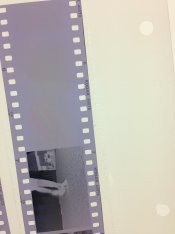
The stain also seems to fade unevenly with time. Two year old Tri-x.
 

Attachments

  • IMG_0720.JPG
    IMG_0720.JPG
    511.1 KB · Views: 446
Tri-X will be steal grey and flat as a pancake if you let it sit in plain water for 60 - 90 mins after developing.
Not sure if that is bad for the base or emulsion.

It's probably best to limit the wet time for film to a minimum. The magenta stain is not going to harm anything.
 
I - like Eric - just soak the films. Only with Kodak I have this purple stain and while I didn't care in the beginning (and have a lot of purple negatives) I started soaking the films for 20-30 minutes after the Ilford wash (5-10-20-40 inversions and a fresh water change in between).
The result is always a perfectly clear roll of film. I am happy with this result, especially that it doesn't waste extra water.

Ben
 
I discussed this with a former EK engineer and one of the inventors of the layered dye technique which seems to be the culprit here. It was not a problem at one time, so if it is one now and getting worse, I suggest that there be a conversation between customers and Kodak. But, there appears to be a solution such as the long wash Ben mentions above and others I have heard such as soaking in Sodium Sulfite solution.

PE
 
It may be worth noting that my problem was completely resolved by switching to two-bath fixing. No extended wash times, no additional clearing step, just 2 bath fix and then straight into a wash.

Interestingly, the 1st fix bath comes out barely tinted pink while the second fix bath comes out electric neon Barbie pink. I've never seen something like this before where the majority of the chemical to be removed "washes" out in the 2nd bath. I also find it interesting that the pink color in the fixer vanishes by the time I use the fixer again a few days later.
 
The dye is rapily destroyed by sulfite and oxygen both. It can be oxidized and reduced depending on conditions.

PE
 
It may be worth noting that my problem was completely resolved by switching to two-bath fixing. No extended wash times, no additional clearing step, just 2 bath fix and then straight into a wash.

Interestingly, the 1st fix bath comes out barely tinted pink while the second fix bath comes out electric neon Barbie pink. I've never seen something like this before where the majority of the chemical to be removed "washes" out in the 2nd bath. I also find it interesting that the pink color in the fixer vanishes by the time I use the fixer again a few days later.
That is very interesting indeed. I use fresh fixer dilution pretty much every time, but only one fixer bath of 5-6 minutes.
I haven't noticed that removing the dye. I'll see if a two batch approach makes a difference. Would be nice to cut down on the soaking and washing time.
 
This problem was happening occasionally with Pan F. I just developed a roll the other day that had a slight pinkish cast. Since we had an overcast day yesterday I taped the archival sheet to the window. After about 8 hours of indirect light compounded by filtering thru a fairly heavy overcast, there was little change. Then the sun broke thru with some dappled light and was at an angle to directly hit the film. In about five minutes the pink was completely gone.

Another roll was developed several weeks ago and has just been sitting on the table. I checked it and it has cleared, as well.
 
This problem was happening occasionally with Pan F. I just developed a roll the other day that had a slight pinkish cast. Since we had an overcast day yesterday I taped the archival sheet to the window. After about 8 hours of indirect light compounded by filtering thru a fairly heavy overcast, there was little change. Then the sun broke thru with some dappled light and was at an angle to directly hit the film. In about five minutes the pink was completely gone.

Another roll was developed several weeks ago and has just been sitting on the table. I checked it and it has cleared, as well.

Good luck in 10 years when they are all fogged :/
 
I haven't gone through the whole thread, not having been on APUG for a long time but I stopped having magenta stain problems with a 10 minutes running water wash rather than using the old 'ILFORD' method of a process of exchanges.

Tom
 
Why is this such a vexing problem for some? There must be other matters that are more important. Like why paper towels never tear neatly along the perforations. :smile:
 
Quite. I noticed it recently with Tri-X developed in DD-X mostly because my usual dev of choice Rodinal seems to get rid of it. I did a little test just like others where I left some film on the window sill for a day and that was enough to remove the pink stain even given our recent lack of sunshine for about the last 4 months.
 
Why is this such a vexing problem for some? There must be other matters that are more important. Like why paper towels never tear neatly along the perforations. :smile:
Paper towels not neatly tearing does cause some discomfort indeed. I can totally relate to you on that.
I am too angry though, because even in that 'not so neat' state they still soak up liquid.
 
Photrio.com contains affiliate links to products. We may receive a commission for purchases made through these links.
To read our full affiliate disclosure statement please click Here.

PHOTRIO PARTNERS EQUALLY FUNDING OUR COMMUNITY:


Ilford ADOX Freestyle Photographic Stearman Press Weldon Color Lab Blue Moon Camera & Machine
Top Bottom