• Welcome to Photrio!
    Registration is fast and free. Join today to unlock search, see fewer ads, and access all forum features.
    Click here to sign up

Paint the easel?

Recent Classifieds

Forum statistics

Threads
202,560
Messages
2,842,352
Members
101,380
Latest member
andi63
Recent bookmarks
1

chuck94022

Member
Allowing Ads
Joined
Jan 11, 2005
Messages
869
Location
Los Altos, C
Format
Multi Format
While I've got my black paint out (see my other post on making an new negative carrier), I saw a passing reference recently to using a black easel.

I've got an 11x14 easel that has a beige base. Should I spray paint it flat black while I've got the paint out? Will that improve my prints (by reducing reflection back into the print from below)?
 
Paint Easel?

Chuck-my saunders adjustable and several others that I have all seem to have a flat matte yellow paint. I suspect that the makers of these easels know what they are doing. If your prints don't have a problem why bother to paint? If it aint broke don't try to fix it
Best, Peter
 
I have seen a few people do that over the years. I used to think there might be some logic in having a black non-reflective easel.

Then I realized that the enlarger light would first encounter the WHITE paper base before reaching the easel...
 
The best thing to find out - before taking the drastic measure of painting the easel matt black - is to make a print with a piece of black paper underneath the photo paper.

Hans
 
The reason that the easels are painted that sickening yellow is that it the same color as the OC safelight and will appear white in the darkroom. Then it is easier to focus the negative on the easel. But of course if you are a proper darkroom worker and have a grain focusing scope, then the color of your easel does not matter.
 
Not too long ago I purchased an old 11x14 easel in good mechanical condition, though some area's had begun to rust while others had paint flaking. I sanded it down and painted the paper area flat black. I've not noticed any difference, though I do have to insert paper to get an image bright enough to focus on.
 
Joe Lipka said:
...Then it is easier to focus the negative on the easel. But of course if you are a proper darkroom worker ...

A "proper darkroom worker" is not going to be focusing on the surface of an easel but rather will be using a sheet of the same paper they are printing on to focus upon. The thickness of the paper makes a difference in sharpness of the prints. Some workers actually attach a cut-out of their favorite paper to the grain magnifier to correct for the difference in focusing plane.

Either do that or paint the easel black. Personally, I'd paint the easel black, especially if you are doing any color work. In color printing, the reflection of the easel color through the back of the paper can affect the color balance of the resultant print.

Joe
 
Have an old Saunders that came black. A pain to use.

Slip a black paper under a 5x7 and make a plain one. See if there is a difference.
 
Well, my 11x14 easel is painted black. I gave it a quick sanding, blades and all with fine grit sand paper just to rough up the surface so the paint would hold better. Then I spray painted it flat black.

I also took a small lawn mower blade and shaped it to fit the bottom blade of the easel and then epoxied down.

My paper sits about as flat as possible on the easel.

Innovations often lead to inventions.
 
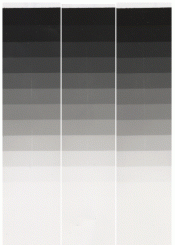
Decided to see what if any difference the easel colour has on B&W prints so....

I exposed a transmission grey scale in the enlarger neg carrier so as to favour the highlights (the logic being that that is where any fogging will show). The scan below is of the resulting three prints (MG-IV RC glossy). The 1st strip is with just the white easel surface, the second is with a sheet of matt black cartridge paper under the paper and the third, just for a laugh (I thought), is with the shiny side of some aluminium kitchen foil underneath the paper.

No difference. Not in the scan, but more importantly, not by inspecting them under a variety of lighting (i.e. from daylight, up to and including a 1kw security lamp). There is actually a very, very, slight hint of a suspicion of a suggestion of a possibility of extra density in the foil strip when viewed by transmitted light on the light box, but other than that, they are all identical.

Cheers, Bob.
 

Attachments

  • Easel1.gif
    Easel1.gif
    76.7 KB · Views: 208
paint it red.... same color as your safelight (if your safelight is red that is)
 
Will S said:
paint it red.... same color as your safelight (if your safelight is red that is)

I see a red door and I want it painted black
No colors anymore I want them to turn black
I see the girls walk by dressed in their summer clothes
I have to turn my head until my darkness goes
Hmm, hmm, hmm,...
I wanna see it painted, painted black
Black as night, black as coal


- The Rolling Stones​

Joe
 
I painted mine black, but that's because I print color sometimes. I haven't really tested if it makes a difference.
 
I did the test with a pice of black paper and didn;t see much difference, so I didn;t bother

For me having a white or yellow base is easier to frame/compose my enlargemtnets. I also painted some black lines (sharpie) in the base to compose.
 
psvensson said:
I painted mine black, but that's because I print color sometimes. I haven't really tested if it makes a difference.
That's what you need to do with those silly Saunders yellow easels and all the others that have not stuck with either white or neutral gray. Yellow easels, red easels, shellac painted wooden baseboards etc. all tend to introduce noise into the colour printing process. The choice between white, neutral gray or black is, I think, more a question of application than much else. If the frame or baseboard will be used as a a reproduction rig then black is probably the best colour. If its for colour and B&W and one uses single weight or vellum stocks then gray formica is a good choice. Gray paint, however, tends to be less neutral than the matted whites that are available so if its about painting then I'd select white. A good flat black does not hurt but its less than practical and, in general, provides little advantage over gray or even white-- and there is always the possibility to sandwidth a piece of black board between a white base and paper.
 
Bob F. said:
No difference. Not in the scan, but more importantly, not by inspecting them under a variety of lighting (i.e. from daylight, up to and including a 1kw security lamp). There is actually a very, very, slight hint of a suspicion of a suggestion of a possibility of extra density in the foil strip when viewed by transmitted light on the light box, but other than that, they are all identical.

Cheers, Bob.

The answer, as usual, is to test and find out. Thanks for doing that Bob!

Murray
 
I was a bit surprised myself, especially with the silver foil result which I though would be a "control" and show a clear difference!

I just did another quick check with a small light and my exposure meter and I find the paper attenuates the light by a surprising amount: just over 3 stops each way. So that makes a total of 6 stops less light hitting the emulsion from underneath even if you used a mirror under the paper... Which I guess, explains the results: minus 6 stops extra exposure is simply not going to show. That's using Ilford MG-IV RC, MG-IV fibre attenuates by 3.5 stops each way so would show even less effect. The MG-IV RC is the thinnest paper I have.

Cheers, Bob.

P.S. This is the great thing about the Nova vertical "processor": because the chemicals are left in the slots, it took me 30 minutes to expose and process the RC test strips because I didn't have to faff about mixing chemicals and washing trays up afterwards. Digital printers eat your hearts out! :tongue:
 
Photrio.com contains affiliate links to products. We may receive a commission for purchases made through these links.
To read our full affiliate disclosure statement please click Here.

PHOTRIO PARTNERS EQUALLY FUNDING OUR COMMUNITY:


Ilford ADOX Freestyle Photographic Stearman Press Weldon Color Lab Blue Moon Camera & Machine
Top Bottom