I managed to get information from the local company that sells the food grade pig gelatin in question.
Their gelatin is imported from Germany. All the batches come from the same manufacturer, they say. They even told me sulphur content according to batch analysis. It's < 50 ppm, and they say there's only little variation between batches.
So, given this information, I made some calculations:
50 ppm(wt) = 0.005 wt-% = 0.05 mg/g
Our emulsion used on average 3 g of gelatin during making at 42C -> 0.15 mg Sulphur
As we compare to hypo (Na2S2O3.5H2O) used in sensitization figures, it has molar weight of
(158.108 + 5*(2*1.007 + 16.00)) g/mol = 248,178 g/mol
S has 32.065 g/mol
-> ratio between hypo and S is 7.73x.
-> 0.15 mg S corresponds to 1.16 mg hypo
We had 0,0765 mols of silver
->
Final corresponding figure during making is: 15 mg hypo / mol silver
Then, a calculation of final Sulphur level, after addition of gelatin just before wash.
Note: This has not gone through any kind of heat treatment, as it was quickly
chilled, washed and then put to rest, but this is important for later treatments.
Gelatin total 18.5 g -> 0.925 mg Sulphur ~ 7.15 mg hypo
Same Ag content
->
Final corresponding figure after making is: 93 mg hypo / mol silver
Questions arisen
1) Sulphur is in a different form in gelatin than in hypo. Do they react at the same ratio, so that I can convert them based on weight as I did above?
2) Are some Sulphur compounds washed away in emulsion washing?
3) They told me it's below 50 ppm. What we cannot know is if it's really near to 50 ppm or lower, like 25 ppm.
In any case, if it contains already about 100 mg/mol hypo-equivalent, or a little less, it's no surprise that adding 100 mg/mol more did what it did. We're gonna try sensitization without added hypo at all next time.





 . I'm sorry but I probably can't give more exact information, but I'll restart my own experiments quite soon and I can give specific information about them...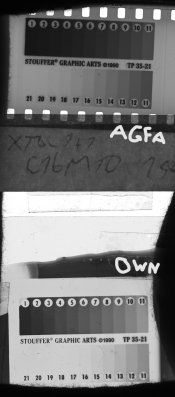
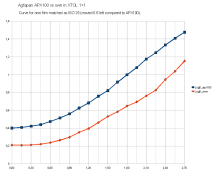

 .
. 