• Welcome to Photrio!
    Registration is fast and free. Join today to unlock search, see fewer ads, and access all forum features.
    Click here to sign up

Our newest results.

Somewhere...

D
Somewhere...

  • 5
  • 2
  • 93
Iriana

H
Iriana

  • 7
  • 1
  • 158

Recent Classifieds

Forum statistics

Threads
202,750
Messages
2,845,041
Members
101,499
Latest member
ThomasE
Recent bookmarks
1
hrst,

Thankyou very much for that wonderful post with your detailed procedure.

Your scientific approach is really appreciated!

Regarding the gelatine, I like your approach of using food grade product. It is far easier to obtain at a reasonable price.

Emulsion
 
Very nice.

Some observations...

At that level of gelatin, I would imagine that the final melt would be very viscous or that the gelatin has a low Bloom Index making it inherently lower in viscosity. Of course, this does not take into account expansion during washing which I cannot judge.

And, that addition profile can be deleterious to the proper grain growth. The middle curve should either be flat, with the next addition starting where that one left off, or it should rise with the next one starting where that left off. This is to take into account the growing crystal size. You accelerate addition to try to match the rate of growth.

I might add that this is very close to an emulsion currently in the book.

PE
 
Today we took a look at the commercial corona treatment unit again and made some... ahem... measurements. I don't know if I'm allowed to give exact information about the unit such as name, but I can now give.... an educated guess for starting point for corona treatment: simple sine wave AC without any DC offset, Urms = around 2.5 kV, with frequency of about 20...30 kHz. As it is AC without offset, it doesn't have a problem of correct polarity :wink:. I'm sorry but I probably can't give more exact information, but I'll restart my own experiments quite soon and I can give specific information about them...

I still probably have some work with correct electrode design, but my problem with my earlier experiments is becoming clear to me; I have been using DC voltage, or too high DC offset voltage when using AC. All I got was huge static charge. Corona was on all the time. But the key to surface treatment seems to be in the quick toggling of corona on and off, that is, AC voltage with high enough frequency.
 
HF surface effect

I still probably have some work with correct electrode design, but my problem with my earlier experiments is becoming clear to me; I have been using DC voltage, or too high DC offset voltage when using AC. All I got was huge static charge. Corona was on all the time. But the key to surface treatment seems to be in the quick toggling of corona on and off, that is, AC voltage with high enough frequency.

Hi -

I once worked on a high voltage amplifier, which ran at about 20 khz at 20,000 V. I used to light my cigarettes from quite a distance with that rig. The arc had strange properties - if you put you finger near it, it would arc over, but it would just burn the callus of your finger, it wouldn't go deep. I think that HV HF is conducted only on the surface. Not sure if that has anything to do with your polyester prep, but it is an interesting effect. In some ways High Freq HV is much safer than DC HV (which can cause a lock on situation while you just sit there frying)

Regards - Jim Browning
 
Anyway, our meter showed 600 kOhm, whereas it shows 800 kOhm for deionized water, 400 kOhm for 0,030 g/l NaBr and 200 kOhm for 0,200 g/l NaBr.

What kind of conductivity meter are you using. Typically, conductivity is read in uS/cm (that's "microsiemens per centimeter) as the resistance increases as the distance between the electrodes increases.

Keep in mind a Siemen (S) is equal to a Mho, which is 1/Ohm. Some people forget about the distance aspect and omit it. Also, really good DI water should read "18 MOhm" or higher.
 
I just used a regular digital multimeter and made a simple metering electrode with a fixed distance that wasn't selected by any correct means. My point was just to get some quick relative numbers that can be compared against each other.
 
Sensitization experiment:

We added hypo at 100 mg/mol and stirred at 60 deg C, getting and coating samples every 10 minutes.

After 10 min, there was a little fog. After 20 min, quite a bit, after 30 min, almost completely foggy, and after 40 min, completely fogged.

However, the results at 10 and 20 min, however a bit fogged, were very poor when we exposed Stouffer scale on them. We found that the speed actually DROPPED (which is quite surprising) and contrast and DMAX seems to be dropping as well. The coatings were quite poor quality due to small samples and that may play a part in the results, but still I'm surprised. The best one in the series is the first one which we made before adding hypo and before reaching 60 deg. C. It hasn't changed at all during storage for 14 days. It was also nice to see that is survived the process quite well even without any hardener and with only one hour of drying time, assisted with hair dryer. I can post curves from it quite soon. Our approximation of ISO 25 stays so. Sensitization was a failure. We could try it again with less hypo or with no hypo at all, as the residual sulfur compounds in gelatin might do it with the heat treatment only.

Is there a chance that 14 days in refrigerator might render the emulsion to non-sensitizable, even though it's perfectly ok otherwise?
 
I think that your emulsion is coarser grained than mine. The use of hypo is a surface phenomenon and therefore as size increases, amount should decrease. By the results you report, I might suggest going to 25 mg/mole.

PE
 
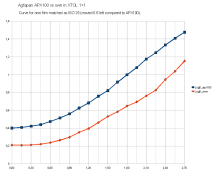
Curves!

Curves.
Without hypo sensitization which was failure. Test coating was a bit uneven which may affect results a bit. Test exposure was 1 stop more than for APX100, (so if they matched, it would be ISO50.)

Epson V700 scanner, profiled with a Stouffer scale, was used as a densitometer. X axis is not actual lux-second scale but should be considered relative.

Density readings may be a bit off, too. They sound a bit low to me. But the curve shape and logH range are interesting. Contrast is quite close to APX100.

But, despite having the first visible step at ISO25 compared to APX100, when looking with bare eye, it's probably better shot at EI16 or EI12.5 due to curve shape.
 

Attachments

  • scan_for_curves.jpg
    scan_for_curves.jpg
    161.4 KB · Views: 147
  • curves.png
    curves.png
    12.3 KB · Views: 132
Last edited by a moderator:
Why did you decide to go with the higher temp? 60C is mighty hot for an ammoniacal emulsion. I've never seem it that high in the literature, and the one time I let the temperature get away from me when I got distracted, the emulsion was horrible (flat and slow.) I keep to 40-45C.

And, for what it's worth from my experience: I don't use hypo sensitization, but I do add gold to the washed noodles during the last ripening. I've had noodles in the frig for three weeks (without preservative) and things went fine.

d
 
Making temperature was 42C. Finishing (sensitization) temperature was 60C as instructed by PE in all of his posts concerning sensitization. There should be no ammonia left after neutralizing and washing, if I have understood it correctly.
 
Last edited by a moderator:
I managed to get information from the local company that sells the food grade pig gelatin in question.

Their gelatin is imported from Germany. All the batches come from the same manufacturer, they say. They even told me sulphur content according to batch analysis. It's < 50 ppm, and they say there's only little variation between batches.

So, given this information, I made some calculations:

50 ppm(wt) = 0.005 wt-% = 0.05 mg/g

Our emulsion used on average 3 g of gelatin during making at 42C -> 0.15 mg Sulphur

As we compare to hypo (Na2S2O3.5H2O) used in sensitization figures, it has molar weight of
(158.108 + 5*(2*1.007 + 16.00)) g/mol = 248,178 g/mol
S has 32.065 g/mol
-> ratio between hypo and S is 7.73x.

-> 0.15 mg S corresponds to 1.16 mg hypo

We had 0,0765 mols of silver

->
Final corresponding figure during making is: 15 mg hypo / mol silver

Then, a calculation of final Sulphur level, after addition of gelatin just before wash.
Note: This has not gone through any kind of heat treatment, as it was quickly
chilled, washed and then put to rest, but this is important for later treatments.

Gelatin total 18.5 g -> 0.925 mg Sulphur ~ 7.15 mg hypo

Same Ag content

->
Final corresponding figure after making is: 93 mg hypo / mol silver

Questions arisen
1) Sulphur is in a different form in gelatin than in hypo. Do they react at the same ratio, so that I can convert them based on weight as I did above?
2) Are some Sulphur compounds washed away in emulsion washing?
3) They told me it's below 50 ppm. What we cannot know is if it's really near to 50 ppm or lower, like 25 ppm.

In any case, if it contains already about 100 mg/mol hypo-equivalent, or a little less, it's no surprise that adding 100 mg/mol more did what it did. We're gonna try sensitization without added hypo at all next time.

 
Making temperature was 42C. Finishing (sensitization) temperature was 60C as instructed by PE in all of his posts concerning sensitization.

Ah, yes.

Going with a lower temperature might still be worth a try, but I imagine you've already decided that. You seem to have this whole science thing figured out :smile:.

(And, I add my gold at 52C. That's the very top temp I can seem to go without problems, and sometimes I think that might be pushing it. But, again, that's Steigmann's gold, not hypo. For all I know, they're apples and oranges.)
 
Thanks for tip, maybe we go at 50C at the next try. At least it could help if we have too much sulphur to begin with in gelatin.
 
I have made this formula and variants from 40C to 60C. I have done all sensitization with sulfur at 60C. The reason is that the formation of Silver Sulfide from the breakdown of Sodium Thiosulfate is quite good at 60 deg C. The original work was by Sheppard in the 20s, IIRC, and involved the use of Allyl Thiourea. It is what is formed from the sulfur compounds in gelatin.

So, sources of Sulfur include Allyl Thiourea, Thiourea, any Thiocyanate and Sodium Thiosulfate (usually Pentahydrate). These all break down with heat to react with Silver Halide to form Silver Sulfides of some sort. Gold reacts with this to increase threshold speed and fog so it adds a layer of complexity. It is used at the ration of 3 Sulfur / 1 gold or even less gold.

Early documents on Sulfur + Gold are found in the BIOS reports and also in publications by Sheppard and by Woody Thomas (Woodlief) of EK.

PE
 
Photrio.com contains affiliate links to products. We may receive a commission for purchases made through these links.
To read our full affiliate disclosure statement please click Here.

PHOTRIO PARTNERS EQUALLY FUNDING OUR COMMUNITY:


Ilford ADOX Freestyle Photographic Stearman Press Weldon Color Lab Blue Moon Camera & Machine
Top Bottom