• Welcome to Photrio!
    Registration is fast and free. Join today to unlock search, see fewer ads, and access all forum features.
    Click here to sign up

Old Nikon Glass

If You See Kay

A
If You See Kay

  • 0
  • 0
  • 12
Autumn

D
Autumn

  • 0
  • 0
  • 30

Recent Classifieds

Forum statistics

Threads
203,392
Messages
2,853,931
Members
101,817
Latest member
goodman1999
Recent bookmarks
0
What “small imperfections” are you talking about?

For example, the 80 mm f/2 is said to exhibit some chromatic aberration in the red-yellow region, causing blurring in that part of the spectrum. Of course, that's where skin tones are rendered. The positive side effect is that minor skin features, such as skin pores and other minor skin imperfections, are not rendered clinically sharp but softened, which is preferred by many. At the same time, eyelashes, eyebrows, and eyes themselves are as sharp as a Japanese kitchen knife—just perfect!
 
Last edited:
Talking of old glass, are you aware that all glass is fluid in nature and a medieval glass window will be thicker at the bottom than the top, where it has moved over many hundreds of years.

This is a common misconception that is false. Glass panes, especially in stained glass applications were mounted with the thicker side on the bottom for strength
 
Steve W. Martin an associate professor of materials science and engineering at Iowa State University said:
"Window glass at room temperature has a nearly incalculable relaxation time, approaching the age of the universe itself. For all practical observations, this glass is a solid. But its solidity is in the eye of the beholder."

We've exited the path anyways...along those lines.
 
I like the old Nikkors mostly for their rendering but with exceptions. The 2/28 NC is wonderful, the 1.4/35 just great and the 50-55mm lenses generally put a smile on my face. A lens which really won my heart is the characterful H 1.8/85. I had a knurled HC, sold it, now I own a K, both AId. So many great choices. One exception on my list is the 2.8/24 mm which always left me a bit unimpressed. Not a bad lens but compared to the 2.8/28 AIS the latter is clearly a better lens. The 2.8/45 P is a dog btw. I don't know what they have been thinking with that one.
 
Last edited:
I love old Nikon glass; I just love the small imperfections and how that adds character to the rendering. That said, I wouldn't buy non-AI anymore, but I also did that to have it converted. How do you feel about old Nikon glass?

All my favorite photographers, from Henri Cartier Bresson to A. Adams, Eliot Porter, W. Eugene Smith, … all photographed with vintage glass. All of them.
And slow films. No autofocus. And primitive flash, if any at all.
Their work speaks for itself.
Do I really want to see every pore, every wrinkle and skin imperfection on a portrait? Definitely not.
Does a good image merit always perfect focus? Toscanini conducting his last times. Soldiers landing at Omaha beach. These weren’t sharp images. But they’ve made a tremendous impression on our collective awareness.
About Nikkor glass…. Love it. I’m a huge fan of the Non Al Nippon Kogaku. Yes, exposure is tricky. Or perhaps I should say, slightly lengthier. Expose at full open aperture, and adjust as you stop down….
Or just take a meter reading. Easy enough with a Sekonic.
Camera of choice with these old lenses: Df Nikon.
We are living at a wonderful time, when all these legendary lenses are still available, and very modestly priced. And thanks to Nikons vision and craft, they can be used and appreciated on cameras created nearly 70 years later. And they bring character, and vibe to the often clinical and perfect new photographic cameras.
Quite astonishing!
Kind regards, Ralph!
 
I love old Nikon glass; I just love the small imperfections and how that adds character to the rendering. That said, I wouldn't buy non-AI anymore, but I also did that to have it converted. How do you feel about old Nikon glass?

I love visiting the past, I just don't want to live there any more.

My oldest Nikon lens is a 28mm f/2 from 1971, which is AI converted. It's still serviceable, although on a modern camera the 28mm f/1.8G outperforms it edge-to-edge. I also own a 35mm f/2.8PC from 1972. All told, I own 9 manual focus Nikon lenses plus 4 large format Nikkors.

I still enjoy shooting my FA, but I only do so for my own pleasure. I occasionally get roped into volunteer work; then I pick up my (more or less) modern digital bodies and lenses.
 
Yes price but I don't think it's worth it especially when someone like Ralph has to look for someone to modify it. It's worth it if you want your camera to look period for example if you have a Nikon F it looks better with Pre-AI lenses.

That sums it up pretty well.
Its about how the camera looks rather than the quality or lack of in the image.
I always use AI at the minimum preferably AIS.
 
That sums it up pretty well.
Its about how the camera looks rather than the quality or lack of in the image.
I always use AI at the minimum preferably AIS.

I'm the same: I do like the look of my "panda" bodies (F3/T champagne, silver FE2, and sliver Df) with AiS lenses. I have one pre-AI lens, a 105/2.5 P Sonnar version, and it is AI'ed, and I do like its rendering, but it looks out of sorts not being mounted on a pre-AI body.
 
That sums it up pretty well.
Its about how the camera looks rather than the quality or lack of in the image.
I always use AI at the minimum preferably AIS.

I don't see the quality difference between the Pre-AI and AI lenses. So if my cameras require AI I would spend the extra money to buy the AI rather than buying the Pre-AI then convert it.
 
  • cliveh
  • cliveh
  • Deleted
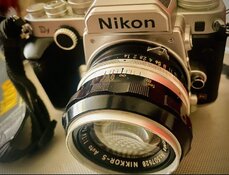
Aesthetics have been mentioned, but has anyone spoken of sheer joy in using these lenses?
The smoothness of this 50mm/1.4 while focusing or adjusting the aperture is unequal to any other lens I’ve photographed with. It is a real treat to use.
And it is not for show, but maximizes focusing precision at the closest ranges, where this lens excels.
And if I may, as far as I’m concerned I feel this old lens and many others like it are every bit as sharp, and contrasty as they needed to be. 35mm film in its day had tremendous resolution. Even today, properly scanned negs favor well against cameras rated in upwards of 20 Megapixels.
As for other so called faults the lens may have, many probably considered them strengths back in the 60s and 70s. I still do.
We darkened our corners on prints purposefully when printing enlargements, and didn’t mind the center of the image being a bit sharper than the corners. Those were given. Folks, that’s how the eye normally sees. You’d want to keep the viewer’s attending at the center of the image, not one of the corners.
We are fortunate to live in these times, where such great lenses are available so modestly priced, and so readily available to use with the various adapters available.
As for ease of operation, what could be easier on my DF, than flip back a tan, store my lens specs on the camera, ID it when using it, and pick my aperture with the front selector with my index, what the pin used to do back in the day?
Camera then meters, and is ready to expose when needed.
The best part? I picked up this fast jewel of a lens, along with a 200/4 with 52mm ocular, and a 300/4.5 for around $250.00. All were in excellent or excellent + conditions.
60 year old lenses, appreciated and meticulously cared for by their previous owners, gifting me the opportunities to create images unlike any other produced by today’s super sharp, and super contrasty lens offerings.
I think of it as a win, win. Don’t you?
 

Attachments

  • IMG_1205.jpeg
    IMG_1205.jpeg
    374.4 KB · Views: 16
Aesthetics have been mentioned, but has anyone spoken of sheer joy in using these lenses?
The smoothness of this 50mm/1.4 while focusing or adjusting the aperture is unequal to any other lens I’ve photographed with. It is a real treat to use.
And it is not for show, but maximizes focusing precision at the closest ranges, where this lens excels.
And if I may, as far as I’m concerned I feel this old lens and many others like it are every bit as sharp, and contrasty as they needed to be. 35mm film in its day had tremendous resolution. Even today, properly scanned negs favor well against cameras rated in upwards of 20 Megapixels.
As for other so called faults the lens may have, many probably considered them strengths back in the 60s and 70s. I still do.
We darkened our corners on prints purposefully when printing enlargements, and didn’t mind the center of the image being a bit sharper than the corners. Those were given. Folks, that’s how the eye normally sees. You’d want to keep the viewer’s attending at the center of the image, not one of the corners.
I fully agree: The pixel-peeping aesthetic, where lenses are judged on microscopically defined flaws, and MTF curves are more important than resulting images, has driven modern lens designs that, while _amazing_ performers, are simply not my cup of tea: Too large, too heavy, too expensive, and mostly, just missing the point of the art of photography which is to create a _vision_ of what was there, reflected into the brain of the viewer, and not simply to document with perfect accuracy the light-wavefront to the scene. My favourite two lenses (Nikkor 105/2.5 and 24/2) are both designs from the 70's and I could not be happier! No modern lens even comes close to reflecting my artistic intent and needs than these two "ancient" pieces of glass.
 
Last edited:
I have a Nikon F, and the F2, both with pre-AI compatible meters, although the way the cards fell most of my lenses are actually AI-S. I’m absolutely fine with pre-AI lenses, they’re cheap and I don’t pixel peep. I think my favorite lens I’ve used is the 15/3.5 AI, although unfortunately I’m just borrowing that. Maybe one day I’ll get one though!
 
I don't see the quality difference between the Pre-AI and AI lenses. So if my cameras require AI I would spend the extra money to buy the AI rather than buying the Pre-AI then convert it.

I should have qualifed my statment with I use FE2, FA and F3 only, the other bodies are just place holders on the shelf.FAs need AIS for full function.
 
I should have qualifed my statment with I use FE2, FA and F3 only, the other bodies are just place holders on the shelf.FAs need AIS for full function.

Yes, the AiS lenses are needed for the FA's Shutter-priority and Program modes. Some criticize the FA's implementation of these modes, since it introduces a substantial shutter-delay (the body will stop the lens down and then re-measure the exposure before actually exposing the shot).

Otherwise, I generally prefer AiS lenses, even though my Wife's FA is the only body that I have requiring their use. I like the reduced size/weight, more modern aesthetics, and the generally shorter focus-throw. As well, my 105/2.5 AiS has the built-in hood loved by some (me) and hated by others (Bjørn Rørslett). I actually own no purely AI generation lenses, only AiS, and a single factory AI'ed 105/2.5 P "Sonnar"
 
Outside the domain of the 35mm forum, but the Nikkor lenses I had for my Bronica S2A system were excellent. Maybe I should have kept it.
 
Aesthetics have been mentioned, but has anyone spoken of sheer joy in using these lenses?
The smoothness of this 50mm/1.4 while focusing or adjusting the aperture is unequal to any other lens I’ve photographed with. It is a real treat to use.
And it is not for show, but maximizes focusing precision at the closest ranges, where this lens excels.
And if I may, as far as I’m concerned I feel this old lens and many others like it are every bit as sharp, and contrasty as they needed to be. 35mm film in its day had tremendous resolution. Even today, properly scanned negs favor well against cameras rated in upwards of 20 Megapixels.
As for other so called faults the lens may have, many probably considered them strengths back in the 60s and 70s. I still do.
We darkened our corners on prints purposefully when printing enlargements, and didn’t mind the center of the image being a bit sharper than the corners. Those were given. Folks, that’s how the eye normally sees. You’d want to keep the viewer’s attending at the center of the image, not one of the corners.
We are fortunate to live in these times, where such great lenses are available so modestly priced, and so readily available to use with the various adapters available.
As for ease of operation, what could be easier on my DF, than flip back a tan, store my lens specs on the camera, ID it when using it, and pick my aperture with the front selector with my index, what the pin used to do back in the day?
Camera then meters, and is ready to expose when needed.
The best part? I picked up this fast jewel of a lens, along with a 200/4 with 52mm ocular, and a 300/4.5 for around $250.00. All were in excellent or excellent + conditions.
60 year old lenses, appreciated and meticulously cared for by their previous owners, gifting me the opportunities to create images unlike any other produced by today’s super sharp, and super contrasty lens offerings.
I think of it as a win, win. Don’t you?

absolutely! These lenses are optical and mechanical marvels, and it is a joy to hold and use them. each one of them could win an industrial design award!
 
Photrio.com contains affiliate links to products. We may receive a commission for purchases made through these links.
To read our full affiliate disclosure statement please click Here.

PHOTRIO PARTNERS EQUALLY FUNDING OUR COMMUNITY:



Ilford ADOX Freestyle Photographic Stearman Press Weldon Color Lab Blue Moon Camera & Machine
Top Bottom