


• Welcome to Photrio!
    Registration is fast and free. Join today to unlock search, see fewer ads, and access all forum features.
    Click here to sign up

Nikon PB-6 on a mirrorless digital camera: reproduction ratios change?

Recent Classifieds

Forum statistics

Threads
201,977
Messages
2,833,163
Members
101,040
Latest member
Geo58
Recent bookmarks
0

_T_

Member
Joined
Feb 21, 2017
Messages
440
Location
EP
Format
4x5 Format
If you’re using a nikon z camera you’re at a slight disadvantage for a setup like yours as it’s flange distance is the shortest of any of the major manufacturers at 16mm.

Compared to the flange distance of the system the bellows is designed for (46.5mm) this means you’re losing about 30.5mm of extension from the nominal value of the bellows (208mm). At the required extension for 1:1 for an 80mm lens (≈160mm) this means you would only have about 17.5mm of further movement on the rail with which to focus.

Whether or not those 17.5mm are a viable distance in which to focus depends on how far from the sensor plane the frame of film is being held.

All of this being the case I definitely agree with Ian C that reclaiming the lost flange distance is the most obvious solution to this problem. Every mm of extension tube added is a mm of movement given back to the rail.

A set of extension tubes are also very affordable and readily available, especially compared to buying a different lens or finding and buying a difficult to source rail extension.

I would rig up a test where an object is held at the correct distance from the setup to allow it to be in focus and measure the distance at which it lies from the front of the lens with a ruler. Subtract that distance from the distance at which the film is held from from the front of the lens in your holder and that will give you the amount of additional movement you need and thus the length of extension tube(s) required. Or if the results show too great a distance for extension tubes, it will tell you if you really do require the additional extension of the extension rail
 
Last edited:

Dan Fromm

Member
Allowing Ads
Joined
Mar 23, 2005
Messages
6,922
Format
Multi Format
If you’re using a nikon z camera you’re at a slight disadvantage for a setup like yours as it’s flange distance is the shortest of any of the major manufacturers at 16mm.

Compared to the flange distance of the system the bellows is designed for (46.5mm) this means you’re losing about 30.5mm of extension from the nominal value of the bellows (208mm). At the required extension for 1:1 for an 80mm lens (≈160mm) this means you would only have about 17.5mm of further movement on the rail with which to focus.

Whether or not those 17.5mm are a viable distance in which to focus depends on how far from the sensor plane the frame of film is being held.

All of this being the case I definitely agree with Ian C that reclaiming the lost flange distance is the most obvious solution to this problem. Every mm of extension tube added is a mm of movement given back to the rail.

A set of extension tubes are also very affordable and readily available, especially compared to buying a different lens or finding and buying a difficult to source rail extension.

I would rig up a test where an object is held at the correct distance from the setup to allow it to be in focus and measure the distance at which it lies from the front of the lens with a ruler. Subtract that distance from the distance at which the film is held from from the front of the lens in your holder and that will give you the amount of additional movement you need and thus the length of extension tube(s) required. Or if the results show too great a distance for extension tubes, it will tell you if you really do require the additional extension of the extension rail

Hmm. If I'm clear on the OP's equipment, he has a PB-6 bellows. F-mount. He has a Z6 II body. Z-mount. F-mount into Z-mount does not go.

Attaching an F-mount bellows to a Z-mount body requires a a mount adapter FTZ or FTZ II. Male end, Z-mount, female end, F-mount. F-mount flange-to-sensitized surface distance is 46.5 mm. You say the Z-mount f-to-ss distance is 16 mm. So the adapter has to be 30.5 mm thick.

What have I missed?

If I understand the PB-6 correctly, fully collapsed it is 48 mm thick. Fully extended it is 208 mm thick. So, minimum front flange (female) to sensitized surface distance is 94.5 mm. Maximum is 254.5 mm.

In post #1 above the OP stated that a 50/2.8 enlarging lens on his rig (Z6 II + something + PB-6) "I still can't focus at 1:1 and I don't get the whole negative/slide on the sensor." The OP must have put an adapter between the PB-6 and enlarging lens. I don't think he's ever said what he used. If I'm right, he should tell us what he used.

Today the OP wrote, in post #23 above:

Today I have finally bit the bullet and tried my newly bought 80mm El-Nikkor. I had to extend it to around 160mm from the sensor plane to focus at 1:1, which made it impossible to focus on the negative, as there's not enough rail to get it further away! I need more rail... or I should have gotten a shorter lens (the Micro-Nikkor 55mm comes to mind). Looks like the 80mm El-Nikkor wasn't a good buy after all.

I suspect that the OP meant that whatever he's using to hold the negative being copied won't hold it far enough away from the lens. So, OP, what are you using to hold the neg?

The obvious solution for copying 35 mm slides/negs has been mentioned several times in this discussion. Z6 II + FTZ (or FTZ II) + PB-6 + 55 or 60 mm MicroNikkor + (ES-1 or ES-2 or PS-6) will do that jobs.

The obvious solution for copying a larger negative is Z6 II + FTZ (or FTZ II) + PB-6 + (any old lens, the OP's 50/2.8 enlarging lens would do, so would his 80/2.8) on a copy stand with the neg on a light box. OP, what are you trying to use to hold the larger neg?
 

wiltw

Subscriber
Allowing Ads
Joined
Oct 4, 2008
Messages
6,709
Location
SF Bay area
Format
Multi Format
For simplicity of checking various distances...the film plane to object being copied at 1:1 will be 4*FL ...
  • 2*FL is distance of film plane to lens optical node,
  • 2*FL s the distance from lens optical node to object being copied.
 

_T_

Member
Joined
Feb 21, 2017
Messages
440
Location
EP
Format
4x5 Format
Hmm. If I'm clear on the OP's equipment, he has a PB-6 bellows. F-mount. He has a Z6 II body. Z-mount. F-mount into Z-mount does not go.

Attaching an F-mount bellows to a Z-mount body requires a a mount adapter FTZ or FTZ II. Male end, Z-mount, female end, F-mount. F-mount flange-to-sensitized surface distance is 46.5 mm. You say the Z-mount f-to-ss distance is 16 mm. So the adapter has to be 30.5 mm thick.

What have I missed?

If I understand the PB-6 correctly, fully collapsed it is 48 mm thick. Fully extended it is 208 mm thick. So, minimum front flange (female) to sensitized surface distance is 94.5 mm. Maximum is 254.5 mm.

In post #1 above the OP stated that a 50/2.8 enlarging lens on his rig (Z6 II + something + PB-6) "I still can't focus at 1:1 and I don't get the whole negative/slide on the sensor." The OP must have put an adapter between the PB-6 and enlarging lens. I don't think he's ever said what he used. If I'm right, he should tell us what he used.

Today the OP wrote, in post #23 above:


I suspect that the OP meant that whatever he's using to hold the negative being copied won't hold it far enough away from the lens. So, OP, what are you using to hold the neg?

The obvious solution for copying 35 mm slides/negs has been mentioned several times in this discussion. Z6 II + FTZ (or FTZ II) + PB-6 + 55 or 60 mm MicroNikkor + (ES-1 or ES-2 or PS-6) will do that jobs.

The obvious solution for copying a larger negative is Z6 II + FTZ (or FTZ II) + PB-6 + (any old lens, the OP's 50/2.8 enlarging lens would do, so would his 80/2.8) on a copy stand with the neg on a light box. OP, what are you trying to use to hold the larger neg?

You’re right. I forgot about the adapter.
 
OP
OP
fdonadio

fdonadio

Member
Allowing Ads
Joined
Jan 15, 2015
Messages
2,166
Location
Berlin, DE
Format
Multi Format
For simplicity of checking various distances...the film plane to object being copied at 1:1 will be 4*FL ...
  • 2*FL is distance of film plane to lens optical node,
  • 2*FL s the distance from lens optical node to object being copied.

BINGO!

That’s what’s happening here. PB-6’s rail is 250mm long. I need 320mm between the Z6 II sensor and the slide/negative being digitized. This can be solved by using a long extension ring, like @Ian C and @_T_ said. The camera will go further back and the bellows can be contracted a little.

I have also noticed that my problem with the El-Nikkor 50mm is the exact opposite: the bellows won’t contract enough to make the lens nodal point be 100mm away from the sensor.

Using lenses designed for Nikon cameras (Micro-Nikkors) would be the best solution, as @Dan Fromm suggests. They are designed with the flange distance in mind. Also, for 35mm, I wouldn’t need more than 60mm focal distance.
 

Ian C

Member
Allowing Ads
Joined
Feb 8, 2009
Messages
1,306
Format
Large Format
I set up my PB-6 with a Nikon FE SLR. The flange distance is 46.5 mm. But so too is a Nikon Z camera when the Nikon FTZ adapter is attached, as is the case when using an F-mount lens, extension tubes, or bellows. The flange distance of the Z camera is 16 mm + 30.5 mm for the adapter = 46.5 mm.

So, using a Nikon Z camera with the FTZ adapter gives the same overall F-mount lens flange to image plane distance as a Nikon film SLR—46.5 mm.

My Fotodiox M39-Nik adapter allows attaching an M39 Leica thread enlarging lens to the adapter. The adapter has the male Nikon F mount on the rear. Its thickness is 2.0 mm (for computing lens position relative to the image plane).

https://www.bhphotovideo.com/c/product/1413323-REG/fotodiox_m39_nikf_lens_mount_adapter_for.html

Here are some pertinent measurements:

Nikon PB-4 has a closed thickness (flange-to-flange) of 43 mm per the owner’s manual and confirmed by my measurement.

Nikon PB-6 has closed thickness of 48 mm

I attached the PS-6 Slide Copier to the front of the PB-6 rail.

I mounted the Fotodiox M39-Nik adapter onto the PB-6 and installed a 50 mm f/2.8 EL Nikkor enlarging lens onto the Fotodiox adapter. I placed a 35 mm mounted slide into the copier and was able to fill the viewfinder frame with the image of the slide. I didn’t compute the magnification but judged it to be about 1:1.

This was done with the focus adjustment on the bellows unit at—or close—to the fully-closed limit. Though close, a precise 1:1 magnification might not be realized. This is easier on the PB-4 because the bellows contract 5 mm closer than the bellows on the PB-6.

Next, I removed the 50 mm lens and installed an 80 mm f/5.6 EL Nikkor into the adapter. I used two Star-D extension tubes between my FE SLR and rear of the bellows unit. The tubes are 13 mm, 21, mm, and 31 mm. They can be used singly in any combination. I used 31 mm + 13 mm = 44 mm. Now I could place the flange of the 80 mm EL Nikkor at the required position relative to the image plane of the camera for 1:1 magnification. This allows fine-tuning the lens position and consequently, the magnification.

But this won’t work because the slide is now TOO CLOSE TO THE LENS TO FOCUS, even though the slide copier is as far forward as possible on the PB-6 rail.

An intermediate focal length lens, such as 60 mm f/4 Rodagon, 60 mm f/4 Rodagon WA, or a 63 mm f/2.8 EL Nikkor—used without extension tubes—would work to give 1:1 magnification and provide sufficient leeway to fine-tune the magnification.

These Nikon bellows units would have greater utility had Nikon chosen to make the rails a bit longer, say, 25 – 50 mm longer. The PB-4 and its dedicated PS-4 or PS-5 slide copiers are more versatile than the PB-6 because they allow positioning of the copier farther forward relative to the end of the rail. The PB-4 also allows side-to-side shift of the front standard and some degree of Scheimpflug correction.

https://www.cameramanuals.org/nikon_pdf/nikon_pb-4.pdf
 
Last edited:

MarkWalberg

Member
Allowing Ads
Joined
Jan 19, 2026
Messages
1
Location
USA
Format
35mm
BINGO!

That’s what’s happening here. PB-6’s rail is 250mm long. I need 320mm between the Z6 II sensor and the slide/negative being digitized. This can be solved by using a long extension ring, like @Ian C and @_T_ said. The camera will go further back and the bellows can be contracted a little.

I have also noticed that my problem with the El-Nikkor 50mm is the exact opposite: the bellows won’t contract enough to make the lens nodal point be 100mm away from the sensor.

Using lenses designed for Nikon cameras (Micro-Nikkors) would be the best solution, as @Dan Fromm suggests. They are designed with the flange distance in mind. Also, for 35mm, I wouldn’t need more than 60mm focal distance.

If you want to use an enlarging lens, the Nikkor 63/2.8 would probably work, and is a very good lens, and is not too expensive.
 
OP
OP
fdonadio

fdonadio

Member
Allowing Ads
Joined
Jan 15, 2015
Messages
2,166
Location
Berlin, DE
Format
Multi Format
If you want to use an enlarging lens, the Nikkor 63/2.8 would probably work, and is a very good lens, and is not too expensive.

I used an enlarging lens because that what came in my initial kit. I should have noticed that it might not be the best option, but I just went ahead with it. As I also need lenses for an enlarger, I thought it would be a good idea and didn't think enough about it.
 
Last edited:
OP
OP
fdonadio

fdonadio

Member
Allowing Ads
Joined
Jan 15, 2015
Messages
2,166
Location
Berlin, DE
Format
Multi Format
@Ian C, @gorbas and @Dan Fromm,


Here's a picture of my setup (the FTZ adapter is, in fact, an FTZ II):

IMG_3401.jpg


When using the 50mm El-Nikkor, even with the bellows fully contracted, the distance between focal plane (sensor) and lens' nodal point exceeds 100mm, which makes it impossible to get the whole slide or negative in the sensor:

IMG_3402.jpg


On the other hand, with the 80mm Componon-S, the right distance between focal plane (sensor) and lens' nodal point can be achieved, but then there's no way to focus on the slide or negative, as the rail is too short for the PS-6 to be moved farther away from the lens:

IMG_3403.jpg


@Dan Fromm: I am still not digitising any 120 film yet.

Conclusions:

1. Using enlarger lenses was not a good decision with this specific setup. A Micro-Nikkor 55mm (in its various incarnations) or a 60mm AF-D would have been a better choice, at least for 135 film.

2. One possible solution for digitising 135 film with the 80mm Componon-S is using a long extension tube (like a PN-11) between the FTZ II and the PB-6. This may make it possible to move the PS-6 far enough from the lens.

3. A copy stand setup is the only option for both 120 and 135 film.

Now I can spend money on the tube, but it doesn't seem to be a logical decision... Maybe it's better going the copy stand route and ditching the PS-6.

P.S.: I have never bought anything at Fritz Luhn, so I can't recommend his business.
 

Ian C

Member
Allowing Ads
Joined
Feb 8, 2009
Messages
1,306
Format
Large Format
Regarding conclusion 2 of post #35:

Read post #32. I tried using an 80 mm lens and 44 mm of extension tubes between Nikon FE lens mount and the PB-6 on 1-25-26. The required lens-to-sensor distance can be attained with the setup I described. But the slide copier is too close to the lens to obtain focus.

Here is the PB-6 manual.

https://www.cameramanuals.org/nikon_pdf/nikon_pb-6_bellows.pdf

50 mm f/2.8N EL Nikkor: f = 52.0 mm, flange distance is 43 mm. The second nodal point is 52 mm – 43 mm = 9 mm forward of the lens flange.

https://www.galerie-photo.com/manuels/el-nikkor-enlarging-lenses.pdf

When mounted on the PB-6, the minimum image distance = second node to enlarger lens flange + M39 adapter (assumed 2 mm) + minimum bellows distance + forward face of FTZ mount to sensor.

Minimum image distance = 9 mm + 2 mm + 48 mm + 46.5 mm = 105.5 mm

magnification = image distance/focal length – 1 = 105.5 mm/52 mm - 1 = 1.03X

This isn’t exactly 1:1, but it is close. It’s slightly greater magnification than 1:1. Since the design of the PB-6 prevents placing the lens closer to the camera. This is the maximum magnification possible with this lens and the PB-6.

It’s possible to use the 80 mm lens on the PB-6 for 1:1 copying. You might have to build a simple light box with a light source inside and place the box far enough from the lens to get correct focus.

It might resemble a contact printing box. The light source could be a flash unit or a lamp. The film or slide would be held in a glass carrier consisting of two sheets of glass to keep the film flat (roll film). The film must be centered with the lens axis and be parallel to the camera’s sensor. The focusing and photography would be done in a darkened room. The distance from the lens to the box would be adjusted to obtain the magnification you require.
 

gorbas

Subscriber
Allowing Ads
Joined
Dec 9, 2007
Messages
1,306
Location
Vancouver, Canada
Format
35mm Pan
Thank you fdonadio for posting pictures. It clears a lot of confusion for me. Issue is, PB-6 has less extension than PB-5 I'm using. Difference is that PS-5 (negative holder) add's "working distance" to the bellows. With your PB-6 and PS-6 it's subtracts, because they share the same track.
I'm doing 1:1.07 reproduction ratio instead of 1:1(thin white line around full frame) and with 75mm lens distance from negative plane to the sensor is ~290mm. It's hard to figure out exact iris plane on the lens but I assume that those ~290mm should be equally divided between distance in the front of the lens and behind.
You can add rail extension to the bellows or extend bellows by adding extension tubes but as Ian C said, he was then lacking space to move PS-6 in proper focus.
In term of the quality I got way better scans with 80mm Componon S than with 3.5 or 2.8/55 Micro Nikkors or any other 6 element enlarging 50mm lenses I tried. I did not try any of 60mm Micro Nikkors. Back in the day I tried copy stand approach and in term of keeping things parallel and lack of pain in the neck, right Nikon bellows and negative holder in horizontal position beats is big time.
Good luck!
 
OP
OP
fdonadio

fdonadio

Member
Allowing Ads
Joined
Jan 15, 2015
Messages
2,166
Location
Berlin, DE
Format
Multi Format
@Ian C,


Regarding all of your posts, especially #36: thanks so much for all the effort and maths.

I've met a friend today that happened to have a set of extension tubes made by Kenko, maybe the exact ones you suggested (12, 20 and 36mm). I've borrowed them and have just tested the 36 and 12 mm tubes "in series" between the FTZ and the PB-6. Bellows is almost totally collapsed. Everything sits at their limits: the back "standard" of the PB-6 is at the near end (relative to the camera) of the rail and the PS6 is at the far end.

I got the whole negative in the sensor with a very thin border around it! Everything is in perfect focus (even the dirt). Measurements show the distance between focal plane and negative to be (almost?) exactly 320mm (4x FL), as suggested by @wiltw.

About the problems' roots, I guess it's case closed. Again, in my opinion, the PB-6 is more useful with taking lenses, not enlarger lenses.

I think I'm going for the holder you suggested, instead of the PS-6. I will have to deal with the parallelism between the original (slide or negative) and the camera's focal plane, but it's OK.

There are affordable light sources out there. Most of what I shoot is black and white, so CRI is not that important. Anyway, I only scan to have previews of my shots. The real magic will happen in the darkroom.
 
OP
OP
fdonadio

fdonadio

Member
Allowing Ads
Joined
Jan 15, 2015
Messages
2,166
Location
Berlin, DE
Format
Multi Format
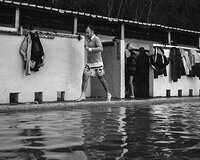
I've shot this a couple years ago. Used the rig with tubes, illuminated with a Godox flash. Basic curves editing (including inversion) and resized to 2000x3000 (bicubic). All the dirt and hairs are there to be seen, you can even see that some are on the back, others on the front. No unsharp mask applied. Looks sharp enough. 😊

Rowers.jpg


Rowers. Nikon FM2, 35-70mm f/3.5 AI(s?)? No idea what focal distance and aperture was set, probably more like 70mm. Film is Adox HR-50, shot at box speed and developed with HR-DEV, according to the instructions on the package.
 
Photrio.com contains affiliate links to products. We may receive a commission for purchases made through these links.
To read our full affiliate disclosure statement please click Here.

PHOTRIO PARTNERS EQUALLY FUNDING OUR COMMUNITY:


Ilford ADOX Freestyle Photographic Stearman Press Weldon Color Lab Blue Moon Camera & Machine
Top Bottom
