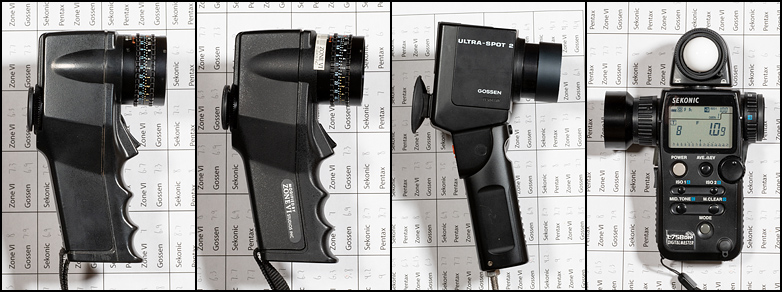
The realistic odds are that the Pentax is correct, and the others aren't! I've got five different Pentax spot meters at the moment. The oldest is 45 years old and so heavily used that it is held together with electrical tape; but it still reads accurately. I have an otherwise unused one to periodically check the performance of the others, and have never had any of them vary more than a third stop in linearity from the others; and if one did, I sent it to Quality Light Metric in Hollywood (now out of business) for recalibration (only about once a decade). All these also perfectly matched the readings on my Minolta Spotmeter F too.
The question is, does this particular meter you got ahold of happen to be a Zone VI modified one? If so, it was meant to read differently than a standard meter. But that also means that the supplemental filters inside, to balance its spectral sensitivity to that of Tri-X sheet film, might have faded over time. Richard Ritter can handle that kind of maintenance issue too. The mere presence of that silly redundant gray zone sticker from Zone VI doesn't necessarily mean it is a modified meter. They stuck those onto unmodified meters too, and even sold the labels by themselves.
Pentax spotmeters are famous for their consistent linearity and reliability, and have long been a standard in the movie industry. They have a silicon receptor with peak sensitivity at green just like the human eye, which makes them ideal for color photography. But good ole Fred Picker seemed to think the only film in the world was Triassic-X, so there you go. You can still use it for color photography, but just need to know the offset - and then just set the ASA dial to the corrected amount.
You also need to become accustomed to metering with a one-degree spot meter versus a wider angle one, or TTL metering, which forces the light to jump through hoops first.
I don't know what you paid for it; but if it's in clean condition it's definitely a keeper. The battery is not an issue unless it's been left inside the meter long enough to decompose and cause corrosion. Either silver oxide or alkaline batteries are fine.