• Welcome to Photrio!
    Registration is fast and free. Join today to unlock search, see fewer ads, and access all forum features.
    Click here to sign up

New Silver Chloride Azo type paper

Somewhere...

D
Somewhere...

  • 3
  • 1
  • 71
Iriana

H
Iriana

  • 6
  • 1
  • 137

Recent Classifieds

Forum statistics

Threads
202,745
Messages
2,844,975
Members
101,494
Latest member
FlyingDutchman
Recent bookmarks
0
Yes, Kirk, that seems to be what I was asking. But, in that case there may be no advantage to having green sensitivity at all except for more green speed. I can make it faster without green speed. So it might just increase the effort and expense with no yield of any benefit in imaging, as the speed alone is easy to do.

PE
 
The thing that I so loved about Azo was the 3-D effect one could get. In the past, PE, you've said that was a paper or base effect, not an emulsion effect. Is that still the case?
juan
 
Yes, Kirk, that seems to be what I was asking. But, in that case there may be no advantage to having green sensitivity at all except for more green speed. I can make it faster without green speed. So it might just increase the effort and expense with no yield of any benefit in imaging, as the speed alone is easy to do.

PE

Yeah, that's kind of the way I see it. A neat thing to be able to do, but maybe not that useful?
 
How soon can I order a couple of hundred sheets of 11x14?

Curt
 
Juan;

Others would have to evaluate the effect on my paper to see if it is, in their opinion, 3D. IDK. I'm not an expert in Azo printing, merely Azo making (if you will - :D ).

It cannot, at this time, be made fast enough for enlarging, but I do have a Kodabromide type paper that is about the same speed as Ilford MGIV paper.

PE
 
The thing that I so loved about Azo was the 3-D effect one could get. In the past, PE, you've said that was a paper or base effect, not an emulsion effect. Is that still the case?
juan

Juan,

If by "3-D effect" you are referring to the surface texture, like fine grain,silk, etc., then yes, this was a result of the paper support the emulsion was coated on. There were several different textures available on Azo papers. However, the textures were the same as in other product lines and often the same paper would be used in more than one product line.
 
Juan,

If by "3-D effect" you are referring to the surface texture, like fine grain,silk, etc., then yes, this was a result of the paper support the emulsion was coated on. There were several different textures available on Azo papers. However, the textures were the same as in other product lines and often the same paper would be used in more than one product line.

As I write this, I am looking at an 8X10 glossy AZO contact print that displays the 3D effect. IMHO, the surface texture of this print is not a significant contributor to its 3D appearance. IMHO, tonality is an important factor.
 
If there is a 3-D effect, it does not come from the paper support.
 
Tom;

You will have to judge that from what M&P re-create or what I'm able to do. Or, OTOH, convince Fuji to coat it on paper support and sell their product in the US. I pretty much know the formula, and can tweak it in miniscule grades, but whether it satisfies an afficionado in the field is another matter.

PE
 
If there is a 3-D effect, it does not come from the paper support.

I believe that the 3D effect displayed by this particular print has its source in the combination of the high spatial resolution of this AZO paper/emusion combination taken together with its ability to resolve micro-changes in contrast/tonality.

FYI, I am looking at an AZO print I own, made by Francesco Cicoli Abad. Francesco split developed the print in Agfa Neutol WA and Moersch Pyrocatechol, then Selenium toned it.
 
I believe that the 3D effect displayed by this particular print has its source in the combination of the high spatial resolution of this AZO paper/emusion combination taken together with its ability to resolve micro-changes in contrast/tonality.

FYI, I am looking at an AZO print I own, made by Francesco Cicoli Abad. Francesco split developed the print in Agfa Neutol WA and Moersch Pyrocatechol, then Selenium toned it.

Tom;

FYI, the actual tone scale of grade 2 azo was rather compressed compared to some other contact and enlarging papers, so it is really difficult to explain what is going on. It may be physical and outside of H&D curves, or it may be just perception. IDK, but there are data to say both are true.

I cannot answer this, except to say that Azo was unremarkable in many ways.

PE
 
Tom;

FYI, the actual tone scale of grade 2 azo was rather compressed compared to some other contact and enlarging papers, so it is really difficult to explain what is going on. It may be physical and outside of H&D curves, or it may be just perception. IDK, but there are data to say both are true.

I cannot answer this, except to say that Azo was unremarkable in many ways.

PE

unremarkable in many ways - perhaps - , but in the hands of a photographic artist - beauty is most surely achievable.

As I write this, I am looking at Alex Hawley's Beautiful 8x10 contact print - "Barn Siding" - printed on Strathmore art paper coated by Ron Mowrey with his silver chloride contact printing formulation. This is a beautiful print and it is IMHO, very similar to AZO. Alex developed this print in Ansco-130 and Selenium toned it.

"Barn Siding" shows the "3 dimensional" light and shadow effects that I associate with AZO prints and PtPd prints made by master photographers/printers.
 
Tom;

Thanks very much for the comments. I have been trying to duplicate Azo, but I was still not sure how well I had done. You have made me feel that I'm getting close.

The Strathmore was chosen for my original efforts due to ease of coating, cost and most importantly to me, the fact that it had a slight warm tone to it similar to a Kodak Ivory or Buff colored support.

PE
 
IMHO the 3-D effect is something of an artifact of the contact printing process, when using a negative that has a high contrast, but good tonality in the highlights. Some of my contact prints on Varycon and Ilford MG display this effect, usually negs that I have shot and developed for N+1. The curve and Dmax of AZO no doubt contribute, when using that paper, or similar.
 
unremarkable in many ways - perhaps - , but in the hands of a photographic artist - beauty is most surely achievable.

As I write this, I am looking at Alex Hawley's Beautiful 8x10 contact print - "Barn Siding" - printed on Strathmore art paper coated by Ron Mowrey with his silver chloride contact printing formulation. This is a beautiful print and it is IMHO, very similar to AZO. Alex developed this print in Ansco-130 and Selenium toned it.

"Barn Siding" shows the "3 dimensional" light and shadow effects that I associate with AZO prints and PtPd prints made by master photographers/printers.

Many thanks for those very kind words Tom.

One of my goals in selling that portfolio was to get it in front of someone knowledgeable and objective with a critical eye. I think Tom possesses those traits so I hold his opinion in high regard.
 
It is possible to estimate the resolution, when you compare it with a standard bw-paper?
 
Yes, with a simple set of resolution charts. I have a 4x5 negative and positive chart that I use. I have posted some examples here on APUG. Support is more important than any other factor.

PE
 
To measure resolution has been my passion, and sometimes it ruined my eyes. But any better paper is of interest and I will try a MTF-function for this paper and -taking the opportunity- to similar paper types. The quantity is very little for that, because I will work in 24x36mm, using the paper as film in the RTS III thanks its vacuum back.
 
MTF of paper is almost impossible to measure and rather meaningless unless it is measured in a viewing cabinet with instruments. The angle of illuminant, viewing distance and many other factors make up part of the problems that do not exist when measuring film.

I can only say that very heavily packed baryta with a glossy finish gives the best sharpness, while low levels or no baryta on soft cold press papers give the worst sharpness visually.

However, at the same time, contrast can be confused for sharpness and this confounds the issue.

PE
 
When no MTF exist, perhaps is that the reason, that - lets say- esoteric values will appear to determine paper qualities. This is here in apug just running with "3-dimensional look" in paper. I am impressed about the lyric textes and the descriptions about the feelings. I prefer, what I can measure. And to measure is a lot of work.

In past, the same unhappy situation was with optics, some people were writing lyrik articles about this and that to an optic. Today thanks some japanese (is it correct?) we got a discussion about Boukeh, together with the point diagram. Today we can measure an optic. The same I want for paper.
 
Well, angle of view is important with a print. We found that Goniophotometry showed this to be true, but never formalized it beyond showing it to be important.

For those interested, this is roughly the relationship between viewing angle and surface reflectance.

PE
 
There is written a lot about surfaces and measuring, starting from like - The Gloss Characteristics of Photographic papers by L.A. Jones and M. F. Fillius, no.134 in Abridged Scientific Public. Eastman Kodak, Vol. VI,1922 - to the extrem carefully with all possible goniophotometer-possibilities - Photometrische Untersuchungen an photographischen Papieren verschiedener Oberfläche von Wolfgang Falta, Jenaer Jahrbuch 1954/1, page 92-191. In my eyes the bible for paper-surfaces, a must for the Getty-collectingpeople today.

Never I read about incorporating optical thinking in emulsion-making. Once a cine-man told me about his problems with reflexion from the surface of the film-emulsion. In optical terms you minimize reflexion with interference-filters - the so called coating. What's with "coating" in emulsions? To calculate the right refraction-index for the safety-gelatine at the end of emulsion could be interesting, if - this seems possible - you can reduce reflexion even only few percent. This helps Hollywood.

To reduce reflexion on glossy paper would be the same, another way to reduce reflexion was done with Gevaluxe. It has no safety-coating, and testing this paper after 50 years storage shows no fog.

If somebody will ask me, what is the quintessence, the minimal necessary measuring for quality, I as a Dipl.-Ing.phot. (photoengineer) would answer to the normal amateur:

You know, what is a gradation curve. Please imagine -parallel to this gradation curve- a curve of highest resolution. At around density D = 0,4 -let's say- will be the point of best resolution. At higher densities the curve will going down. Depending on the different developers on the market, this function will have very different "GOING DOWNS" of the higher densities parts of this resolution curve. What make the curve going down and let show Highlights looking grey-smeared? It is the diffusion aspect of oxydised and infecting developer, of halogene, of luminescence, of infecting silver ions and so on. You measure the resolution, when you photograph testtargets in different contrast from underexeposure up to 12 stops overexposure. The humanoid negative factor by this work is - it is a lot of work.

How could this done in simple filmtesting? I found a good example, showing in the motive for the testobject a 10 stop range - please see only to the pictures

filmspeed 25-64 ISO
http://www.schwarzweiss-magazin.de/swmag_leser_11_a.htm
filmspeed 100 ISO
http://www.schwarzweiss-magazin.de/swmag_leser_11_b.htm
filmspeed 125-400 ISO
http://www.schwarzweiss-magazin.de/swmag_leser_11_c.htm
filmspeed 400-3200 ISO
http://www.schwarzweiss-magazin.de/swmag_leser_11_d.htm

This I want to see in paper-testing. The work would I do, and nobody needs to pay me. Its my own job.

Some more simpler testing is using FOGRA or UGRA- stripes from reprographic industry for screendot-projection (I dont know the US-variants), but they use high contrast. The negative you enlarge on the paper, will never have high contrast values, because its max. density is normally around D=1.8. I am thinking to check the idea, to change a FOGRA-UGRA stripe to contrast 1:30 and/or 1:1.6, perhaps this would be more in the direction of the GOLDBERG-DETAILPLATE. (E.Goldberg - Der Aufbau des Photographischen Bildes, Teil I: Helligkeitsdetails, 2. edit., 1925, my exemplar is stamped: Kodak Ges. m. b. H., 76 Markgrafenstr. Berlin) With this detailplate you can get with one test the most possible datas from an emulsion - for resolution, diffusion, gradation, point-spread-function.

Looking to whole field of science, at first you must look to the individuum itself. Every human see a little bit different, and the data-connecting of the eye-signals is different. Next is measuring from institutes, national or global, all sensual aspects in feeling, here in Germany is this done by www.grp.de since 40 years all 5 years with 4000 people. The results show a intensiv change in the feeling of viewing - anything you see gets a more importance, the ethic values from your memory will not asked more than in earlier times.

Looking to whole field of science, at last you mention to see in 3-d a quality, this is mentioned in the text "Für ein neues Photopapier" -for a new photopaper- from 4. jan. 2003. Anything, people is mentioned in forum 46113 in seeing differences in a better paper, all about the subtil mechanism of unconscious, there it is. Sorry, it is in german, but for these, who want to read the original, look to /download/neues_photopapier.pdf on

http://www.gigabitfilm.de/html/deutsch/anwendung/wissenschaft/chemie/chemie.php?Layout=normal

Thank You for your patience.

 
The qualitative examples shown in your references mean absolutely nothing unless suplemented by hard data.

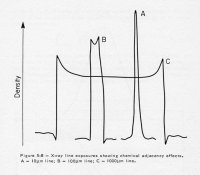
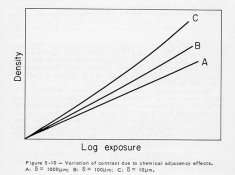
I will post again here, the two pertient graphs from Mike Kriss' treatment of the subject. The entire paper is 60 pages long and mostly math.

Basically, the left chart shows the traces from edges of 10, 100 and 1000 micron lines, and the right chart shows the contrasts taken from a step wedge of each of these sets of lines. You will note therefore that contrast is a function of magnification as much as sharpness is.

This means that the greater the magnification, the higher the contrast, but this is offset by the magnification itself. At equal magnification, the increased contrast increases apparent sharpness.

This crossover between sharpness and contrast will confuse you if you don't have hard data, but of course pictures are more important than data. But it still proves nothing, it only proves what we percieve, not what is. That is why you need both in a side-by-side comparison.

To get more data, it is useful to do the line exposure by visible light and X-ray both to aid in determining actual sharpness and sharpness degraded by turbidity and inter-reflections from the base. This latter experiment is critical in the design of any film system.

PE
 

Attachments

  • Edge Effects.jpg
    Edge Effects.jpg
    139.5 KB · Views: 137
  • Micro Contrast.jpg
    Micro Contrast.jpg
    126.5 KB · Views: 129
To reduce reflexion on glossy paper would be the same said:
If you are interested in minimum reflection of the print surface, I would suggest obtaining some JDSU (formerly OCLI) HEA glass. It has a multi-coating 'high efficiency anti-reflection' coating which reflects between 0.1% and 0.2% in the visible spectrum. You can get it coated either both sides or one side. Use the one sided version, and coat a thin silver rich emulsion to the uncoated side. Dry, expose, develop. Then spray a layer of Barium Sulfate white reference standard (Kodak used to sell this, but you can make your own by ball milling high purity Barium Sulfate with isopropyl alcohol). Use a spray gun to spray on the backing layer. You then view the print from the front, the HEA coated surface will not reflect much light, and the gelatin has an index of refraction not too far from the glass, so you won't get much reflection there, the light will pass through the silver/gelatin layer, and scatter back from the ultra white backing. This is the optimal method of displaying in the reflection mode. I've been intending to do this using Dye Transfer instead of silver halide, but the principle is the same.

Regards - Jim Browning
 
Photrio.com contains affiliate links to products. We may receive a commission for purchases made through these links.
To read our full affiliate disclosure statement please click Here.

PHOTRIO PARTNERS EQUALLY FUNDING OUR COMMUNITY:


Ilford ADOX Freestyle Photographic Stearman Press Weldon Color Lab Blue Moon Camera & Machine
Top Bottom