There is written a lot about surfaces and measuring, starting from like -
The Gloss Characteristics of Photographic papers by L.A. Jones and M. F. Fillius, no.134 in Abridged Scientific Public. Eastman Kodak, Vol. VI,1922 - to the extrem carefully with all possible goniophotometer-possibilities -
Photometrische Untersuchungen an photographischen Papieren verschiedener Oberfläche von Wolfgang Falta, Jenaer Jahrbuch 1954/1, page 92-191. In my eyes the bible for paper-surfaces, a must for the Getty-collectingpeople today.
Never I read about incorporating optical thinking in emulsion-making. Once a cine-man told me about his problems with reflexion from the surface of the film-emulsion. In optical terms you minimize reflexion with interference-filters - the so called coating. What's with "coating" in emulsions? To calculate the right refraction-index for the safety-gelatine at the end of emulsion could be interesting, if - this seems possible - you can reduce reflexion even only few percent. This helps Hollywood.
To reduce reflexion on glossy paper would be the same, another way to reduce reflexion was done with Gevaluxe. It has no safety-coating, and testing this paper after 50 years storage shows no fog.
If somebody will ask me, what is the quintessence, the minimal necessary measuring for quality, I as a Dipl.-Ing.phot. (photoengineer) would answer to the normal amateur:
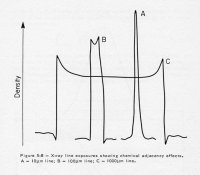
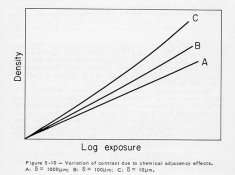
You know, what is a gradation curve. Please imagine -parallel to this gradation curve- a curve of highest resolution. At around density D = 0,4 -let's say- will be the point of best resolution. At higher densities the curve will going down. Depending on the different developers on the market, this function will have very different "GOING DOWNS" of the higher densities parts of this resolution curve. What make the curve going down and let show Highlights looking grey-smeared? It is the diffusion aspect of oxydised and infecting developer, of halogene, of luminescence, of infecting silver ions and so on. You measure the resolution, when you photograph testtargets in different contrast from underexeposure up to 12 stops overexposure. The humanoid negative factor by this work is - it is a lot of work.
How could this done in simple filmtesting? I found a good example, showing in the motive for the testobject a 10 stop range - please see only to the pictures
filmspeed 25-64 ISO
http://www.schwarzweiss-magazin.de/swmag_leser_11_a.htm
filmspeed 100 ISO
http://www.schwarzweiss-magazin.de/swmag_leser_11_b.htm
filmspeed 125-400 ISO
http://www.schwarzweiss-magazin.de/swmag_leser_11_c.htm
filmspeed 400-3200 ISO
http://www.schwarzweiss-magazin.de/swmag_leser_11_d.htm
This I want to see in paper-testing. The work would I do, and nobody needs to pay me. Its my own job.
Some more simpler testing is using FOGRA or UGRA- stripes from reprographic industry for screendot-projection (I dont know the US-variants), but they use high contrast. The negative you enlarge on the paper, will never have high contrast values, because its max. density is normally around D=1.8. I am thinking to check the idea, to change a FOGRA-UGRA stripe to contrast 1:30 and/or 1:1.6, perhaps this would be more in the direction of the GOLDBERG-DETAILPLATE. (
E.Goldberg - Der Aufbau des Photographischen Bildes, Teil I: Helligkeitsdetails, 2. edit., 1925, my exemplar is stamped: Kodak Ges. m. b. H., 76 Markgrafenstr. Berlin) With this detailplate you can get with one test the most possible datas from an emulsion - for resolution, diffusion, gradation, point-spread-function.
Looking to whole field of science, at first you must look to the individuum itself. Every human see a little bit different, and the data-connecting of the eye-signals is different. Next is measuring from institutes, national or global, all sensual aspects in feeling, here in Germany is this done by
www.grp.de since 40 years all 5 years with 4000 people. The results show a intensiv change in the feeling of viewing - anything you see gets a more importance, the ethic values from your memory will not asked more than in earlier times.
Looking to whole field of science, at last you mention to see in 3-d a quality, this is mentioned in the text
"Für ein neues Photopapier" -for a new photopaper- from 4. jan. 2003. Anything, people is mentioned in forum 46113 in seeing differences in a better paper, all about the subtil mechanism of unconscious, there it is. Sorry, it is in german, but for these, who want to read the original, look to /download/neues_photopapier.pdf on
http://www.gigabitfilm.de/html/deutsch/anwendung/wissenschaft/chemie/chemie.php?Layout=normal
Thank You for your patience.





 ).
).