• Welcome to Photrio!
    Registration is fast and free. Join today to unlock search, see fewer ads, and access all forum features.
    Click here to sign up

New HC-110 Formula

Recent Classifieds

Forum statistics

Threads
203,062
Messages
2,849,343
Members
101,629
Latest member
Evgenymv
Recent bookmarks
0
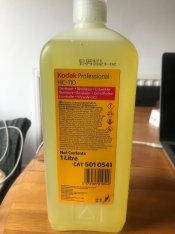
That is what my bottle looks like (USA). I bought in 2018, supposedly expired in July 2020. So far it is still good (last used in July).
Well I got my new bottle today and it expires in 2023. So either Kodak is still making this stuff somewhere in the UK/EU or that the new formula is only targeted in the US due to their environment regulations, just like how Velvia 100 is discontinued.
76AF3E9B-D6CD-437B-98EF-4E166B035715.jpeg
 
Is that stuff syrupy and viscous, or thin and watery? If the latter, it's the new formula in the old style bottle.
 
It's the syrup stuff. If you look at the production number it's like 10,000 more.
 
I found a paper by Li, Jiao and Chen on the solubility of SO2 in several solvents, including DEA. The title of the paper is "Solubility of sulphur dioxide in polar organic solvents". Unfortunately, the paper is not complete enough to be useful. It gives solubility at several temperatures, but it does not specify what the partial pressure is for SO2 equilibrated with the liquid. This means that the data in the paper is useless in its present form. I am actually surprised it got past the peer review process.

SO2 (which is a gas) can be bought in cylinders. I believe HBr (which is also a gas) can also be bought in cylinders. In principle it should not be too hard to build an apparatus that would allow SO2 and HBr to be added to DEA. Of course, good safety practices would need to be followed. On approach would be to treat DEA in two separate fractions, one for SO2 and one for HBr and then combine the two solutions in the proper proportions.

If we make the assumption that the partial pressure of SO2 in the experiments in the paper was 101 bar (i.e. one atmosphere pressure) and take information from figure 1 of the paper and convert mole fraction to weight percent we would calculate that the equilibrium concentration (in percent by mass) of SO2 in DEA would be 19.2%. That's actually pretty close to the weight percent of SO2 in the old HC-110 as listed in the MSDS. Of course, DEA itself only makes up about 30-35% of the old HC-110, so the solubility of SO2 in it won't be the same as in pure DEA, but at least it may be of similar order of magnitude.

Also consider an important fact. If the partial pressure of SO2 in old HC-110 is greater than one atmosphere, then the SO2 gas in the headspace of a bottle would be greater than one atmosphere, which would make a closed bottle tend to bulge, or even burst, so we can be pretty sure that the partial pressure of SO2 is less than one atmosphere. This means that it should not take a pressure vessel to dissolve the required amount of SO2 into HC-110. This considerably relaxes the technical requirement to make a safe process for adding SO2 to the mixture.
 
My researches indicate that the exclusive distributor in Europe for Kodak Alaris chemicals was - wait for it - Tetenal.
And the retailers there are still looking to get their Kodak branded chemicals from Tetenal.
And don't know what is going to happen with Kodak Alaris out of the picture.
 
This means that it should not take a pressure vessel to dissolve the required amount of SO2 into HC-110. This considerably relaxes the technical requirement to make a safe process for adding SO2 to the mixture.

If you're thinking of doing this, isn't it much easier to simply take out Sulphite from the formula of the concentrate? Sulphite can always be added while preparing the working solution.
 
101 bar (i.e. one atmosphere pressure)

Just to clarify, one atmosphere is ONE bar, or about 101 kiloPascal (1 Pascal = 1 Newton per square meter).
 
In the UK , I received my bottle of 501 05141, 2016 msds today.
It is marked "Made in Germany for Kodak Alaris" "Expiry 2023"
This link from 2019 notes that "Today Kodak's cash cow developers Xtol and HC-110 [were] produced by Tetenal":
https://petapixel.com/2019/02/01/a-closer-look-at-tetenal-a-photo-firm-thats-too-important-to-fail/
Here Matt notes production of many Kodak Chemicals [but not Ilford] was moved to the US after the Tetenal bankruptcy:
https://www.photrio.com/forum/threads/would-we-agree-about-xtol.183124/page-3#post-2406311
So it seems that [but is not positively proven] that the Expiry 2023 product still available in the UK may be the last of the traditional HC-110.
The Ilford chemicals appear to be made by New Tetenal.
I put a few drops from my new bottle on a piece of film emulsion for 20 minutes, there was no detectable development, the 2016 msds product appears water free.

HC-110 bottle.jpg
 
To add to the potential confusion, note the words on that label: "For distribution in U.S.A."
 
For those who like the old version of HC-110, you may wish to try to get some from Europe while you still can.
I have reason to understand that there is a component used in that production that has become difficult to obtain in Europe, and impossible to import into the US. And that once that component is no longer obtainable in Europe, HC-110 in that form will no longer be produced.
The version made in the USA uses much more easily sourced materials, and has better long term viability because of that.
The package size for the US produced version may be re-considered, due to the different keeping properties.
 
I have a bottle of the new formula, I use sparingly.
If it goes bad on me in a year or so, I guess I'll go LegacyPro L110.
I'm damn close to using all their stuff for my B&W needs as it is.
HC 110 is the last Kodak branded thing left in my stash besides some color film.
 
I must say that I am confused about the new Kodak/Alaris HC-110. I had used the old syrup HC-110 years ago, I remember mixing a "stock solution" of 1:3 (syrup hc-110 : water). Then to make a "working solution", dilution B would be: 1 part stock solution to 7 parts water. With the new HC-110 which is not a syrup at all, I am not clear on how I mix it. Do I still make a "stock solution" and then dilute that further for Dilution B like the old HC-110? I can't find a data sheet on Kodak's site. If someone can link me to one I would appreciate it. If I knew it would be so confusing I would have just stuck to DD-X.
 
It is supposed to be equivalent to the old formula. so you could do the two step dilution, or just do one part of the package solution to 31 parts water to get directly to dilution B. (that is the way I am used to using HC-110) I believe the Bottle I have says to go directly to Dilution B. (as needed)
 
Thanks, Charles. So I should just ignore the fact that this solution is so much thinner and use it like the old HC-110 syrup? I would feel better if there was some documentation. However, if that is the way you are using the new HC-110 then I will try it using it the same way. So if I have a 16 oz. developing tank then I can just take 1/2 ox of HC-110 from the bottle and mix it with 15 1/2 oz of water. Then I could do away with mixing a "stock" solution. That would be easy.
 
Here's an oddball question: What if one were to do an intermediate dilution (i.e. make a stock solution), but instead of using water it would be to use something like ethylene glycol or popylene glycol? The idea here would be to make the solution less-aqueous, with the hope that it might have a longer shelf life.

One thing that is uncertain about this strategy is whether diluting the "syrup" (even though the new style HC-110 is not actually a syrup, but I had to call it something) would result in precipitation of some components of the solution.

Another thing that is uncertain is whether this would actually extend the shelf life.

And another question: would storing the new style HC-110 in the fridge extend the shelf life? A wild card is whether refrigeration might cause precipitation of some components, but if not then it seems likely that refrigeration might extend the shelf life by several fold.
 
And another question: would storing the new style HC-110 in the fridge extend the shelf life? A wild card is whether refrigeration might cause precipitation of some components, but if not then it seems likely that refrigeration might extend the shelf life by several fold.

I would avoid that. Cold does make crystals precipitate out. Supposedly if you apply heat and time, the crystals will go back into solution. If I recall correctly, Kodak has stated that they'll be giving a slight tweak to reduce that.
 
Thanks, Charles. So I should just ignore the fact that this solution is so much thinner and use it like the old HC-110 syrup? I would feel better if there was some documentation. However, if that is the way you are using the new HC-110 then I will try it using it the same way. So if I have a 16 oz. developing tank then I can just take 1/2 ox of HC-110 from the bottle and mix it with 15 1/2 oz of water. Then I could do away with mixing a "stock" solution. That would be easy.
That is what Sino Promise (the new source of Kodak chemicals) recommends - the HC-110 datasheet linked to on their website is just the old Kodak Alaris datasheet which was the old Eastman Kodak datasheet, except the company names were changed.
Here is the page with the various links: https://kodak.sinopromise.com/photo-chemistry.html
 
I’ve found that the new HC-110 formula loses strength when mixed and stored properly in glass bottles over the course of about two months. This might seem long, but compare to the old HC-110, which was stable mixed and stored in same conditions for 6-8 months or more.

I also suspect as the concentrate gets older, this “working time” for mixed developer decreases as well.

Dilution B, and characterizing new emulsion batches for dry plates.
 
Thanks again, Charles. I will treat it like the old HC-110. And with this thinner solution it probably will be easier to go directly to 1:31 for B dilution.
 
I’ve found that the new HC-110 formula loses strength when mixed and stored properly in glass bottles over the course of about two months. This might seem long, but compare to the old HC-110, which was stable mixed and stored in same conditions for 6-8 months or more.

I also suspect as the concentrate gets older, this “working time” for mixed developer decreases as well.

Dilution B, and characterizing new emulsion batches for dry plates.
With respect to the first part of your post, that behavior is actually closer to the manufacturer's recommendations than the old stuff!
 
Has anyone checked to see if undiluted new formula HC-110 will develop a snip of exposed film? This may give a rough indication of how susceptible it is to oxidation.
 
Just a heads up for anyone in Australia who yearns to acquire the old HC-110 rather than the new formulation. Vanbar have 1Litre CAT_5010541 at around half of their previous (high) price because it is "Expired." It is marked EXP:2020-09 and is $33 (Australian dollars, not real dollars).

I don't usually use HC-110 these days, but bought a bottle to try with some rather old film.
 
The main carrier for sulfite in c110 was diethanolamine sulfur dioxide (DESO). It is not available commercially so I make this regularly at home when I want to concoct hc110 concentrate (about as close as I can get reverse-engineering it). DESO can easily be made from diethanolamine and sulfur dioxide. It is stable and has very little odor once made. Best make it out of doors even if you have a SO2 scrubber as part of your setup.
 
Photrio.com contains affiliate links to products. We may receive a commission for purchases made through these links.
To read our full affiliate disclosure statement please click Here.

PHOTRIO PARTNERS EQUALLY FUNDING OUR COMMUNITY:


Ilford ADOX Freestyle Photographic Stearman Press Weldon Color Lab Blue Moon Camera & Machine
Top Bottom