

• Welcome to Photrio!
    Registration is fast and free. Join today to unlock search, see fewer ads, and access all forum features.
    Click here to sign up

Mystery bulk roll of film - cine sprockets, no rebate?

Recent Classifieds

Forum statistics

Threads
203,398
Messages
2,854,044
Members
101,817
Latest member
goodman1999
Recent bookmarks
0

devixluvic

Member
Joined
Apr 16, 2026
Messages
1
Location
Canada
Format
35mm
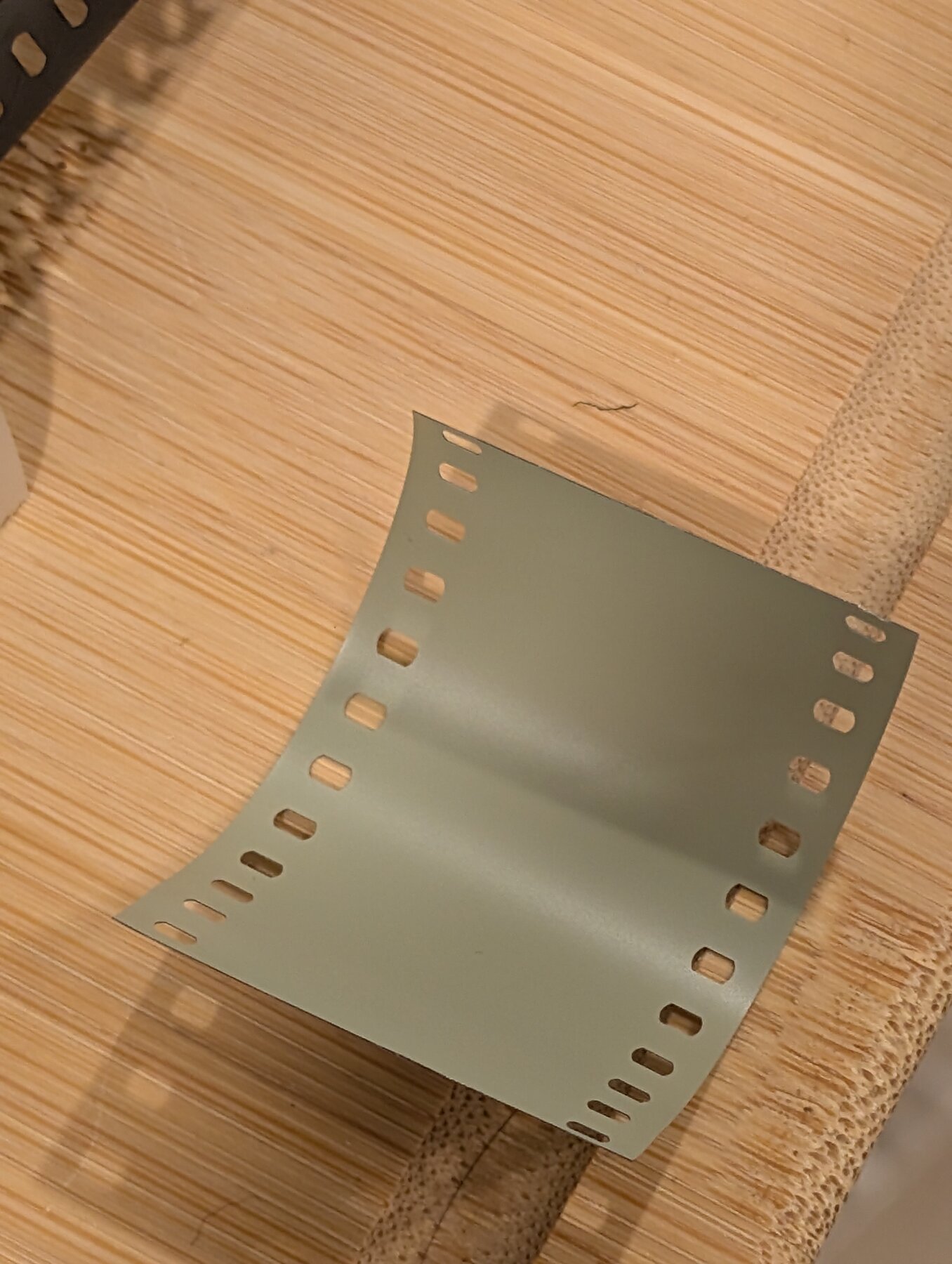
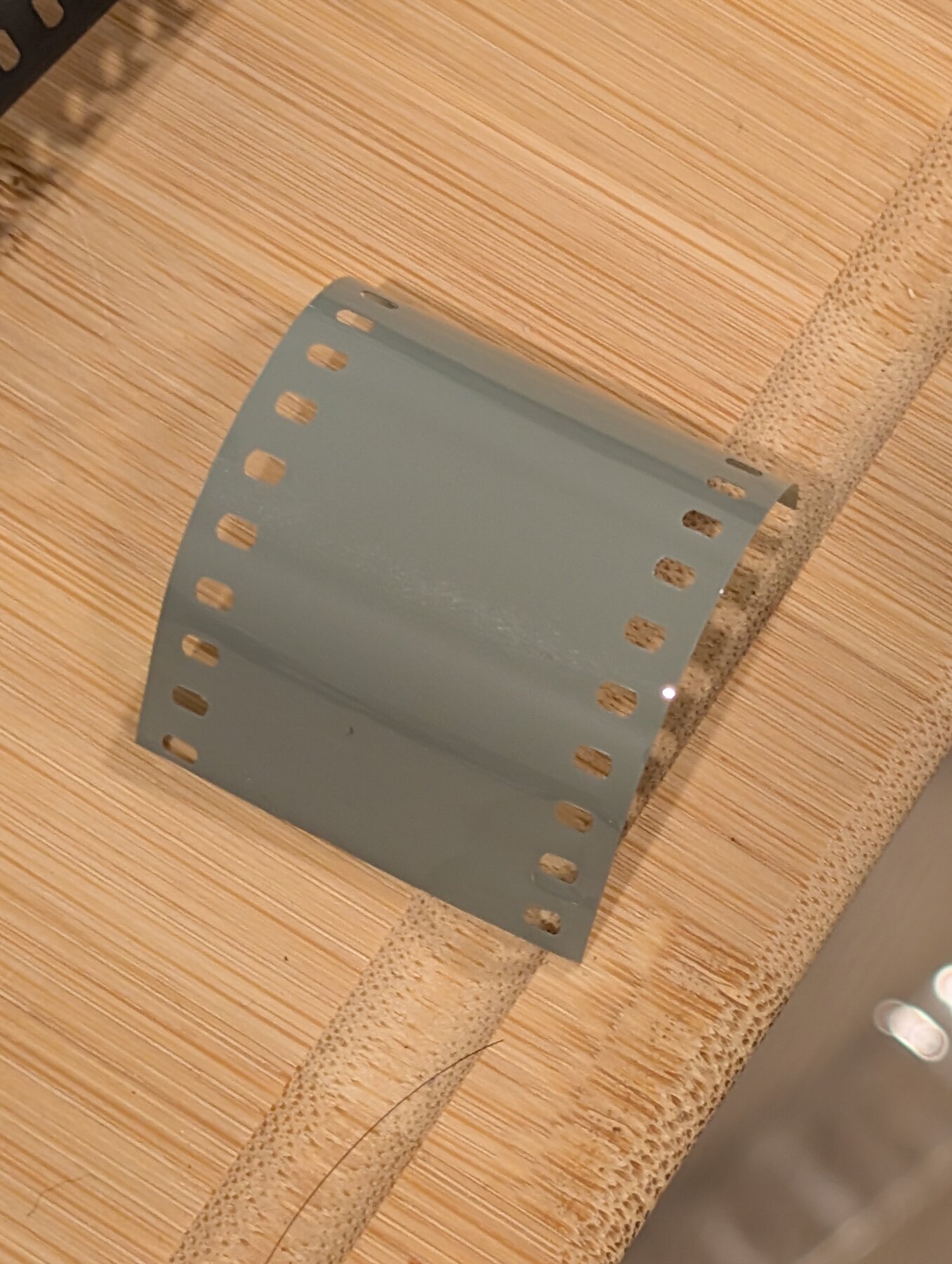
I recently bought a used Alden bulk loader for 35mm film, but when I picked it up there was a roll of black and white film loaded. It's got no remjet and looks like B+W film, but oddly it has cinema-film style perforations with the rounded edges. Undeveloped it has a fairly pale grey colour to it. It's very curly, though that may be due to age. In case it adds to the history, the bulk loader has a "Property of NSCAD" sticker which looks to be an art school/university in Halifax, NS - nearly all the way across the continent from where I bought the loader. This film definitely has a polyester base, it does not tear anywhere close to as easy as HP5 does.

This is how it looks undeveloped:
PXL_20260415_005622338.jpg
PXL_20260415_005631938.jpg


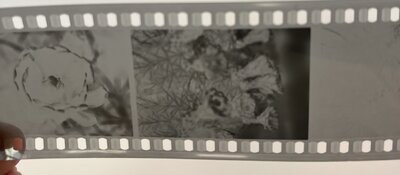
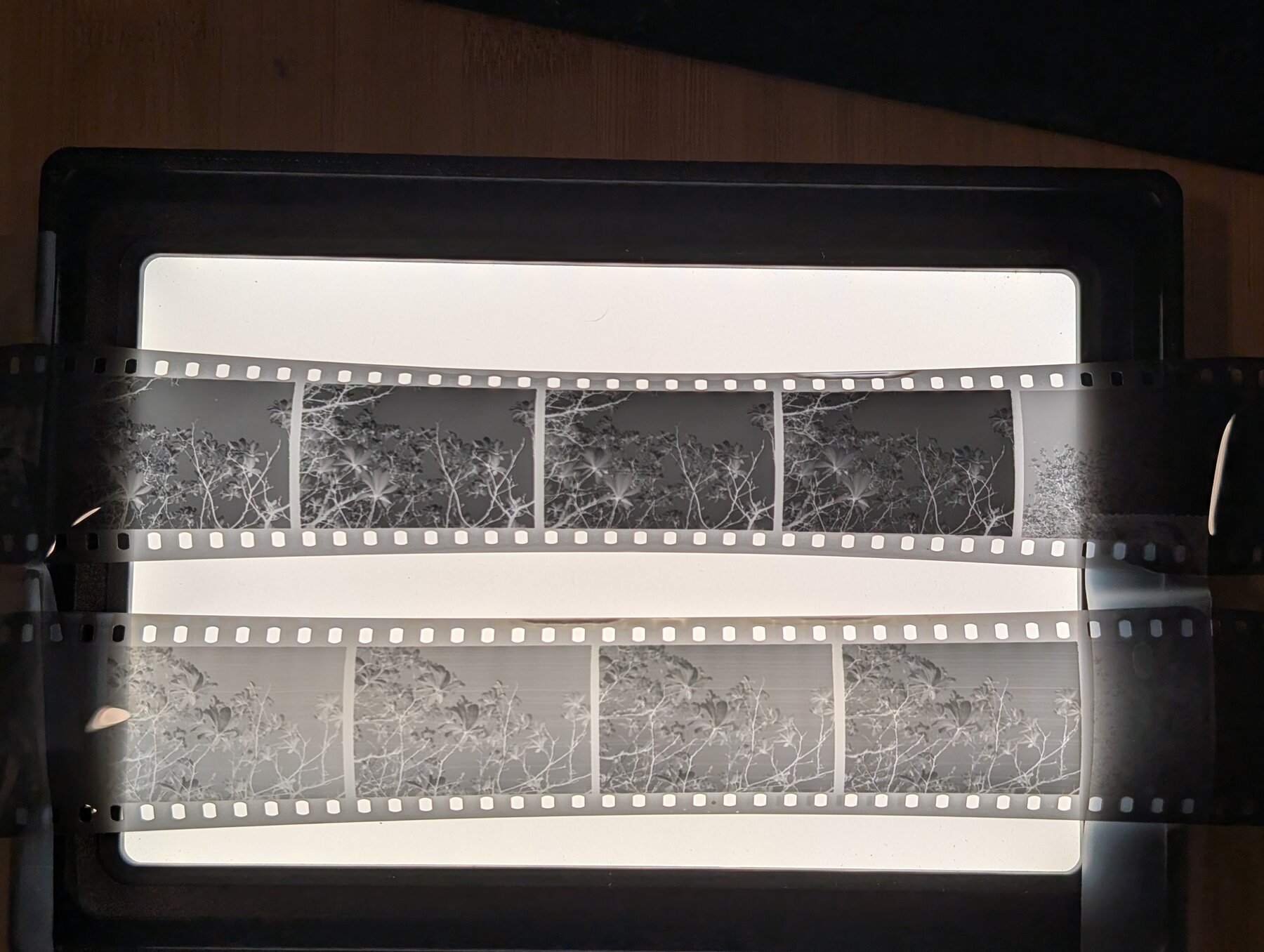
Thinking it might be super expired Kodak Double-X, I shot a test roll bracketing my exposures 5 stops from ISO 100 down to ISO 6. I used my Canon Elan 7e which has an accurate meter. These were taken outside in bright sunlight (very blue sky, no filter):
PXL_20260415_004551260.jpg


Both test strips were developed in HC-110 dilution B. The bottom one was developed for 7 min 30 seconds, and the top strip had 20mL of Flic Film Fog-Off added to the tank (benzotriazole in solution). The Fog-Off bottle recommended adding 10% dev time per 5mL of chemical added, so I did 7.5 x 1.4 = 10.5 min development for the top strip. There's a good amount of base fog, even with the BZT/Fog-Off added. Definitely some usable images, but... no rebate or edge markings of any sort!


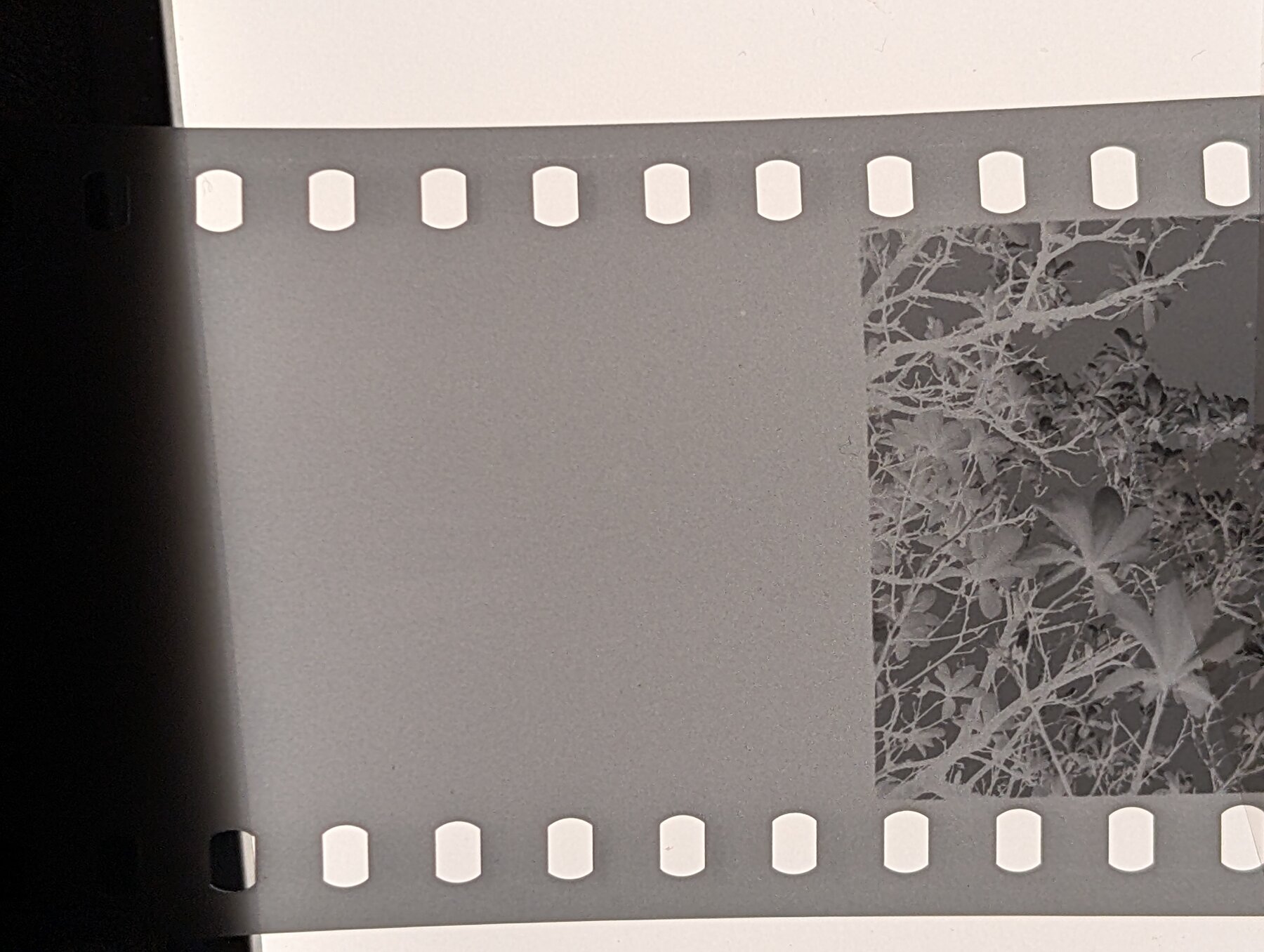
The film has some very pronounced grain, visible even when looking at the negatives on a light table:
PXL_20260415_004659322.jpg


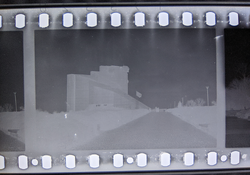
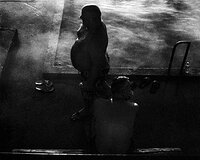
And here are some scans from the Fog-Off roll. Please keep in mind the film wanted to curl inwards very badly, so the edges of these scans will be out of focus unfortunately...

Rated at ISO100:

ISO100.jpg


Rated at ISO 25:
ISO25.jpg


Rated at ISO 6:
ISO6.jpg


I've read that some bulk Foma rolls have no edge markings, but I also read that Foma uses normal still-photography style perforations on their edges.


If anyone had any insight as to what this roll might be I'd appreciate the help!
 
Welcome aboard @devixluvic !

The sprockets holes are cinema perforations, so this is likely some cinematographic stock repurposed for still photography. Could be a lot of things. One of the things you might try is whether it's sensitive to red (panchromatic) or orthochromatic (no red sensitivity).

I also read that Foma uses normal still-photography style perforations on their edges.
Yes, correct.

Plenty of bulk film has / had no edge markings. This could be literally one of several dozens of types of film.

it might be super expired Kodak Double-X
I don't know if and when this was last manufactured without keycode edge printing.
 
Unfortunately as Koraks says, lots of film back in the day didn't have edge markings, especially if it was long rolls of cinematographic stock. It's not really possible even to guess at the age of the film.

It may remain a mystery unless someone out there knows what films were used by NSCAD.
 
The only film I can think of that somewhat matches the 'mystery' is UN-54 from ORWO Filmotec. However, their base is not polyester. In fact, I somewhat doubt this film has such a base, considering how it curls.
 
The lack of printed in edge codes always mystifies me on cinema stock, as they were integral to conforming the negative for striking release prints. Of course, there were after market film code machines that would print numbers with a solvent based ink in the perforation area, but it was a messy, dangerous operation that took a lot of labor and risked damaging the film in the process.

In any event, you could counter-wind it on a 2 inch film core after processing and try to get it to relax before cutting strips. Polyester has a tendency to "core set" to the shape of the wind with long storage times. Counter-winding can help relax the film.
 
As one who worked in the 35mm slitting and perforating factory in Rochester, nearly all motion picture stocks with Bell-Howell perforations would have edgeprint. There is one single dot in between perforations under the 3rd frame of the picture, but the slitter repeat, Kodak, would requiore processing of roughly 25 inches of film. Yes there are gaps in the printing which would go further than the four or five frames shown. Industrial films, which would be panchromatic, like traffic surveillance, check recording or bank security films might not have the formal edgeprint and most likely would have been on polyester base, but would not typically be offered with BH perforations.

Other companies, like AGFA and Fuji would also have been manufacturing similar film and this might be from one of those companies. I will check my information later today to see if I can locate any EKCo stock that matches this interesting request.
 
Could be any of a number of films as mentioned, but this film looks a lot like Polypan F, which was on polyester. I'll have to check the sprocket holes on some of mine from way back to see if it was cin sprockets.
 
Consider also that ORWO made quite a lot of cinema film. I have several 60m cans of NP-55 (same as NP20, but cinema perfs and slightly thinner base) that while not as strong as Estar, are not nearly as easy to tear as acetate based films.

I will have to look and see if my NP-55 has edge codes, it was (as far as I can find!) intended for news crew vans.
 
The old NP-55 and NP-7 films had a strongly purple-tinted acetate base, and all of them had edge markings. I still have some NP-55 - surprisingly, it's very good.
However, the newer UN-54 from ORWO Filmotec had no markings, but again used an acetate base.
But now that I think about it, Polypan F indeed had no markings, with that kind of perforation and a polyester base. Maybe we have a winner :smile:
 
Could be any of a number of films as mentioned, but this film looks a lot like Polypan F, which was on polyester. I'll have to check the sprocket holes on some of mine from way back to see if it was cin sprockets.
That came to my mind as well, but (1) it'd have to be panchromatic, hence my earlier question; I'm not sure it is and (2) it looks too fast for polypan-F which really only hit about ISO 50 on a sunny day, wind in back and going down hill. The film OP shows looks a little faster. And (3), fog level is kind of high for Polypan F, but my memory might be...foggy.
 
One thing to keep in mind is this very well might be a special order film. Large institutions, especially technical ones, would often have special requirements for film that were not normally available to order. Kodak especially is well known for offering such films. Custom finishing to different SP numbers and SO films were common back in the day. This very well could be XX or Tri-X cine stock on PET base for use in something like a high speed camera. It’s not unprecedented, that’s what SO-078 was, just with TMax emulsion.
 
1776702808007.png
Perhaps someone will recognize this single dot as lone edge marking? Could be italian motion picture film?
 
Photrio.com contains affiliate links to products. We may receive a commission for purchases made through these links.
To read our full affiliate disclosure statement please click Here.

PHOTRIO PARTNERS EQUALLY FUNDING OUR COMMUNITY:


Ilford ADOX Freestyle Photographic Stearman Press Weldon Color Lab Blue Moon Camera & Machine
Top Bottom