• Welcome to Photrio!
    Registration is fast and free. Join today to unlock search, see fewer ads, and access all forum features.
    Click here to sign up

My Dollar Densitometer

Recent Classifieds

Forum statistics

Threads
202,083
Messages
2,834,844
Members
101,104
Latest member
tcruicks
Recent bookmarks
0
OP
OP

Alan Townsend

Member
Joined
Dec 7, 2025
Messages
166
Location
Peoria, IL, USA
Format
Multi Format
In fact, you do. Part of the trick (insofar it works) is in the fact that @Alan Townsend's "$1" meter relies on a >$150 DMM
My meter is not a great one. I would say kind of middle quality. It is autorange only with only three ranges on impedance. I had a much better one 20 years ago that got stolen.
since anything more modestly priced will generally not perform sufficiently well in high-impedance applications. Hence, part of the non-linearity you're running into is likely caused by meter itself.
Yes, mostly the current from the meter circuit causing heating in the CdS cell, which slews the reading
As I alluded to in my earlier post, there are also challenges in managing the actual light path. With low-density samples, these effects drop away sufficiently in some cases, but as you try to measure higher densities, things get tricky. This is in addition to more fundamental issues mentioned earlier.

Like I said before, the principle (sort of) works, but the question is how well it works, and what conditions need to be met to make it work sufficiently well. Once those are figured out, you've re-invented the densitometer...
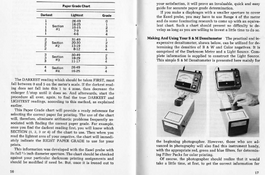
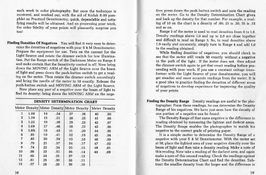
No, just copying this old design with more modern instrumentation. http://www.jollinger.com/photo/meters/meters/sci-mech_a3.html

I had one of these when I was a kid and was amazed at the simplicity.
 

koraks

Moderator
Moderator
Joined
Nov 29, 2018
Messages
27,315
Location
Europe
Format
Multi Format
I see your point, but it might be more manageable in practice than it seems.
My comments are based on many practical projects along these lines and the theoretical issues encountered in the process. Give it a try, see how it goes. You may recognize some of the things I mentioned.

With the ADS1112's 16-bit base plus 4-bit PGA, we get a theoretical 20-bit range
I think it's 3-bit PGA, not 4. Also, you're simplifying things a bit. Refer to the datasheet and see how the input range works. You'll notice you lose another bit if you're working with a positive signal instead of a differential input. Now, of course, you could shift the analog signal into a differential pair on the ADC...we could complicate things in any number of ways. Then we'd have to see how many bits of precision we lose in this manageable practice to S/N issues.
Given a 16-bit DAC, the average electronics enthusiast (like myself) will struggle to get 16 'clean' bits of resolution. 18...wow. 20...amazing.

Off-the-shelf chips like the AD8310 log amp offer 95dB (approx.D 9.5) of range via internal six-stage gain. That’s likely far more than here requires. The issue you mentioned was resolved by ADI engineers.
Sure. Btw, in consumer quantities around here that's a €15 part. This excludes everything else needed. Like I said, the problem isn't that there's no solution. It's just that you end up reinventing the wheel and realize that it was a pretty decent wheel to begin with. Now, that can be lots of fun and might even make sense sometimes.

Anyway, we're veering off course. To each their own; presently I'm not working on a densitometer project, although in the long list of plans (most of which will never materialize) there indeed is also something (things, actually) along these lines.
 

Sharktooth

Member
Joined
Apr 4, 2022
Messages
428
Location
Canada
Format
Medium Format
I’ve got some good news about the cds cell measurements.

I put some more thought into this today, to figure out what’s happening. The response curves that bernard_L showed for a specific cds cell, shows linear response on a Log - Log scale. The straight lines don’t go through the zero point, so you have a non-zero Y intercept.

Any straight line function can be described in the form Y = mX + b where m is the slope and b is the Y intercept value (or value of Y when X=0). If we just look at Logs of the two resistance values or two conductance values for Y, we can look at the difference. Log(Y2) - Log(Y1) = Log(Y2/Y1) = Log((mX1+b/(mX2+b))

If b was 0 then this reduces to Log(mX1/mX2) and the m cancels out to be Log(X1/X2) This would mean the Log difference in light intensity (or difference in density) would equal the Log difference in Resistance or Conductance.

Unfortunately, b is not 0, so it’s not an easy calculation.

The good news is that if the Log Log response is linear over a wide range, we can still use a relatively simple linear formula to calculate densities. We just need two known reference densities to calibrate the system.

If you have a step wedge with already marked density values, you can use that.

I have a home-made step wedge I made decades ago with marked density values. I took two medium density steps, one at 2.16, and the other at 0.87. I then measured the resistance values of the cell under each step. I made sure the light source was strong enough to get resistance readings around the middle of it’s range. I then calculate the Log of each of these resistances.

Since density values are already Log units, these become my X values. The Log Resistance values become my Y units. If a straight line is plotted through these two points, you can easily calculate m and b. m = (Log(R2)-Log(R1))/(Density2-Density1)

b can be calculated using either one of the points b = Y - mX b = Log(R1) - m(Density1)

Now use the formula Y = mX + b to calculate the density for any other resistance value. To do that, you rearrange the formula to calculate Density from Resistance, to the form X = (Y - b)/m

or Density = (Log(Resistance3) - b)/m

I made up a simple Excel sheet to do the calculations. I have the two reference densities already entered. I just need to find the resistance values for the two points, and enter those. The last entry is the resistance at any other random point, and just calculate the density using the formulas. Excel does all the heavy lifting with the calculations. The results were excellent for a seat-o-the pants experiment. Caculated density values were very close to the actual density. I’ve attached some pictures of a couple of sample measurements. It definitely would be good enough for doing quick evaluations of the density of your negatives, without needing a densitometer.

If you’re using your reference steps in an enlarger, you need to calibrate the system at a specific height and aperture, and all the measurements need to be made at the same conditions.

In the sample pictures of the Excel file, X Density 1 and X Density 2 are my reference negative densities. Y Resistance 1 and Y Resistance 2 are going to vary depending on the brightness of the light source, so they are specific to each setup.
Slope m and b are calculated values, and will be unique for each setup. New Resistance is the measured Resistance value of the cell under an unknown density. Calculated Density is the calculated density of the unknown density, based on the linear formula. Actual is the actual measured
density via a densitometer.

CDS 1 pic.jpeg


CDS 2 pic.jpeg
 
Last edited:

Yezishu

Member
Allowing Ads
Joined
Dec 21, 2024
Messages
165
Location
Hong Kong
Format
35mm
My comments are based on many practical projects along these lines and the theoretical issues encountered in the process. Give it a try, see how it goes. You may recognize some of the things I mentioned.

I think it's 3-bit PGA, not 4. Also, you're simplifying things a bit. Refer to the datasheet and see how the input range works. You'll notice you lose another bit if you're working with a positive signal instead of a differential input. Now, of course, you could shift the analog signal into a differential pair on the ADC...we could complicate things in any number of ways. Then we'd have to see how many bits of precision we lose in this manageable practice to S/N issues.
Given a 16-bit DAC, the average electronics enthusiast (like myself) will struggle to get 16 'clean' bits of resolution. 18...wow. 20...amazing.

Sure. Btw, in consumer quantities around here that's a €15 part. This excludes everything else needed. Like I said, the problem isn't that there's no solution. It's just that you end up reinventing the wheel and realize that it was a pretty decent wheel to begin with. Now, that can be lots of fun and might even make sense sometimes.

Anyway, we're veering off course. To each their own; presently I'm not working on a densitometer project, although in the long list of plans (most of which will never materialize) there indeed is also something (things, actually) along these lines.

A decade ago, I worked on sensors featuring a dynamic range of 100+dB. Talking about AD8310 here doe'sn't mean a light meter really need 96dB; I just wanted to point out that hitting logD 4.0 isn't a “large dynamic range” or major hurdle in market level. To digress a bit, we prefer approaches that don't push the limits, such as buying a 32-bit ADC with a dynamic range exceeding 120dB for 16~20 bit measurement, as the core issue is the sensor, not how to measure it.

Most of your considerations exsist, but only really matter if you’re aiming for a fully automated, commercial-grade device for under $10. In this situation, all the parameters are runing at their edges. For a fun-project, it’s not that deep. As for OP's example, the 1972 A-3 model mentioned: components of that era even frequently utilized resistive dividers or bridge networks for range shifting rather than transistors. We're talking about some resistors, a range switch, and a 50uA meter here. Even a direct clone would hardly break the bank.

Also I agree with you about we have pretty decent wheel—buying a commercial product is always the most reliable way to access current industry standards.
 
Last edited:

koraks

Moderator
Moderator
Joined
Nov 29, 2018
Messages
27,315
Location
Europe
Format
Multi Format
Of course, I agree with you about pretty decent wheel—buying a commercial product is always the most reliable way to access current industry standards.

Well, yeah, although that's not the feeling I have with all this. the sentiment is that " a dmm plus a $1 CdS makes a perfectly good 1% accuracy densitometer." I have my doubts about that. Can you make something that works OK? Sure, you can. But then the question is whether it's worth it. What does an old, beat-up but still functioning film densitometer cost? It may take some time to find one, but generally it's possible and it'll cost a fraction of the DIY solution unless someone values their time at $0.

Anyway...I feel I've said enough on the subject. I find the question of a decent DIY topology for a densitometer interesting; it's a nice project that's not necessarily too complicated. I personally hold very little stock in the CdS + DMM solution for a variety of reasons, and usability is also one. But this thread isn't about the best solution; it's about whether the shoestring approach works for someone. I'm not that someone, so there's not much more I could say about the topic.
 

Chan Tran

Subscriber
Allowing Ads
Joined
May 10, 2006
Messages
7,162
Location
Sachse, TX
Format
35mm
Well, yeah, although that's not the feeling I have with all this. the sentiment is that " a dmm plus a $1 CdS makes a perfectly good 1% accuracy densitometer." I have my doubts about that. Can you make something that works OK? Sure, you can. But then the question is whether it's worth it. What does an old, beat-up but still functioning film densitometer cost? It may take some time to find one, but generally it's possible and it'll cost a fraction of the DIY solution unless someone values their time at $0.

Anyway...I feel I've said enough on the subject. I find the question of a decent DIY topology for a densitometer interesting; it's a nice project that's not necessarily too complicated. I personally hold very little stock in the CdS + DMM solution for a variety of reasons, and usability is also one. But this thread isn't about the best solution; it's about whether the shoestring approach works for someone. I'm not that someone, so there's not much more I could say about the topic.

Quick question does the OP DMM has better than 1% accuracy in resistance measurement?
 
OP
OP

Alan Townsend

Member
Joined
Dec 7, 2025
Messages
166
Location
Peoria, IL, USA
Format
Multi Format
I’ve got some good news about the cds cell measurements.

I put some more thought into this today, to figure out what’s happening. The response curves that bernard_L showed for a specific cds cell, shows linear response on a Log - Log scale. The straight lines don’t go through the zero point, so you have a non-zero Y intercept.

Any straight line function can be described in the form Y = mX + b where m is the slope and b is the Y intercept value (or value of Y when X=0). If we just look at Logs of the two resistance values or two conductance values for Y, we can look at the difference. Log(Y2) - Log(Y1) = Log(Y2/Y1) = Log((mX1+b/(mX2+b))

If b was 0 then this reduces to Log(mX1/mX2) and the m cancels out to be Log(X1/X2) This would mean the Log difference in light intensity (or difference in density) would equal the Log difference in Resistance or Conductance.

Unfortunately, b is not 0, so it’s not an easy calculation.

The good news is that if the Log Log response is linear over a wide range, we can still use a relatively simple linear formula to calculate densities. We just need two known reference densities to calibrate the system.

If you have a step wedge with already marked density values, you can use that.

I have a home-made step wedge I made decades ago with marked density values. I took two medium density steps, one at 2.16, and the other at 0.87. I then measured the resistance values of the cell under each step. I made sure the light source was strong enough to get resistance readings around the middle of it’s range. I then calculate the Log of each of these resistances.

Since density values are already Log units, these become my X values. The Log Resistance values become my Y units. If a straight line is plotted through these two points, you can easily calculate m and b. m = (Log(R2)-Log(R1))/(Density2-Density1)

b can be calculated using either one of the points b = Y - mX b = Log(R1) - m(Density1)

Now use the formula Y = mX + b to calculate the density for any other resistance value. To do that, you rearrange the formula to calculate Density from Resistance, to the form X = (Y - b)/m

or Density = (Log(Resistance3) - b)/m

I made up a simple Excel sheet to do the calculations. I have the two reference densities already entered. I just need to find the resistance values for the two points, and enter those. The last entry is the resistance at any other random point, and just calculate the density using the formulas. Excel does all the heavy lifting with the calculations. The results were excellent for a seat-o-the pants experiment. Caculated density values were very close to the actual density. I’ve attached some pictures of a couple of sample measurements. It definitely would be good enough for doing quick evaluations of the density of your negatives, without needing a densitometer.

If you’re using your reference steps in an enlarger, you need to calibrate the system at a specific height and aperture, and all the measurements need to be made at the same conditions.

In the sample pictures of the Excel file, X Density 1 and X Density 2 are my reference negative densities. Y Resistance 1 and Y Resistance 2 are going to vary depending on the brightness of the light source, so they are specific to each setup.
Slope m and b are calculated values, and will be unique for each setup. New Resistance is the measured Resistance value of the cell under an unknown density. Calculated Density is the calculated density of the unknown density, based on the linear formula. Actual is the actual measured
density via a densitometer.

View attachment 416993


View attachment 416994

Thanks for the information. Not sure how you're making the measurements. Are you using your enlarger, or a desk lamp or other? You should be in a dark room with no other lights on to measure these other than a single lamp perpendicular to sensor. Are you eliminating side light from coming in?. Other objects in the room, the wall, or ceiling can reflect a fair amount of light. How do you read the meter? Built in light or other light or using the lock function? You could mount the sensor so all side light is blocked, use a diffuser over the CdS cell, or make other improvement to the physical mountings.

I suggest using your smart phone with a lux meter app and a desklamp to measure those two densities. When I do that, I get the same value for a negative density I measured at 2.2 density on my enlarger.
Also, if you measure each density seperately with CdS, what do you get?

I believe the power function you're trying to model has an exponent close to the squar root of 2, but unsure of the units for that. Remember that the response curve for a CdS cell is an arbitrary curve, not a math function. This curve has a tremendous dynamic range, much greater than most sensors, of over a million to one. For a 4.00 density range, we are looking at only 1/100 of that curve, a small enough section that it's nearly linear. We forget how distorted a log curve can be, kind of like thinking Greenland is a huge island due the distorted projection method used to make the globe on a flat piece of paper.

I appreciate you simplifying my metering method, but I think the math approach to this is a complication. Figuring out why you get such different results that I do is another matter.
 
OP
OP

Alan Townsend

Member
Joined
Dec 7, 2025
Messages
166
Location
Peoria, IL, USA
Format
Multi Format
Quick question does the OP DMM has better than 1% accuracy in resistance measurement?
I really have no idea, but it's a moderate quality one I paid $32 for about 25 years ago at Radio Shack. I mostly got it for the nifty rs232 feature it has. When making these measurements, the digits drift constantly at a low rate. They drift down on MOhms, but stabilize in about 15 second to about 2% lower. That happens when the auto ranges switches. On KOhms, the meter doesn't drift much but sometimes drifts upward very slowly for a short while. I assumed these could be temperature drifts from current heating but doubt this now. Possibly a meter problem. I looked it up today and found the temperature coefficient is a function of the light level, being low at high illumination, and higher at low illumination. A quick question with my typical encyclopedic answer. 🙂
 

Sharktooth

Member
Joined
Apr 4, 2022
Messages
428
Location
Canada
Format
Medium Format
Thanks for the information. Not sure how you're making the measurements. Are you using your enlarger, or a desk lamp or other? You should be in a dark room with no other lights on to measure these other than a single lamp perpendicular to sensor. Are you eliminating side light from coming in?. Other objects in the room, the wall, or ceiling can reflect a fair amount of light. How do you read the meter? Built in light or other light or using the lock function? You could mount the sensor so all side light is blocked, use a diffuser over the CdS cell, or make other improvement to the physical mountings.

I suggest using your smart phone with a lux meter app and a desklamp to measure those two densities. When I do that, I get the same value for a negative density I measured at 2.2 density on my enlarger.
Also, if you measure each density seperately with CdS, what do you get?

I believe the power function you're trying to model has an exponent close to the squar root of 2, but unsure of the units for that. Remember that the response curve for a CdS cell is an arbitrary curve, not a math function. This curve has a tremendous dynamic range, much greater than most sensors, of over a million to one. For a 4.00 density range, we are looking at only 1/100 of that curve, a small enough section that it's nearly linear. We forget how distorted a log curve can be, kind of like thinking Greenland is a huge island due the distorted projection method used to make the globe on a flat piece of paper.

I appreciate you simplifying my metering method, but I think the math approach to this is a complication. Figuring out why you get such different results that I do is another matter.

I think you're misunderstanding what I'm doing. I'm taking 2 measurements with the cds cell, using the multimeter to read resistance in ohms. The readings are done the same way that you describe them. You can put the film over the sensor, or put the film in the enlarger. The only difference is that you need to know the actual density value of the film for the two readings. Once you have those two readings, you can calculate the density for any other piece of film with an unknown density by just taking the resistance reading with that film over the sensor, or in the enlarger. The accuracy is incredibly good, as can be seen in the two samples shown.

I started with two pieces of film, one with a density of 2.16, and the other with a density of 0.87. You can use any two known density values you have available, since you just need two points to define any straight line. Those two points are used to create the formula for the straight line, and then you can calculate the density value of any other piece of film, if you measure the resistance under the same lighting conditions.

You're just calculating the m and b parameters for the straight line function Y=mX + b. Once you have those, you can calculate the density of any other piece of film by just measuring the resistance.

In the first example, I used my two reference pieces of film to determine the m and b parametes. Once I have those, I just measure the resistance of another piece of film. In the first unknown sample I measured a resistance of 22,700 ohms. Using the formula, I calculated that this would be a density of 1.75. The actual measurement on a densitometer was 1.72.

In the second example, I'm still using the same m and b parameters that I used in the first, since the setup was the same. In the second unknown sample I measured a resistance of 1954 ohms. Using the formula, I calculated that this would be a density of 0.179. The actual measurement on a densitometer was 0.18.

This works, since there is a direct correlation between the Log of light intensity, and density, since density is also on a logarithmic scale. You're essentially plotting the Log of Resistance vs Density. That's a linear relation, and can be described by the simple straight line function. You need two points to fully define the line, and once you've done that you can calculate any other density based on the resistance value. The math is extremely simple.
 
Photrio.com contains affiliate links to products. We may receive a commission for purchases made through these links.
To read our full affiliate disclosure statement please click Here.

PHOTRIO PARTNERS EQUALLY FUNDING OUR COMMUNITY:


Ilford ADOX Freestyle Photographic Stearman Press Weldon Color Lab Blue Moon Camera & Machine
Top Bottom