

• Welcome to Photrio!
    Registration is fast and free. Join today to unlock search, see fewer ads, and access all forum features.
    Click here to sign up

My 1st paper emulsion & some success

Somewhere...

D
Somewhere...

  • 5
  • 2
  • 104
Iriana

H
Iriana

  • 7
  • 1
  • 169

Recent Classifieds

Forum statistics

Threads
202,750
Messages
2,845,070
Members
101,504
Latest member
Saturnuria
Recent bookmarks
0
With apologies, I see what happened in some previous posts....

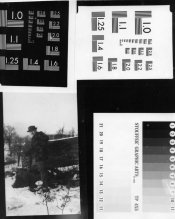
This is a typical exposure on an 8x10 sheet testing with the Stouffer step wedge, 2 resolution charts and a normal photo.

In some previous posts, I had cropped the scan of the prints to illustrate the resolution charts and in another case to illustrate the contrast but I had not shown all 4 in one print.

Right now, I have 3 of the prints here, but cannot locate the full scan of the Ilford, nor the original print. The 4 print set got separated somehow. When I can, I will repost as much as I have here, but the exposure here is pretty typical of how I test my print emulsions.

If anyone wishes to see the film tests, let me know. It is just about the same as this though except shot in a camera.

PE
 

Attachments

  • Full 4 way test print baryta.jpg
    Full 4 way test print baryta.jpg
    68.2 KB · Views: 153
Thanks, Ron. I'm glad you found the whole step tablet (I was wondering :smile:) I see you are still having surfactant problems (unless these are the same prints from four years ago - they look familiar, but I know you follow the same basic research protocol I do, which is to re-use materials to keep an established baseline.) Keep up the good work. Post often!

I think a lot of things are coming together, each of us in our own areas of particular interest. I can hardly wait to see Ron's superspeed films. Bill Winkler is having very good luck with ortho emulsions and is well on his way to pan. If I were a betting woman, I'd bet Kirk will be busting open the T-grain puzzle soon. I'm almost ready to go public with hand-subbed film, which should make the 'capture' side of emulsions a lot easier. With apologies to Bill, as beautiful as glass is, a backpack full of dry plates is a load going up a trail!. And of course, there's Tim's great work with paper. I hope 'hrst' and 'totalamateur' haven't given up. I can tell you that I'm in regular contact with a number of people who have started working with emulsions, but are too shy to share just yet.

On a tangential note, I submit a gentle elbow nudge to lurkers. I see that there are many more hits to this thread in the last hour or so than views of Ron's jpegs. If you are just lurking here without membership jpeg privileges, you're missing half the fun. It's free and painless to sign up as an APUG member. You can always decide to support the site with a subscription later.

d
 
Denise;

My surfactant problems came about when I tried to use Photo Flo 600 unfortunately. No amount would work for me. I have used many other surfactants. This includes TX-100 which is the active ingredient in Photo Flo 200. I've used TX-200 and also Alkanol XC with quite good results. My standard is Photo Flo 200, but I do go in and out of problems as we did at the workshop. I find that this is related to some contaminant that yields itself (as we found at the workshop) to plain old soap and water. I am working on a surfactant mix that will solve this type of problem.

Yes, the photos posted above are what you saw in the workshop. I have carted them back and forth to workshops so often they are getting "shop worn :smile: ". That is probably how I mislaid the Ilford originals which are here somewhere or languishing in a corner somewhere in Montana or NYC. :sad:

When I find them, I will post them, but in the meantime I found another set of prints and one of them is coffee stained in the center. I either did it here or one of the students did at a workshop. Baptism by coffee is not good for a print.

The first set of prints and the curves that I posted above were done this spring when I made the Azo comparison.

PE
 
I hope 'hrst' and 'totalamateur' haven't given up.

Thanks :smile:.

I've started playing with high voltages for PET corona subbing again, after a pause of a few months (I've been building control electronics for my ECN/ECP cine film lab project recently). But, now I have a 18 kV very dangerous voltage source ready that gives a bright glowing corona in dark. I hope I'll post some results of that sooner or later, if I find a proper wire to give enough corona power...

I find it so that I have to find a way to get emulsion stick to base first before I can continue with emulsions. ... and I find buying a ready-subbed base cheating :wink:.
 
HRST;

Please note a patent by Yost of Kodak that describes fog formation by corona discharge and methods to prevent it. I was not aware of this until I did a recent search. Dick Yost's work should have stuck in my mind, but it was so long ago.

PE
 
Several questions for PE & others

I would really like to make smaller batches of Denise's paper emulsion. I can handle scaling the ingredient quantities, but I'm unsure how to scale some variables, such as silver addition. Could anyone make suggestions or does this require elaborate and expensive control devices.:confused: I am using a stopcock buret and a timer to add silver nitrate. How about other variables, ripening, digestion, and etc.

A while ago I read some info on using rice starch to make a matt paper surface. I though I read it here on APUG, but can;t locate it for the life of me! Actually, I thought it was a post by PE. If memory serves correctly, the info described warming the starch until the coagulum settled to the bottom. This was then used as the matting agent in the emulsion. Well, I might be just full of it, but I would really like a matt finished paper.:D

thanX
T
 
Tim;

If you scale the emulsion just multiply all volumes by the scale factor. This works between about 100 ml and 500 ml. After that, you need more vigorous mixing in the form of a magnetic stirrer on the bottom and a prop mixer in the middle or the solution viscosity (gelatin) will mess up the make.

Keep everything else constant. Keep addition rates and hold times the same. Heating things up and cooling them move more slowly and you will need to speed them both up.

Starch is a good matting agent, but I didn't bring it up. Someone else must have. Your comments are right about on. Modern coatings use Poly Methyl Methacrylate beads suspended in gelatin and that is about the same as starch in gelatin. It should work.

Best of luck.

PE
 
With apologies to Bill, as beautiful as glass is, a backpack full of dry plates is a load going up a trail.

d[/QUOTE]

Denise,
No apologies called for. Its all a matter of philosophy. When I am doing "Art" and not "Research",I will spend 3-4 days getting 4 shots. OTH, I know very good photographers who shoot hundred of shots in a day, then a week editing, looking for "the Good one".
Dry Plate Bill:tongue:
 
Some new progress to report!

Hi all,

Thought I would update this thread with some notes. But first I want to say a big Thank U to everyone for the help and encouragement.:smile:

2.22.10 05:03

Had a chance to work with my first batch of emulsion this morning. ItÂ’s now four weeks old and starting to exibit a lot of peppering. So now I can use it under white light to prefect my coating technique; itÂ’s fubarred anyhow.

I coated several test sheets of Fabriano, but first humidified them above water for about, well I took a nap, so a long time :rolleyes:. Anyhow I guess they where like 100% humidified. The paper was flat, soft, and ready to accept the coat. Of course the emulsion still floated of in the final wash, but not as badly as other test pieces.

I really like this paper, it dries flatter, has better contrast, is brighter, and I just like it better than Arches. Two different papers with the same emulsion is a nice idea though.

Did a little searching on the net looking for info on a chrome alum fixer and found this on Google form “The Focal Encyclopedia of Photography.”

Chrome Alum 12.5 g
Sodium Metabisulfite 12.5 g
Sodium Sulfite, anhydrous 6.25 g
Sodium Thiosulfate 400.0 g
Water to make 1.0 L

adjust pH to 4.0 – 6.5

The amount of sodium thiosulfate seemed high to me so I cut it back to the more common 24%. Not sure that was the right thing to do. I guess I will have to do some residual silver testing. Maybe PE could comment or improve upon this formula for us.

Â…And the emulsion now sticks to Fabriano.:D

Hopefully, this week I will have the time to make a new batch and coat it all in one go, on both Arches and Fabriano paper.

Just for giggles, measured pH of solutions.
Ansco 130 (10.1)
Metabisulfate Stop Bath (5.0)
Chrome Alum Fixer (4.9)
TodayÂ’s tap water (8.0)
 
My Humidifying Chamber

Very simple. Go to Lowe's or similar DIY store and get a sheet of egg crate diffusion material made for in ceiling fluorescent lighting and also some fiberglass screen. In a suitable sized developer tray lay several layers of paper towels. Pour hot or cold (your choice) water over the paper towels and then pour most of it out. Lay the egg crate material on the damp towels and a sheet of screen on top of this. Lay your paper to be humidified on the screen. Finally, cover the tray with something like a sheet of plexiglass to keep the moisture in.

Mike Ware describes the method on his web site with info on how to exactly control the amount of humidity using various salts.
 
What on earth is that? (Do you have a pix?)

Yes, here is a link to a decent image of what it looks like.
http://www.acehardware.com/product/index.jsp?productId=3044089&cp=2624969.3050359

Click on the 'view enhanced image' to get a better idea.
I bought a single 2' x 4' sheet @ Lowes for ~ $11.00.

I use paper towels so I don't have to worry about getting the paper I am humidifying wet and the screen further diffuses the moisture. You may get an 'egg crate' pattern if you don't do this.

T
 
I coated several test sheets of Fabriano, but first humidified them above water for about, well I took a nap, so a long time :rolleyes:. Anyhow I guess they where like 100% humidified.

Why humidify them? It's not platinum paper we are making...

At PE's class a couple of years ago we did not humidify the paper and we had no problems with the emulsion coming off paper. (Off the glass and film -yes, but not off the paper.)

I forget which paper I liked best, but I think it was a cold pressed paper with a pretty smooth surface. I'm sure PE remember what we used.
 
We used mostly Strathmore smooth hot press at 100# weight. We also used Velour and Watercolor. The Baryta was one of the other papers we coated on. None had to be humidified.

PE
 
Why humidify them? It's not platinum paper we are making...

At PE's class a couple of years ago we did not humidify the paper and we had no problems with the emulsion coming off paper. (Off the glass and film -yes, but not off the paper.)

I have not used Fabriano so please ignore my comments.

The Fabriano uses a different chemical treatment than most Arches paper.
This might be involved, but yes it should not normally be necessary.

... perhaps he uses it for other alt prints anyway?
 
Last edited by a moderator:
We also used Velour...

I would like to touch a sample of the Velour.
Was it Hanemure or Hahnemuhle...

Does anyone have a sample any size from a 1 cm square upwards they could spare?

Plain or processed doesn't matter.

It is not avail here and I would just like to see it up close.

Ray
 
I don't normally humidify my paper, I have for some alt processes, but if you have a piece of paper with a crease or buckle I think humidifying before coating might save the day. Also, coating one side of paper causes it to expand, and then contract on that side more than the uncoated side. Humidifying pretty much solves that problem.

As I said, I don't as a normal routine, but the paper stayed flatter as it dried, and was flatter after fully dried.

I hope Denise Ross sees this; she humidifies her paper sometimes. In fact I was thinking her when I wrote it.

Some say Fabriano uses Aquapel as a size.

T
 
Strathmore Baryta?

Here is what you had said:
We used mostly Strathmore smooth hot press at 100# weight.
We also used Velour and Watercolor.
The Baryta was one of the other papers we coated on.
PE

Humm...
The only paper you specified as being "Strathmore" was the "smooth hot press"...

Perhaps if you had said:
"We also used Strathmore Velour and Strathmore Watercolor"
I would not have gone down the wrong path!

Anyway, I will see if I can locate any Strathmore Velour.
 
Sorry if I was unclear. All hot press papers were Strathmore. We also used a Canvas which was ok, and Cranes 90# cold press which fell apart during the process. It is a nice paper but does not survive the traditional photo process. Credit Denise for finding that Cranes 90# paper is not good for silver-gelatin. I didn't know.

We also used a 300# cold press paper that was very nice, but I forget the manufacturer.

The only way to find out what is good or not is to try it!

PE
 
Sorry if I was unclear.

Thanks... Well, the only Strathmore Velour I can find is with the name "inkjet" and even that is not on their current web page I was able to find.

I was only able to pull up 3 images with an image search; 1 of the package and 2 deceptive catch alls that list everything- which I guess is an attempt to raise someones hit count... I don't really know... but the internet is getting way too cluttered with waste... :mad:

I just wanted to know what the stuff feels and looks like up close...
the name implies one thing but I am getting the impression
it ain't all dat purdy!

One never knows, though, so I still wish I could actually get some tiny samples of the Strathmore and Hahnemuhle's Velour... to help me judge it's potential value before the confronting the expense of obtaining a real supply.
 
I get mine across the counter at Michaels, a very well known art supply house here. They come in pads of about 11x14x25 sheets.

Of course, living in Japan may make things difficult. All sources are not created equal. First star on the right and on till morning and all that you know!

PE
 
I get mine across the counter at Michaels, a very well known art supply house here.
PE

PE,
Have you ever looked at Hyatt's, there is one on Jefferson Rd. near the 390. In Buffalo they are cheaper than Michael's. I have also bought quantities from several online sellers; Cheap Joe's, Dick Blick, etc., cheaper yet. You will pay tax at Blick.

I found your comment about cold press paper intriguing, have you ever tried rough? I have some of both, will have to give it a go some day.

T
 
I've tried a lot of papers Tim. I have stacks of different paper samples here. This includes rough surfaces, glossy surfaces and others. I also have shopped at the RIT art supply center, but Hyatts is quite inconvenient most of the time and Michaels is very close by. I usually combine the trip to Michaels with other shopping. I drove by it yesterday on another errand, but did not need any paper, so convenience counts. Thanks.

PE
 
Photrio.com contains affiliate links to products. We may receive a commission for purchases made through these links.
To read our full affiliate disclosure statement please click Here.

PHOTRIO PARTNERS EQUALLY FUNDING OUR COMMUNITY:


Ilford ADOX Freestyle Photographic Stearman Press Weldon Color Lab Blue Moon Camera & Machine
Top Bottom
