• Welcome to Photrio!
    Registration is fast and free. Join today to unlock search, see fewer ads, and access all forum features.
    Click here to sign up

Mounting a shutter on an enlarger.

The Hot Waters

A
The Hot Waters

  • 2
  • 2
  • 92
The Hot Waters

A
The Hot Waters

  • 3
  • 1
  • 105

Recent Classifieds

Forum statistics

Threads
204,459
Messages
2,869,012
Members
102,283
Latest member
MTLMan
Recent bookmarks
1
For my film duplicating set up I use a Prontor electronic shutter that mounts on top of the printing lens ( inside the bellows ) of a DeVere 504 enlarger.
The duplicator controls the shutter timings.

The advantage in this instance of using a shutter instead of switching the lamp itself, is the light is instantly switched 'in and out' of the optical path, as apposed to the lamp powering up and powering down.

Timings are much more accurate ( and repeatable ) but as the lamp is on all the time, there has to be a cooling fan.

John S
 
You can do it just like a large format lens. Here's mine on a Durst lens panel and in my case, I wanted to expose/contact print a step-wedge on film.
 

Attachments

  • 20260612_232119.jpg
    20260612_232119.jpg
    509.2 KB · Views: 9
It shouldn't be a problem at all, but it depends on the shutter and the enlarger & board. A #1 shutter fits a standard enlarger hole for a lens with a 39mm thread. If you use a different sized shutter, you'll need a larger or smaller hole -- which you might have to make. The other problem might be the lens board. It needs to be large enough to fit the shutter -- some are just too small or the shutter might bump in the sides of the lens standard on the enlarger.
 
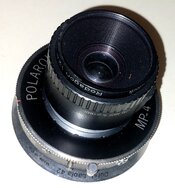
Some enlarger lenses fit straight into a shutter which would make it easy. Just unscrew the front and rear elements and install them into the shutter. The later barrel mounted Componon-S lenses are some. I'm sure there are others. I've mounted my 105mm Componon-S lens into a shutter for a custom Polaroid pack film camera for example. Fitting a shutter onto a lens board should be a piece of cake.
 
I have an electric shutter for my Omega D3, it is used with the early cold light head. It allowed the cold light (florescence) to left on at operating temperature. the shutter is controlled by the timer. Mine has not worked in a long while, because I use VC paper I have used my old cold head so I have gotten around to repairing it. I think it needs a new motor. I have only seen a few for sale on Ebay over the years.
 
Depending on the focal length you need, certain appropriate leaf shutter lenses adapted from the graphics industry or view camera macro usage can be used. I've experimented with standard in-shutter G-Claron lenses - better than many typical enlarging lenses, not as good as my Apo Nikkor process lenses which were originally used in conjunction with a Compur electronic shutter, and which I've often used for very high quality duping purposes in relation to MF and LF film originals. For highly accurate timing, an electronic solenoid could be employed. But I always try to keep the exposure times standardized to 10 sec or more, so that the "warm-up" color shift time and momentary "afterglow" phase will be negligible anyway.

Some expensive professional colorheads have built-in shutters. The additive colorhead I use for dupe and color interneg purposes has a built-in timer accurate to 1/10th sec intervals if needed. I should probably dig into my old cartons of darkroom odds n' ends up on the loft some day, and take a second look at the Compur electronic shutter just for sake of curiosity; but I've never seen the need for it myself.
 
Last edited:
I've done hundreds of unsharp masks with basic electronic enlarger timers (not the old luminous dial type). Again, the secret is to standardize on something like 10 or 20 seconds, long enough to evade warm-up/drop-down lamp issues, short enough to evade recip failure long exp issues.
 
Last edited:
I did that to expose unsharp masks. a dark room timer wasn't accurate enough but a large format lens in a shutter would do the trick.

thanks Ralph never thought about that. I've used just the timer for unsharp masks, but a shutter would definitely be more accurate.
 
Beseler takes a 4 inch lens board, there are 4 inch boards that fit Calumet CC-400 cameras that are sized for popular shutters. Used to be always around on KEH and Ebay.
There's also a 4 inch to Speed/Crown Graphic lens board adapter (3 1/2??)
 
I have a Schneider Componon-S 150mm mounted in a copal0 shutter. There's a grub screw on the outer lens barrel that lets you get access to the elements. They screw directly in to the shutter. I think this is actually mentioned on the original docs for the lens as a supported usage.
I have it on a linhof board and use it with the intrepid 4x5 and their enlarger kit.
I'm not aware of any copal0 shutters that'll get you 1000th though. Maybe the new intrepid one will? Or you can use an ND filter to get exposure down.
 
Last edited:
Such leaf shutters are rarely accurate at their highest speed of 1/500th. If you don't want to use ND filtration for slowing the exp down to more predictable timing, internal scrims could also be used, like in a filter drawer. I once had a colorhead with a set built it, activated in place with an external lever.

Do you need such short times to reduce contrast by pre-flashing the film or what ?? What kind of film are you using anyway?
 
Will you be forming an image or is this strictly for light control?

Light control.
Such leaf shutters are rarely accurate at their highest speed of 1/500th. If you don't want to use ND filtration for slowing the exp down to more predictable timing, internal scrims could also be used, like in a filter drawer. I once had a colorhead with a set built it, activated in place with an external lever.

Do you need such short times to reduce contrast by pre-flashing the film or what ?? What kind of film are you using anyway?

I'll be using the setup as a sensitometer. Essentially a controlled light source.
 
For my film duplicating set up I use a Prontor electronic shutter that mounts on top of the printing lens ( inside the bellows ) of a DeVere 504 enlarger.
The duplicator controls the shutter timings.

The advantage in this instance of using a shutter instead of switching the lamp itself, is the light is instantly switched 'in and out' of the optical path, as apposed to the lamp powering up and powering down.

Timings are much more accurate ( and repeatable ) but as the lamp is on all the time, there has to be a cooling fan.

John S

Is there any discernible difference in the print to useing a switch?
 
OK. I get it. A DIY sensitometer. Sounds like a fun project. Do you have an electronic shutter tester to verify actual shutter speeds and their statistical variability? The specific f-stop in play also factors into that.
 
OK. I get it. A DIY sensitometer. Sounds like a fun project. Do you have an electronic shutter tester to verify actual shutter speeds and their statistical variability? The specific f-stop in play also factors into that.

I have a shutter tester and flash meter and an integrating radiometer/photometer for calibration
 
Photrio.com contains affiliate links to products. We may receive a commission for purchases made through these links.
To read our full affiliate disclosure statement please click Here.

PHOTRIO PARTNERS EQUALLY FUNDING OUR COMMUNITY:



Ilford ADOX Freestyle Photographic Stearman Press Weldon Color Lab Blue Moon Camera & Machine
Top Bottom