
-
Welcome to Photrio!Registration is fast and free. Join today to unlock search, see fewer ads, and access all forum features.Click here to sign up
- Home
- Forums
- Analog Workflow Forums (100% Analog/Traditional)
- Analog Equipment
- Miscellaneous Equipment
You are using an out of date browser. It may not display this or other websites correctly.
You should upgrade or use an alternative browser.
You should upgrade or use an alternative browser.
Most useless photographic accessory
-
A
- Thread starter cliveh
- Start date



Recent Classifieds
-
For Sale Fuji GW670 III
- Started by campy51
-
For Sale Hasselblad X Pan w/ 45mm/f4 Lens
- Started by eftones
-
For Sale 6 antique French pneumatic shutters _ Guerry
- Started by Manual Camera
-
For Sale Voigtländer Nokton Classic 35mm/1.4 with Leica M-mount
- Started by Klaus Mähring
-
For Sale Voigtländer Bessa R2 Special Edition Olive Green
- Started by Klaus Mähring
Forum statistics


Chromium VI
Member
Film retrievers work really well. Just remember to wind the film round a couple of times inside the cassette before you insert it.
That's right, they are a nice accessory for some emergencies (I already needed on a couple times). Have you ever seen a Noritsu Film Retriever? Is a massive ~5kg machine with an oversize synchronous motor and big levers, etc... that does exactly the same as a small plastic retriever, but automatically with the power of Thor, used one couple of times, probably nice for big labs but quite useless in an educational BW darkroom where no one knows what that machine even does.
EDIT: It's the Noritsu model Koki SB-3U, if someone is interested in searching it around.

foc
Subscriber
I must be a masochist. I enjoy squeegees and film retrievers.

wiltw
Subscriber
Mido 4x5 film holders...I could not get them to function, and neither could the pro equipment sales guy in the professional photography-oriented store -- even using a dummy piece of film in a well illuminated area, both of us failed.
thinkbrown
Member
My box of assorted UV filters. I've ended up with so many of them from various eBay purchases and I'm not paying for nice lenses to put a cheap uncoated piece of glass in front of them.

The plastic tongues that everyone seems to sell in darkroom starter kits (patterson I think?). Absolutely useless. They have a click close feature that mostly seems to exist to annoy me, and that assumes they dont crack after your first use (OK, a couple of pairs lasted a bit longer than that). They do have the advantage of being insanely expensive for what they are, meaning it's not a mistake I'll be making again any time soon.
@tcolgate ,
I read this about six times before I realized what it was a reference to.
I believe you must be referring to plastic darkroom TONGS (not tongues).
I would agree that plastic tongues wouldn't be of much use ...

thinkbrown
Member
They're pretty important for Polaroid shootersI would agree that plastic tongues wouldn't be of much use ...


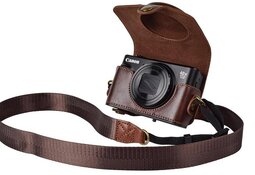
Well, I'm one of those rare individuals who love(d) using these camera cases for my Nikon FE/FE2. I had both the normal snout for my 24mm lens, and a longer snout for my 105mm. Sure, changing film meant taking the bottom of the case off, but I shot 36exp rolls, and I'm not using a motordrive, so that wasn't more than twice a day max, even under the most active shooting days. I used the case like a self-contained camera-bag, and with it on my camera, could either shoulder-carry or just jam it into whatever backpack I was using without worry that my gear would get trashed. When in "active shooter" mode, I would remove the snout and shove it in a pocket or backpack, so didn't suffer from the horror of "dangling". So for me with a mostly one-lens-at-a-time setup, the case worked really well, since I never had a formal camera-bag.
In the modern era, these cases have mostly disappeared, and the aftermarket just produces half-cases. For my Df, I have a really nice half-case with a metal bottom and a door that allows access to the battery/memory-card. I sometimes miss "the snout", but am just using a felt lens bag shoved on the lens when I'm in "jam it in the backpack" mode.
My wife has a Canon SX720is and I found on Amazon a leather Never Ready case, Un-snaps completely when desired.
Attachments

So called brighter waist level viewing screen from China. The one I bought was for my Bronica ETRsi. It might have been brighter, but it turned black as the camera was moved around. Not the whole screen, just mostly in and around the center while trying to focus. Total waste of money, didn't even bother sending it back, just not buying anything like that again.
Last edited:

benderscameracorner
Member
Those non-metered prisms they made for the Nikon F and F2.
It’s difficult to imagine abandoning the convenience of coupled TTL metering.
Yes, but taking off 50+ year old dust and crud-filled Photomic that no longer works anyway, and snapping on a basically NOS plain finder is like peering through a fresh pair of 'glasses.
(not to mention less bulk)

snusmumriken
Subscriber
To be fair, I did once use mine, successfully. But it was redundant because I carry spare film and can use the darkroom at home to retrieve occasional lost film ends.Film retrievers work really well. Just remember to wind the film round a couple of times inside the cassette before you insert it.

Petrochemist
Member
Can anyone beat an 8-dioptres lens?
OneEyedPainter
The Raynox DCR250 is +8 Dioptre (and highly corrected). There are loads of photographers who swear by them for macro. Though personally I prefer the similar DCR150 which is only +4.8
I have to admit the 87mm single element +10 dioptre lens I got is pretty useless
FWIW although not normally described in Dioptres any 125mm lens is actually 8 dioptre. Not a common focal length, but far from useless.

Kino
Subscriber
I found a Canon +2 and a +3 Tiffen SF-113C, 113mm diopter in a thrift store and bought them out of curiosity.
However, they are pretty much useless.
However, they are pretty much useless.

Europan
Subscriber
For many people making movies a tripod seems to be useless.
I find video monitors hooked onto film cameras pointless. You either have a camera with a good viewfinder or you better forget about making movies altogether. Also, you either have faith in your director of photography or you’re useless as a director. Directors’ viewfinders on a cord around the neck go in the same category.
Gaffer tape on cameras and magazines is useless. Either the equipment is well maintained and correctly used or everything is in the hands of ignorants.
I find video monitors hooked onto film cameras pointless. You either have a camera with a good viewfinder or you better forget about making movies altogether. Also, you either have faith in your director of photography or you’re useless as a director. Directors’ viewfinders on a cord around the neck go in the same category.
Gaffer tape on cameras and magazines is useless. Either the equipment is well maintained and correctly used or everything is in the hands of ignorants.


Donald Qualls
Subscriber
Can anyone beat an 8-dioptres lens?
My uncorrected vision is around +8 diopter after accounting for proximity as well as actual refraction. For me, a loupe is just a waste. For those who are farsighted, it's a necessity.

John Salim
Member
For many people making movies a tripod seems to be useless.
I find video monitors hooked onto film cameras pointless. You either have a camera with a good viewfinder or you better forget about making movies altogether. Also, you either have faith in your director of photography or you’re useless as a director. Directors’ viewfinders on a cord around the neck go in the same category.
Gaffer tape on cameras and magazines is useless. Either the equipment is well maintained and correctly used or everything is in the hands of ignorants.
1, Video monitors: ( video tap ) serve a real purpose assisting other crew members apart from the operator ( very useful for the focus puller ) and of course for playback if required.
2, Directors viewfinder: These save lots of time on set, because the director ( and DoP ) can quickly move into any position to visualise a shot and the lens focal length required without having to physically move a heavy camera set up to do the same thing.
Some of the more elaborate viewfinders ( like Panavision ) actually take camera lenses.
3, Gaffer tape: Looks like - but not really holding a film magazine firmly shut if that's what you're thinking.
Different coloured tapes denote different film stocks loaded ( typically orange or red for tungsten, and blue for daylight ). Other tapes ( eg.. white ) can have other film stock information like footage loaded, film type etc ...
John S

mshchem
Subscriber

Adam W
Subscriber
I didn't buy one, I'm just suggesting.
"Suggesting for a friend...."
Adam W
Subscriber
Yes. You win. Not only useless, but will drive you insane until you finally give in and admit it. If I absolutely have to retrieve a leader, licking an old strip of negative and shoving that in the canister tends to work much better (I appreciate it'll probably poison me, but a film retriever will send me crazy faster).
I use one all the time. I bulk load recycled canisters and find it quite simple to use.
1, Video monitors: ( video tap ) serve a real purpose assisting other crew members apart from the operator ( very useful for the focus puller ) and of course for playback if required.
2, Directors viewfinder: These save lots of time on set, because the director ( and DoP ) can quickly move into any position to visualise a shot and the lens focal length required without having to physically move a heavy camera set up to do the same thing.
Some of the more elaborate viewfinders ( like Panavision ) actually take camera lenses.
3, Gaffer tape: Looks like - but not really holding a film magazine firmly shut if that's what you're thinking.
Different coloured tapes denote different film stocks loaded ( typically orange or red for tungsten, and blue for daylight ). Other tapes ( eg.. white ) can have other film stock information like footage loaded, film type etc ...
John S
So much of that comes down to enabling effective team work. Especially remote monitors. Being able to consult with other members of the team on something without them having to physically come over and directly look at something themselves saves so much time and lets far more work get done in a day.
And the gaffer tape is often not only a big communication thing: Colour coding and serving as a space to write labels and such, but it also can act as a major safety net.
Sure, a 'well maintained and properly working' film magazine doesn't "need" gaffer tape to ensure a light-seal stays light tight. But what's the first sign of a light seal failing? Spoiled shots... When you're dealing with tens or hundreds of thousands a day projects, a few cents of tape is pretty cheap insurance against a lost roll.
Alan Townsend
Member
I remember a travel tripod I bought about 30 years ago that was heavily advertised in Peterson's that looked really cool and all the legs rotated around to make it a flat pack for storage. I forgot the name of it, but it was expensive at around $80 at the time but was the most flimsey wobbly piece of junk I ever saw. An absolute piece of junk that was never used and thrown away almost immedietly. Also a Beseler negatrans 35mm film holder for Beseler 23c that didn't hold the film flat and was expensive. These were bad judgements on my part in days before the internet.
DanielCTracht
Member
Most camera bags that that have the form of a sling. I've only ever seen ones that are made with the intention the bag will go over the left shoulder, slinging the bag to the right side for "easy access" - IF you are right handed.
Which I am not.
Sling the thinng over the right shoulder and the balance is off completely, and the openings hard to access.
I have enjoyed using the Wotancraft Pilot bags, both in 3.5L and 7L, with the strap on my right shoulder.
They have a strap whose length is quickly adjustable. When walking, the bag rests on my left kidney. When I want to access the bag, I just loosen the strap and sling in around to my belly.

armadsen
Subscriber
I bought my Nikon F from a retired US Air Force fighter pilot who bought the camera new in 1964 in Japan. It has all the boxes, papers, bunch of accessories etc. The box says Nikon F Photomic, but it came with only the plain prism finder and the waist level finder. I asked him where the metered finder was, and he said that soon after he bought it he realized the metered finder was more trouble than it was worth, got rid of it, and bought the plain prism instead.Those non-metered prisms they made for the Nikon F and F2.
It’s difficult to imagine abandoning the convenience of coupled TTL metering.
I've never used an F with a metered head (have used the F2), but particularly for the original Photomic, they're kind of hard to find in good working order, and hard to get serviced. As far as I know, my F won't work with the later T, Tn, and FTn meters without modification (which I don't want), so I've stuck with the plain prism too. It's certainly not worse than shooting with my Nikon rangefinders which are among my favorite cameras.
As for film leader retrievers, I find the little metal ones indispensable, and use one with every roll of 35mm film I develop. On the other hand, the more common plastic ones are terrible in my experience.
| Photrio.com contains affiliate links to products. We may receive a commission for purchases made through these links. To read our full affiliate disclosure statement please click Here. |
PHOTRIO PARTNERS EQUALLY FUNDING OUR COMMUNITY:  |