

• Welcome to Photrio!
    Registration is fast and free. Join today to unlock search, see fewer ads, and access all forum features.
    Click here to sign up

Mistery flowmarks on C41 negatives from dip and dunk

Ellis Island 1976

H
Ellis Island 1976

  • Tel
  • Jan 26, 2026
  • 2
  • 2
  • 33
Facades

A
Facades

  • 5
  • 0
  • 62

Recent Classifieds

Forum statistics

Threads
201,972
Messages
2,832,999
Members
101,038
Latest member
nasub
Recent bookmarks
0

owk.edo

Member
Joined
Jan 26, 2026
Messages
3
Location
London
Format
Medium Format
Hello! Posting here for the first time and in search of some help on an issue I've been having in my C41 process.

I've been running a Tecnloab dip and dunk for 4 years now, it's been serviced by a professional when first set up at my lab and I've hardly made any changes to the setup, times or workflow.
I use Champion chemistry and monitor sensitometry daily, with pretty consistent results or at least nothing that ever granted for major adjustments.

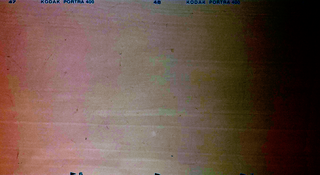
Since a couple of months I've started noticing these flowmarks on the negatives (attaching scan below from unexposed MF Portra 400 I used as test), they are clearly visible on less dense parts of the negs and sometimes even to the naked eye on the base when I look at them on the light table.

I did some troubleshooting with the knowledge I have, but feel like I need the help of someone more experienced in the use of these machines.

This is what I did
- skip the stabilizer bath: I was afraid of the stabilizer being overly concentrated/not replenished enough so I skipped it on a couple of racks and the marks were still there.
- skip the dryer: I pulled a few rolls out of the machine right before the dryer and dried them at room temp in the cabinet I use for B/W. Same result.

I am now afraid that this has to do with agitation in either the dev or the bleach. My sensitometry tells me the agitation is correct but I feel like I might be missing something.

Any help/input will be greatly appreciated. Thank you!

E

 

Attachments

  • Schermata 2026-01-26 alle 11.07.53.png
    Schermata 2026-01-26 alle 11.07.53.png
    1.7 MB · Views: 25

koraks

Moderator
Moderator
Joined
Nov 29, 2018
Messages
27,136
Location
Europe
Format
Multi Format
I'm linking also this thread which involves a D&D system and problems with final wash: https://www.photrio.com/forum/threads/circular-and-hazy-stains-in-dip-and-dunk-c-41.217924 and perhaps @vicb is willing to have a look at your problem as well on the basis of his experience with D&D processing.


I am now afraid that this has to do with agitation in either the dev or the bleach.
It's easy enough to figure out there the problem originates. Take two samples of affected film. Re-fix one sample. Re-bleach and re-fix another sample. If both show the same problem, it existed before bleach and thus must be caused during development. If both look fine, the problem is in the fix. If the re-bleached + re-fixed sample is OK and the re-fixed one isn't, the problem is in the bleach.

The first thing that comes to mind is indeed something associated with agitation and I would expect that the problem is in development, so my money goes to re-bleaching and re-fixing not showing any change. If it's not an agitation problem in the development tank, then I would guess that it's a replenishment and/or carry-over problem in either of the subsequent ones, depending on how the strip test goes.

Btw, your attached sample also shows quasi-circular drying spots but I assumed above that we should ignore those for now.
 
OP
OP
owk.edo

owk.edo

Member
Joined
Jan 26, 2026
Messages
3
Location
London
Format
Medium Format
I'm linking also this thread which involves a D&D system and problems with final wash: https://www.photrio.com/forum/threads/circular-and-hazy-stains-in-dip-and-dunk-c-41.217924 and perhaps @vicb is willing to have a look at your problem as well on the basis of his experience with D&D processing.


It's easy enough to figure out there the problem originates. Take two samples of affected film. Re-fix one sample. Re-bleach and re-fix another sample. If both show the same problem, it existed before bleach and thus must be caused during development. If both look fine, the problem is in the fix. If the re-bleached + re-fixed sample is OK and the re-fixed one isn't, the problem is in the bleach.

The first thing that comes to mind is indeed something associated with agitation and I would expect that the problem is in development, so my money goes to re-bleaching and re-fixing not showing any change. If it's not an agitation problem in the development tank, then I would guess that it's a replenishment and/or carry-over problem in either of the subsequent ones, depending on how the strip test goes.

Btw, your attached sample also shows quasi-circular drying spots but I assumed above that we should ignore those for now.

Hello Koraks, thank you very much for the reply. I did stumble upon the thread you linked when I was googling for issues like mine and, although it offers some useful insights on the drying process, I believe my issue is something entirely different.

The drying spots occurred because I dried these tests way too fast as I was eager to inspect them. No issues with the dryer so far.

I'll be running the re-bleach and re-fix tests, thank you for the suggestion.

I would guess that it's a replenishment and/or carry-over problem in either of the subsequent ones, depending on how the strip test goes

It did cross my mind that I could have a carry-over issue between the stabilizer and the developer: the racks and clips I'm using have been custom made for me after I back engineered the only original rack I have (the person I bought the machine from threw away all the racks and clips he had). When I pull them out of the dryer they often have some wet residue and they usually go straight back through the machine as I don't have loads.
 

koraks

Moderator
Moderator
Joined
Nov 29, 2018
Messages
27,136
Location
Europe
Format
Multi Format
Ah I see. It's definitely possible that cross-contamination plays a role here. You esp. don't want any bleach or fix to end up in the developer. Via the stab bath I could see either (esp. fix) carry over into the developer. Stabilizer itself in the developer is likely not great either. So this is definitely something to eliminate if you suspect it plays a role. To verify you'd have to start over with a fresh developer tank as it's generally not possible to regenerate/repair a contaminated developer bath.
 
OP
OP
owk.edo

owk.edo

Member
Joined
Jan 26, 2026
Messages
3
Location
London
Format
Medium Format
I see your point and from the information I've given it makes sense to come to that conclusion but I'd like to point out that:

1. wouldn't that amount of cross contamination be well visible in my sensitometry? My control strips are within range and - apart from the flowmarks - the negatives are clean and print well
2. I've been running this setup for 4ish years now without any major changes in the workflow and this issue just started arising in the last few months. I must be missing /overlooking something but I can't think of anything I could have done different that started this

I appreciate your input, I'll be running the tests you recommended and if the result is unchanged I'll probably bite the bullet and make a fresh tank of developer.
 

koraks

Moderator
Moderator
Joined
Nov 29, 2018
Messages
27,136
Location
Europe
Format
Multi Format
Yeah, same here, I see your points as well! Let's see what the strip tests say; maybe they will clarify things a bit.

Btw - if it's carryover from stab into dev I can sort of see how it wouldn't shop up on densitometry if the effect remains limited to uneven wetting at a micro scale. But given the snippet you showed above with all the strips I would frankly expect you see this variation in the densitometry as well if you take several measurements of the same patch.
 

koraks

Moderator
Moderator
Joined
Nov 29, 2018
Messages
27,136
Location
Europe
Format
Multi Format
Couldn't this be caused by insufficient mixing (stirring when mixing) of the chemistry?
No way. If you mix solutions (which are what the concentrates used in C41 already are), they diffuse. Even if you tried, you couldn't keep them neatly separated like this when mixed together. This is a fundamental law of thermodynamics.
Even if we ignored that (i.e. we now are talking magic and no longer reality/science), the stuff would still mix because it's a D&D line so there's going to be agitation, typically using nitrogen burst. That will mix the contents of the bath in no time.
 
Photrio.com contains affiliate links to products. We may receive a commission for purchases made through these links.
To read our full affiliate disclosure statement please click Here.

PHOTRIO PARTNERS EQUALLY FUNDING OUR COMMUNITY:


Ilford ADOX Freestyle Photographic Stearman Press Weldon Color Lab Blue Moon Camera & Machine
Top Bottom