
• Welcome to Photrio!
    Registration is fast and free. Join today to unlock search, see fewer ads, and access all forum features.
    Click here to sign up

Mike Ware- New Cyanotype Solution Problems

Sacred

A
Sacred

  • 1
  • 0
  • 49
San Miguel Arcangel

H
San Miguel Arcangel

  • 0
  • 0
  • 43

Recent Classifieds

Forum statistics

Threads
201,964
Messages
2,832,771
Members
101,032
Latest member
Hazel2025
Recent bookmarks
0

LibbyPScott

Member
Allowing Ads
Joined
Jul 21, 2025
Messages
5
Location
Star LAke, Wi
Format
DSLR
I’ve been doing a deep dive into alternative processes with QTR and recently started testing Mike Ware’s New Cyanotype, using the premixed solution from Bostick & Sullivan to eliminate mixing variables.
Setup:
  • HPR paper
  • Tween + citric acid added at 1 drop/ml just before coating
  • Coastal San Diego, ~60%+ humidity (no paper humidification)
  • Citric acid added to first wash
  • LED UV exposure unit, 3-minute exposures
  • Exposure calibrated with a Stouffer 31-step wedge

Despite dialing in exposure carefully, I ran into major fogging issues.
After speaking with B&S, I learned that citric acid had been added to the bulk premixed solution. This destabilizes Ware’s NC and shortens shelf life — citric acid should only be added just before coating.
I ordered a fresh bottle after accidentally leaving my original solution uncapped for several days. Unfortunately, the new shipment leaked in transit. With the new solution, things got much worse:
  • Heavy fogging
  • No clean whites
  • Even an unexposed, developed strip turned light blue
Since I was working under safelights (and NC is usually safe under dim incandescent light anyway), light exposure wasn’t the culprit.
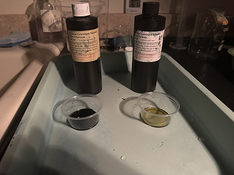
I then poured samples of both the old and new solutions into cups to compare color. The difference was obvious — the new solution was significantly darker. The fogging was clearly coming from the solution itself (see photo).
I spoke with Dana at B&S, and he’s remixing a replacement without citric acid. I’m hoping that resolves the issue — otherwise, I may be done with Ware’s New Cyanotype.
Photos below:
  1. Stouffer 31-step wedge — old solution, no fogging.
  2. QTR Blocking Density Target — fogged, no whites (new solution)
  3. Unexposed strip, developed — light blue (new solution)
  4. Side-by-side solution color comparison

 

Attachments

  • 1_stouffer.jpg
    1_stouffer.jpg
    65.1 KB · Views: 11
  • 2_QTR Blocking.jpg
    2_QTR Blocking.jpg
    96.9 KB · Views: 9
  • 3_baby blue.jpg
    3_baby blue.jpg
    56.4 KB · Views: 9
  • 4_IMG_7014.jpg
    4_IMG_7014.jpg
    108.6 KB · Views: 11

koraks

Moderator
Moderator
Joined
Nov 29, 2018
Messages
27,100
Location
Europe
Format
Multi Format
Citric acid added to first wash
I found that it takes something like hydrochloric/muriatic acid in the first wash. Trying it with citric acid I got similar results to yours. Btw, the 1_stouffer image on the left is also fogged; just less so than the other one.

I notice the one on the left is an actual Stouffer while the other step chart is an inkjet chart. Which printer & inks are you using? Are you sure you have enough UV blocking power for this process? The process likes negatives of 2.2logD or so.

Don't assume a paper works even if people say it does. This process is super picky about the paper you use. You may find benefit in acid-soaking the paper first to get rid of any carbonate buffer, then giving it a wash to neutralize out the acid.

Having said that, I agree the sensitizer on the left is toast.
I'm not sure why they're adding citric acid to this sensitizer in the first place. AFAIK it's not needed.

Personally I've grown to dislike this process because it offers so little real benefit over the old-fashioned classic version while we get people calling in on the forum all the time with it.
 
OP
OP

LibbyPScott

Member
Allowing Ads
Joined
Jul 21, 2025
Messages
5
Location
Star LAke, Wi
Format
DSLR
I use citric acid in my first wash. Do you think I should replace it with hydrochloric acid instead?

I use Epson printers. In San Diego I have a P700, and in Wisconsin (where I live half the time,) an Epson P5370. The print head on the 5370 is identical to the P700/900. Lots of photo friends use (700-/900s- and Christine Anderson suggests the P5370 as it's much more reliable that the alternatives.

And- yes, the whites fogged somewhat with the old solution too. I was thinking of printing with more yellow ink and bulking up the ink density if I don't figure this out soon!
 

koraks

Moderator
Moderator
Joined
Nov 29, 2018
Messages
27,100
Location
Europe
Format
Multi Format
I use an Epson printer myself, but a much older one. However, I don't doubt that the pigment inks in the P700 should achieve the required density as they also do on my old 3880. No worries there; just checking. Still, for testing the process I'd recommend sticking with the Stouffer since we can safely assume it just works.
 
OP
OP

LibbyPScott

Member
Allowing Ads
Joined
Jul 21, 2025
Messages
5
Location
Star LAke, Wi
Format
DSLR
I use an Epson printer myself, but a much older one. However, I don't doubt that the pigment inks in the P700 should achieve the required density as they also do on my old 3880. No worries there; just checking. Still, for testing the process I'd recommend sticking with the Stouffer since we can safely assume it just works.

I can't use the Stouffer to do QTR. I use the Stouffer Step wedge to determine proper base exposure times.
QTR requires you to start with the QTR Blocking target create a correction curve, and edit to get full tonal scale- (hopefully.)
 

koraks

Moderator
Moderator
Joined
Nov 29, 2018
Messages
27,100
Location
Europe
Format
Multi Format
Use the Stouffer to nail down the process without fogging etc. Before that point it's no use to even think about QTR and linearization. First process control, then calibration. You'll drive yourself up the wall if you deviate from that order.
 
OP
OP

LibbyPScott

Member
Allowing Ads
Joined
Jul 21, 2025
Messages
5
Location
Star LAke, Wi
Format
DSLR
You are quite right! I'm off to Yosemite in April for a plat/gum class. Hopefully I can figure it out by then- or my instructor can help.
I will try your hydrochloric acid dev bath method. Have you used Sulfamic acid for development before?
 
OP
OP

LibbyPScott

Member
Allowing Ads
Joined
Jul 21, 2025
Messages
5
Location
Star LAke, Wi
Format
DSLR
I think I figured one of my problems out.... I was using 40% citric acid in my 1st dev bath.... not 10%.

It's looking WAY better- and even have a true white!!
 

Raghu Kuvempunagar

Member
Allowing Ads
Joined
Jul 28, 2016
Messages
3,121
Location
India
Format
Multi Format
If the problem got solved to OP's satisfaction, please consider updating either the title of the thread or the original post to highlight the source of the problem (which in this case is the mistake on the part of the manufacturer and user not following Mike Ware's instructions) and the remedy (follow the exact instructions). :smile:
 
Photrio.com contains affiliate links to products. We may receive a commission for purchases made through these links.
To read our full affiliate disclosure statement please click Here.

PHOTRIO PARTNERS EQUALLY FUNDING OUR COMMUNITY:


Ilford ADOX Freestyle Photographic Stearman Press Weldon Color Lab Blue Moon Camera & Machine
Top Bottom