
• Welcome to Photrio!
    Registration is fast and free. Join today to unlock search, see fewer ads, and access all forum features.
    Click here to sign up

Making a UV projector for alt-process prints

a sidebar

H
a sidebar

  • Tel
  • Feb 3, 2026
  • 0
  • 0
  • 95

Recent Classifieds

Forum statistics

Threads
202,156
Messages
2,836,041
Members
101,146
Latest member
sam_200
Recent bookmarks
0
OP
OP

AndrewBurns

Member
Joined
Jul 12, 2019
Messages
304
Location
Auckland, New Zealand
Format
Multi Format
A truly spectacular achievement and great photo looking! A 350W UV LED, wow...

I've done a little work related to DLP UV projection, so I'm curious about that have you tested the cyanotype process for different wavelengths like 405 nm? Increasing the UV wavelength from 365-385 nm to 405 nm means that many devices designed for visible light can operate much better, and sometimes the increased transmission efficiency can compensate for the decrease in photon energy. This article here suggests that the exposure efficiency of 405nm is about half that of 365nm: https://pubs.rsc.org/en/content/getauthorversionpdf/C4PP00166D

Thanks! Yes previously I've used a 405nm UV source and an LCD screen for contact printing (placing the LCD screen directly onto the paper and shining UV light through the screen to form the exposure) and it worked perfectly fine for cyanotype. I was able to get very short exposure times with this system, however it was limited to the size of the LCD screen which is why I decided to make the projector.

You're right that shorter wavelengths are less optically efficient, both in that lenses and the LCD screen absorb it more strongly and also the LEDs themselves are less efficient, and so although the process might have a peak sensitivity at a short wavelength you might get your best exposure time at a longer wavelength. The reason I dropped from 405 to 380nm for my projector is because I wanted to expose gelatine sensitised with DAS which barely responds at all to 405nm but is reasonably sensitive to 380nm. Although I've recently found that even with the shorter wavelength I'm struggling to get a good exposure because DAS has a minimum amount of energy required to activate and my projector is struggling to generate that much energy despite how powerful it is.
 

Yezishu

Member
Allowing Ads
Joined
Dec 21, 2024
Messages
183
Location
Hong Kong
Format
35mm
Thanks! Yes previously I've used a 405nm UV source and an LCD screen for contact printing (placing the LCD screen directly onto the paper and shining UV light through the screen to form the exposure) and it worked perfectly fine for cyanotype. I was able to get very short exposure times with this system, however it was limited to the size of the LCD screen which is why I decided to make the projector.

You're right that shorter wavelengths are less optically efficient, both in that lenses and the LCD screen absorb it more strongly and also the LEDs themselves are less efficient, and so although the process might have a peak sensitivity at a short wavelength you might get your best exposure time at a longer wavelength. The reason I dropped from 405 to 380nm for my projector is because I wanted to expose gelatine sensitised with DAS which barely responds at all to 405nm but is reasonably sensitive to 380nm. Although I've recently found that even with the shorter wavelength I'm struggling to get a good exposure because DAS has a minimum amount of energy required to activate and my projector is struggling to generate that much energy despite how powerful it is.

Thank you for the reply! I have met the similar UV power issue when using DLP for photochemical reactions. Normally we use 405nm LEDs because everything can be much cheaper. However, if the materials are not sensitive to 405nm(as you say), there's not much else to be done—we have to switch to 365nm, even if it means without warranty and rapid degeneration of the DMD chip......

I also saw your attempts at splicing, and it is already fantastic with flexible substrates, they are usually difficult due to substrate deformation. Paper shrinks and deforms when wet, and the results of splicing on paper have never been better than on a glass plate (for us). I think this is much enough for hard substrates like acrylic sheets/gelatin?
 
Last edited:
OP
OP

AndrewBurns

Member
Joined
Jul 12, 2019
Messages
304
Location
Auckland, New Zealand
Format
Multi Format
Thank you for the reply! I have met the similar UV power issue when using DLP for photochemical reactions. Normally we use 405nm LEDs because everything can be much cheaper. However, if the materials are not sensitive to 405nm(as you say), there's not much else to be done—we have to switch to 365nm, even if it means without warranty and rapid degeneration of the DMD chip......

I also saw your attempts at splicing, and it is already fantastic with flexible substrates, they are usually difficult due to substrate deformation. Paper shrinks and deforms when wet, and the results of splicing on paper have never been better than on a glass plate (for us). I think this is much enough for hard substrates like acrylic sheets/gelatin?

Before I designed this projector I did look at DLP systems as a way of avoiding the huge energy loss of LCD screens, but as you say none were rated for UV operation (unless you wanted to spend a huge amount of money), the amount of power they could handle at UV wavelengths was a tiny fraction of their visible light capability and their useful lifetime at UV wavelengths was also stated to be much shorter.

I'm not sure what you mean by splicing?
 

Yezishu

Member
Allowing Ads
Joined
Dec 21, 2024
Messages
183
Location
Hong Kong
Format
35mm
Before I designed this projector I did look at DLP systems as a way of avoiding the huge energy loss of LCD screens, but as you say none were rated for UV operation (unless you wanted to spend a huge amount of money), the amount of power they could handle at UV wavelengths was a tiny fraction of their visible light capability and their useful lifetime at UV wavelengths was also stated to be much shorter.

I'm not sure what you mean by splicing?

DMD has a limited number of total pixels, so the area exposed in a single exposure is limited while maintaining a certain image resolution. We need to use splicing/multiple exposures to obtain a larger image (mainly on the glass). The work of handling the image boundaries is basically what you've already done.
 
OP
OP

AndrewBurns

Member
Joined
Jul 12, 2019
Messages
304
Location
Auckland, New Zealand
Format
Multi Format
DMD has a limited number of total pixels, so the area exposed in a single exposure is limited while maintaining a certain image resolution. We need to use splicing/multiple exposures to obtain a larger image (mainly on the glass). The work of handling the image boundaries is basically what you've already done.

Ahh yeah I tried stitching together multiple exposures with my LCD contact printing system and could never get it to work reliably. The problem with photo printing vs. lithography is for photo printing you want to display a wide range of tonal values by modulating the UV light intensity, and the human eye/brain is very good at picking up unnatural looking discontinuities, like for example a line of different density at the boundary between two exposures. My understanding of lithography is that you only want to expose or not expose the photo mask, and so stitching together multiple exposures is easier.

I could see that stitching might work if you were doing halftone type exposures, because again each dot is either fully exposed or not at all, and so there would be less visual discontinuity if the boundary between tiles didn't get exactly equal exposure, but I think it would still be a big job.
 

Yezishu

Member
Allowing Ads
Joined
Dec 21, 2024
Messages
183
Location
Hong Kong
Format
35mm
Ahh yeah I tried stitching together multiple exposures with my LCD contact printing system and could never get it to work reliably. The problem with photo printing vs. lithography is for photo printing you want to display a wide range of tonal values by modulating the UV light intensity, and the human eye/brain is very good at picking up unnatural looking discontinuities, like for example a line of different density at the boundary between two exposures. My understanding of lithography is that you only want to expose or not expose the photo mask, and so stitching together multiple exposures is easier.

I could see that stitching might work if you were doing halftone type exposures, because again each dot is either fully exposed or not at all, and so there would be less visual discontinuity if the boundary between tiles didn't get exactly equal exposure, but I think it would still be a big job.

We also work with gradient exposures (utilizing 256 or more distinct exposure doses). In my opinion, while studying the characteristic curves of photochemical reactions to ensure overlapping areas perform as expected is a difficult task, the main challenge remains precise mechanical alignment. If there are random variations in the stitching position for each exposure, it becomes nearly impossible to manage. This is partly why overlapping results on paper are far inferior to those on silicon or glass; for us, the shrinkage of the paper during the slow drying process causes significant issues.

For the first question, our approach is to build a database, test the parameters required for each light intensity, and then use software to automatically process the splicing. For example, given two images with an overlap length of A, the light intensity on one side of the overlap area gradually decreases to 0 via curve B, while the light intensity on the other side increases from 0 to its normal value via curve C. Different combinations of B, and C are tested until the effect of the overlap area is the same as a normal exposure. Due to the non-linearity of the response, curves B and C may be asymmetrical, and they may differ under low and high light intensities (as you observed some reaction requires an initial energy). However, this is based on the premise that the mechanical motion is precise enough to accurately reproduce A each time.
 
Last edited:

Yezishu

Member
Allowing Ads
Joined
Dec 21, 2024
Messages
183
Location
Hong Kong
Format
35mm
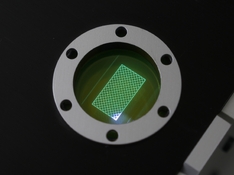
A small project I recently worked on using DLP. I haven't actually used it to print photos so I think I shouldn't start a separate thread, but based on the parameters, it might serve as a useful reference.

The device utilizes TI's DLP4710LC (0.47", 1920x1080), controlled by dual DLPC3479 chips, with power management handled by a DLPA3005. It drives a Luminus CBM-50X-UV 385nm LED. We followe TI’s reference design—specifically the DLP4710EVM-LC evaluation module (manufactured by Young Optics). If you're just looking to start experiment, you can skip the circuit part and simply buy the module to modify its LED and optical components.

The optical path starts from the UV LED with an aspheric collimator lens, followed by a fly-eye lens for light homogenization, then directed to the DMD via a TIR prism. We were lucky to find some components that, while rated only down to 420nm, maintained decent transmittance in the 385nm range (though it drops significantly at 365nm, it remains acceptable). The final stage is a short-throw macro lens (from a photography perspective), which creates a 2x magnified real image of the DMD at the object plane.

Added: I think the easiest way to try is to modify TI's evaluation modules, such as the 4K resolution DLPDLCR471TPEVM (1080p DMD and Pixel Shifting Actuator Technology) and the 1080p DLP4710EVM-LC. Lower resolutions are also available (DLPDLCR160CPEVM, 360x640), but these have bad image quality. It's generally believed that these can directly replace the blue LED (455nm) with a similar 405nm near-UV LED. However, the situation with 385nm depends on the module components, and 365nm are almost impossible to use properly, requiring custom UV components.

If the process allows for 455nm blue light, then the original module might be quite nice. For example, the DLP4710EVMLC's LED model is OSRAM OSTAR™ P1W, operating at a maximum current of 16A (~48W! Impressive for its size). Just need to ask a monochrome projection firmware that only enables the blue LED, Ti likes to support developers.

The cheapest option is to modify a commercial DLP projector(second-hand or obsolete items are better). which can provide high power blue light(~450 nm) by default, but UV application of them is unreliable. The optical path will likely contain various cost-cutting plastic components. The lens also needs some consideration, as commercial projectors may not allow focusing to small areas (such as A4 or A3 size) at close range.


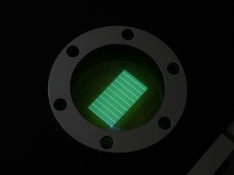
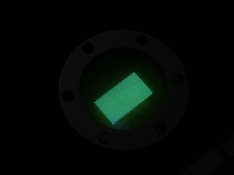
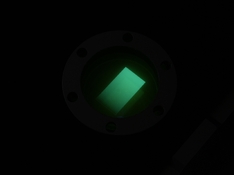
Some test patterns are shown in the images; the UV light is projected onto a fluorescent plastic film, giving it an appearance similar to an old-fashioned CRT monitor.The final projection size is approximately 20mm x 10mm at 1920x1080 resolution. With the 385nm LED running at 5A (35W), the measured irradiance is 1100 W/m2, which is roughly 20 times the intensity of UV radiation in midday sunlight.

I'm not doing just for hobby, so my next step might be to further reduce the projection area (which would correspondingly increase the UV intensity, the current value is still not enough) to make it easier for some photochemical induced material deposition (in a sense, an kind of alternative process?). Finding a macro lens with a smaller magnification is easy (the difficulty in macro photography usually in larger magnification), the main problem is that they may not be suitable for those UV wavelengths.
 

Attachments

  • _DSC8753_副本.jpg
    _DSC8753_副本.jpg
    1.2 MB · Views: 56
  • _DSC8758_副本.jpg
    _DSC8758_副本.jpg
    1 MB · Views: 47
  • _DSC8745_副本.jpg
    _DSC8745_副本.jpg
    965.1 KB · Views: 37
  • _DSC8755_副本.jpg
    _DSC8755_副本.jpg
    1 MB · Views: 49
Last edited:

koraks

Moderator
Moderator
Joined
Nov 29, 2018
Messages
27,427
Location
Europe
Format
Multi Format
Looks nice!
This reminds me that the first time I heard of an alternative use for (essentially) DLP chips was actually in semiconductor manufacture. AFAIK the concept is still used in that specific application.
 

Yezishu

Member
Allowing Ads
Joined
Dec 21, 2024
Messages
183
Location
Hong Kong
Format
35mm
Looks nice!
This reminds me that the first time I heard of an alternative use for (essentially) DLP chips was actually in semiconductor manufacture. AFAIK the concept is still used in that specific application.


As you said. The power here is sufficient for some semiconductor manufacture experiments. For commonly used AZ4620 or AZ9260 photoresist, an exposure just need 10 seconds. Unfortunately, for other specific needs, the light intensity still needs to be increased by one or two orders of magnitude.....
 

DjulLau

Member
Allowing Ads
Joined
Feb 11, 2025
Messages
1
Location
Nodes
Format
Digital
Hi Andrew,

Congrats for this awesome achievement on building a UV enlarger! I want to build something similar too for some time now and your efforts will certainly be of great help.

Could you detail a bit the parts you end up using and where to find them? The UV source, the "UV friendly" Fresnels, the LCD... Any rough idea of the coast?
How did you finally drive the LCD? Windows laptop or raspberry? Custom software?
Did you find out why your projector has already lost some power?

Thanks for your answers.
 
OP
OP

AndrewBurns

Member
Joined
Jul 12, 2019
Messages
304
Location
Auckland, New Zealand
Format
Multi Format
Hi Andrew,

Congrats for this awesome achievement on building a UV enlarger! I want to build something similar too for some time now and your efforts will certainly be of great help.

Could you detail a bit the parts you end up using and where to find them? The UV source, the "UV friendly" Fresnels, the LCD... Any rough idea of the coast?
How did you finally drive the LCD? Windows laptop or raspberry? Custom software?
Did you find out why your projector has already lost some power?

Thanks for your answers.

Thanks.

The UV friendly fresnels were from a company in the USA called https://www.fresneltech.com/
The UV LED was from a company in China called https://www.gmleds.com
The LCD screen was from an Aliexpress seller called Sumopai

The LCD is driven by a raspberry pi using the standard Pi linux OS, although crucially I had to downgrade it to a previous version of the OS to get the screen working properly (details of this are in the 31 megapixel enlarger thread).

I manipulate images so that they display on the screen properly and display them using python scripts, details of this are in my LCD screen contact printing thread.

Not sure if the projector has actually lost power or if so why, but it hasn't really impacted my exposure times. Two things I have noticed about the design that are annoying:
  • Because the two fresnel lenses I use as a condenser stage don't have the same density of ridges and aren't perfectly aligned you can get moire patterns in the edges at different focal lengths that ruin the print. The solution I've found with this is to move the lenses slightly to eliminate the patterns when they show up, but this can reduce UV power a bit as it moves the condenser away from optimum
  • Recently I've been seeing 'burn in' or 'ghost' images from previous exposures that persist on the screen even after it's been turned off, which has caused me some failed prints. I'm not sure why this is happening as I'm not leaving the screen on for that long, I think that maybe where these screens are actually used (3D printers) the exposure times are only a few seconds long and they probably wipe and refresh the screen between every exposure to prevent persistence.
 

imgprojts

Member
Allowing Ads
Joined
May 24, 2024
Messages
189
Location
Seattle WA
Format
Multi Format
On my UV projector I am using a 50W LED focused to almost cover the entire 1080p face of the matrix. Using the New Cyanotype formula it can expose 5.5X8.5" (215mm x 140mm) in about 4 minutes. I wonder if I focus it to 10mmX20mm how fast it could expose. based on the area it should be somewhere around 1 to 3 seconds which sounds crazy. However I recall before it became a UV projector I could expose tiny images in about 5 seconds.
 

Yezishu

Member
Allowing Ads
Joined
Dec 21, 2024
Messages
183
Location
Hong Kong
Format
35mm
On my UV projector I am using a 50W LED focused to almost cover the entire 1080p face of the matrix. Using the New Cyanotype formula it can expose 5.5X8.5" (215mm x 140mm) in about 4 minutes. I wonder if I focus it to 10mmX20mm how fast it could expose. based on the area it should be somewhere around 1 to 3 seconds which sounds crazy. However I recall before it became a UV projector I could expose tiny images in about 5 seconds.

That's is right in theory, but then you'll meet the problem of finding a high-quality lens.
It requires a huge numerical aperture to collect the light, while also having high optical quality (10mm at 1080p, meaning each pixel is 10um). The best fit for this requirement is a short focal length macro lens with large aperture used upside down (instead of using the enlarger lens). But the last problem is that macro lenses for photography usually have various corrections and aspherical surfaces, which often make it difficult for UV light to pass through. If you have some good options for collecting ultraviolet light focused by a Fresnel lens at a wide angle, achieving a 20x reduction at close range, and having good image quality (flat-field vignetting, distortion), please share them. I'm very interested.
 
OP
OP

AndrewBurns

Member
Joined
Jul 12, 2019
Messages
304
Location
Auckland, New Zealand
Format
Multi Format
I really need to get back into it sometime but the PVA-SbQ process really is the perfect match to UV projectors/enlargers. Even with my LCD screen absorbing 95% of my light and enlarging to ~A2 sized paper, exposure times are on the order of 20 seconds per layer vs. 45 minutes for a version of cyanotype chemistry optimized for fast exposure.

It's also quite a flexible process, I've tried coating paper, glass and anodised aluminium sheets which have all worked well. And being a pigment process you can make each layer whatever colour you want.
 

imgprojts

Member
Allowing Ads
Joined
May 24, 2024
Messages
189
Location
Seattle WA
Format
Multi Format
....interested.

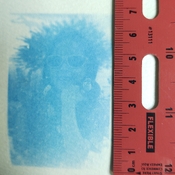
This was 67x45mm in 3 seconds. 5seconds it started making prussian white and I didnt notice until 10 seconds. I did a few of these. This one is not dry yet. I ran into a technical issue....can't mouse around the linux desktop when the pointer is smaller than a flea lol. I used a relatively dilute new cyanotype mix with pva/cmc so it looks light. 3 drops into ~1g.
 

Attachments

  • IMG_20260204_154521_1.jpg
    IMG_20260204_154521_1.jpg
    1,019.6 KB · Views: 6

Yezishu

Member
Allowing Ads
Joined
Dec 21, 2024
Messages
183
Location
Hong Kong
Format
35mm
I ran into a technical issue....can't mouse around the linux desktop when the pointer is smaller than a flea lol.
Good job! An HDMI 1-to-2 splitter and another monitor may help, or write a small program to directly control the HDMI output (for Raspberry Pi).
 

imgprojts

Member
Allowing Ads
Joined
May 24, 2024
Messages
189
Location
Seattle WA
Format
Multi Format
Good job! An HDMI 1-to-2 splitter and another monitor may help, or write a small program to directly control the HDMI output (for Raspberry Pi).

I just figured out how to vnc into it. But actually a vnc splitter is not a bad idea at all. I tried several ways and RDP will give you a different desktop as if you were a different user on that same box while vnc replicates the desktop. My photo room is far from the wifi so its a bit slow but I can fix that easily.
 
Photrio.com contains affiliate links to products. We may receive a commission for purchases made through these links.
To read our full affiliate disclosure statement please click Here.

PHOTRIO PARTNERS EQUALLY FUNDING OUR COMMUNITY:


Ilford ADOX Freestyle Photographic Stearman Press Weldon Color Lab Blue Moon Camera & Machine
Top Bottom