
• Welcome to Photrio!
    Registration is fast and free. Join today to unlock search, see fewer ads, and access all forum features.
    Click here to sign up

Luna Pro SBC

MIT. 25:35

MIT. 25:35

  • 0
  • 0
  • 0
Lutheran Cemetery Angel

H
Lutheran Cemetery Angel

  • 0
  • 0
  • 28

Recent Classifieds

Forum statistics

Threads
202,945
Messages
2,847,958
Members
101,550
Latest member
Paris-Belle
Recent bookmarks
0
If the slides are consistently dark then the problem is caused by not using the light meter correctly. The slides are dark because the photographer is including too much of the sky in the reading. This phenomenology is called an Operator Assisted Failure [OAF]. The proper usage of this term is thus: "The OAF caused the slides to be too dark because the OAF kept aiming the light meter at the sky."
 
That's nonsense about selenium cells too. Selenium cell meters can work well, but even the best have very limited low light capability compared to CdS or, more so, silicon blue cells (the "SBC" in Luna Pro SBC) or other, more modern sensors. Furthermore, selenium cells will age and eventually become worthless. They can be replaced but will have to be eventually. I think a little selenium cell meter (whose one virtue is in fact the lack of need for batteries) can make a dandy backup for the day the battery is dead in another meter - but then so does the light meter ap in my iPhone which is always with me and virtually never has a run down battery.

It is unfortunate that there is not some source of information that folks could check before they make false and uninformed statements. Selenium cells do not "..age and eventually become worthless...". I have a number of selenium cell meters ranging from 50 to 75 years old. Most of them (including the oldest) still work and meter exactly on.

Selenium cells never "wear out", spontaneously "age", or invariably "become worthless". There are certain environmental and usage conditions that will cause internal corrosion to form and increase the internal resistance of the cell. This can cause the meter to give incorrect readings and eventually stop working. But meters that have been stored properly in dry, dark, temperature regulated conditions will continue to work dependably.

Actual experience and testing have shown that the older selenium meters are far more dependable than the cheap plastic CdS meters that replaced them. Although this is likely an indication of the quality that initially went into them and not a fundamental shortcoming of the cells. My oldest CdS camera is going on 50 years old and it still works fine.
 
I wouldn't mind having to change the ASA dial on the camera or the meter IF it would just read accurately. If I meter on the grass in bright sunlight and get 250@f11 with the camera and the meter gives me the same reading, I'm happy. If I go over to the shade of my maple tree and meter that same grass and both give me 250@f5.6 I'm still happy. but, If I turn the camera to the guys house out back around 50 yards and the camera says 250@f8 and the meter says 250@ f11, one of them is wrong.

That's the sort of thing I've been dealing with...inconsistency.
 
It's boxed and ready to go to UPS. I'll see what Quality Light Meter thinks about it.
 
I checked around some and technically yes, selenium cells don't die just from age - it's light exposure and humidity. If they're kept dark and dry when not in use they can be good decades later. But often enough this is not the case. I had one that worked fine and after laying on a shelf a few years was dead as could be. No big loss as I think I gave five bucks for it.

Still their ONLY real advantage is the lack of need for batteries. I'd much rather have the excellent low light sensitivity of my SBC and just carry an extra 9v battery.


Sent from my iPhone using Tapatalk and 100% recycled electrons - because I care.
 
I checked around some and technically yes, selenium cells don't die just from age - it's light exposure and humidity. If they're kept dark and dry when not in use they can be good decades later. But often enough this is not the case. I had one that worked fine and after laying on a shelf a few years was dead as could be. No big loss as I think I gave five bucks for it.

Still their ONLY real advantage is the lack of need for batteries. I'd much rather have the excellent low light sensitivity of my SBC and just carry an extra 9v battery.


Sent from my iPhone using Tapatalk and 100% recycled electrons - because I care.

+1

My SBC has a habit of eating 9 volt batteries so I always carry extra.
 
I got a call from George yesterday afternoon and he's putting it into shipping. The cost was well under $100. I asked him what he found may have been wrong but due to his accent and my poor ears I couldn't quite follow it. He did tell me not to use the Energizer battery I had in it but rather the Duracell and he threw that in for free and was sending the Energizer back. Something to do with the voltage characteristics.

At any rate, it's on the way. Excellent folks to deal with. I asked him if they repaired the Leica Mr and MR-4 meters and he said yes so, that's a plus in the event I need that one CLA'd.
 
I've been amazed at the accuracy of my old MR-4 meter. I hope it will be just as accurate.
 
I got a call from George yesterday afternoon and he's putting it into shipping. The cost was well under $100. I asked him what he found may have been wrong but due to his accent and my poor ears I couldn't quite follow it. He did tell me not to use the Energizer battery I had in it but rather the Duracell and he threw that in for free and was sending the Energizer back. Something to do with the voltage characteristics.

At any rate, it's on the way. Excellent folks to deal with. I asked him if they repaired the Leica Mr and MR-4 meters and he said yes so, that's a plus in the event I need that one CLA'd.

Great
 
The trick is to pick a meter and pair it with a camera.
If the meter is consistent, you can work it out from there.
 

Attachments

  • LightMeters.jpg
    LightMeters.jpg
    1.1 MB · Views: 148
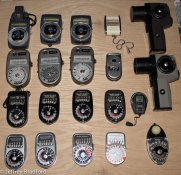
Wide variety there. I once had the Pentax Spotmeter(IV?) and the Sekonic at the bottom right...308, I think it was.
 
I got a call from George yesterday afternoon and he's putting it into shipping. The cost was well under $100. I asked him what he found may have been wrong but due to his accent and my poor ears I couldn't quite follow it. He did tell me not to use the Energizer battery I had in it but rather the Duracell and he threw that in for free and was sending the Energizer back. Something to do with the voltage characteristics.

At any rate, it's on the way. Excellent folks to deal with. I asked him if they repaired the Leica Mr and MR-4 meters and he said yes so, that's a plus in the event I need that one CLA'd.

And the result? How far out of calibration was the unit? All units in sync now?
 
Works fine now. I had to set it on ASA200 for Tri-X before but sometimes it would read fine yet in other light conditions it still would read off. Everything seems to agree now with two other meters I have so, all looks well, thanks to George.
 
Photrio.com contains affiliate links to products. We may receive a commission for purchases made through these links.
To read our full affiliate disclosure statement please click Here.

PHOTRIO PARTNERS EQUALLY FUNDING OUR COMMUNITY:


Ilford ADOX Freestyle Photographic Stearman Press Weldon Color Lab Blue Moon Camera & Machine
Top Bottom