
• Welcome to Photrio!
    Registration is fast and free. Join today to unlock search, see fewer ads, and access all forum features.
    Click here to sign up

Low cost process automation for making emulsions

Somewhere...

D
Somewhere...

  • 2
  • 1
  • 63
Iriana

H
Iriana

  • 6
  • 1
  • 123

Recent Classifieds

Forum statistics

Threads
202,740
Messages
2,844,938
Members
101,494
Latest member
FlyingDutchman
Recent bookmarks
0
Sorry to interrupt all the geek talk but - Didn't know Mr Mowrey was having a little trouble!

Hope you're better every day sir. And I hope karma is for real, and you get a little payback for all your kindness and help around here!
 
Didn't know Mr Mowrey was having a little trouble!

What kind of trouble? Now I got a little worried... I hope it's not a health issue. If it is, get well soon, Mr. Mowrey!

I have been visiting this thread from time to time and I have a couple of questions. First,how low cost you intend to go, Ron? And what about a mid-cost alternative?
 
Sorry to interrupt all the geek talk but - Didn't know Mr Mowrey was having a little trouble!

Hope you're better every day sir. And I hope karma is for real, and you get a little payback for all your kindness and help around here!

The perils of old age I guess. Thanks for your kind wishes.

RM
 
What kind of trouble? Now I got a little worried... I hope it's not a health issue. If it is, get well soon, Mr. Mowrey!

I have been visiting this thread from time to time and I have a couple of questions. First,how low cost you intend to go, Ron? And what about a mid-cost alternative?

We are trying to keep it under $100. At worst it should be under $200.

As I said above, just old age.

PE
 
First,how low cost you intend to go, Ron? And what about a mid-cost alternative?

I guess it's all relative. A while ago Nick came up with a new small peristaltic pump (more expensive than the one mentioned earlier in this thread) that seems to work well with the regulated variable DC voltage power supply I put together. Nick's been busy the past month with classes and some remodeling of the lab space at GE and we haven't been able to make an actual emulsion with the new pump. Hopefully, next Monday or Tuesday.
 
We are trying to keep it under $100. At worst it should be under $200.

As I said above, just old age.

Good to know it's nothing serious.

Considering the complexity of the process being automated and the benefits, $200 is not a bad target either.
 
OTOH, I have made some good emulsions with either a syringe or a burette and the scale has varied up to about 5L. So, our intent is to give as wide a range of equipment as possible.

PE
 
Ron, from what I gather, the automation main purpose would be repeatability, right? It's hard to keep the syringe flowing steadily, at least it's harder than with something automatic. Am I right?
 
Yes, this is true, but a burette can do the same. However, burettes are not cheap either.

I'm finding that some emulsions that I might propose here can take up to 5 hours and require up to 3 solutions running at the same time. This is where a pump shines. You set it (or them) to run and walk away.

PE
 
Thanks, Ron. I am watching this thread closely. Keep up the good work!
 
I see that Amazon also lists a number of inexpensive motor controllers. I've never used any but it seems they might be ideal for this application. Over the winter I was going going to look into another used hospital syringe pump. Unfortunately most seem to be in pretty poor shape in terms of the operating controls although the mechanism works just fine. These pumps look like a more attractive alternative.
 
So I went in for a for a little peristaltic pump and an Arduino R3 to control it. The nice thing about the peristaltic pump is that the solutions only come in contact with the plastic hose inside and not mechanical components. The hose can be easily cleaned and can be replaced. They are about 3x the price of other pumps but in this case that is $12 instead of $4.

Bringing in the Arduino R3 adds the future possibility of directly measuring and controlling things like temperature, pH and VAg, run-time, flow ramps, double-jet and whatever else you could think of by computer. This could be a great leap forward or a rabbit hole depending on how one looks at it. On another forum I was convinced of how simple using this Arduino would be. We'll see.

I really hope I am not sorry about the Arduino.

-- Jason
 
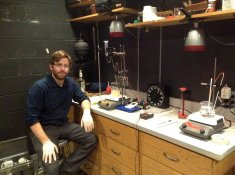
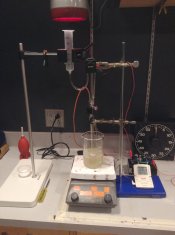
I was with Nick this afternoon when he made a 600ml AgBr emulsion using the new pump setup.

Attached is a photo of Nick at the GEM before starting the emulsion make and a closer view of the apparatus.

IMG_1749.jpg IMG_1752.JPG
 
Thank you, Prof_Pixel. Got a question: at the end of the Ag run through the pump, is there any problem draining the last of the silver solution from the line? Is he using something to flush the line?
 
Thank you, Prof_Pixel. Got a question: at the end of the Ag run through the pump, is there any problem draining the last of the silver solution from the line? Is he using something to flush the line?

The way Nick has the 'plumbing' arranged, the pump clears the lines.
 
Both filling and clearing are important steps and part of the timing for making. If you use an exact amount of solution you just pump dry, but this is not always the case.

PE
 
An early report out on the pumps that I ordered; one peristaltic and one gear. Both pumps run on nominal 12 VDC although voltages can be varied from about 3 to 12 VDC to control rate. They were tried with water and a bench power supply.

Both pumps self prime and happily clear the input and output lines up to the point of blowing bubbles on the output when run completely dry. This is important. We want the lines to fully clear.

Both seem to be nicely made. The gear pump is labeled RS-360H. The peristaltic didn't seem to have a particular model number. Both were purchased through Amazon. Gear pump: $4.00. Peristaltic pump: $12.50

The gear pump is high speed. There are inferences to using this pump to build a model jet powered boat. I'd believe it. It seems to pump at least several litres of water per minute. Since I was using drinking glasses it was hard to get an accurate sense of how much is pumped in a minute. It would be hard to slow this pump down enough for a long silver run of, say, 40ml over 30 minutes.

The peristaltic pumps right around it's specified rate of 100ml per minute at 12VDC and works down to about 3VDC. I would think that controlling this pump for a long run would be workable.

-- Jason
 
Well, if we go with 2A, we need a very good hefty pot.

These are not in great supply since the digital revolution!

:wink:

PE

Most people control small electric motors with a power transistor connected to a 1K pot. Typically the motor connects to a 2N3055.

Simon
 
Thanks Simon, but many of our attempts are to minimize wiring and cost. So, a pot only needs to have basically, two wires. I have found such pots as low as $20 and these need very little expertise to set up.

I do have transistor controlled systems using pots with smaller capacities and I have even set up PWM controlled motors.

PE
 
Thanks Simon, but many of our attempts are to minimize wiring and cost. So, a pot only needs to have basically, two wires. I have found such pots as low as $20 and these need very little expertise to set up.

The adjustable, regulated DC power supply I put together that we are using didn't cost much more and offers a lot more control.
 
Photrio.com contains affiliate links to products. We may receive a commission for purchases made through these links.
To read our full affiliate disclosure statement please click Here.

PHOTRIO PARTNERS EQUALLY FUNDING OUR COMMUNITY:


Ilford ADOX Freestyle Photographic Stearman Press Weldon Color Lab Blue Moon Camera & Machine
Top Bottom