• Welcome to Photrio!
    Registration is fast and free. Join today to unlock search, see fewer ads, and access all forum features.
    Click here to sign up

Learning from Master Platinum Printer Irving Penn

Tybee Beach Pier

A
Tybee Beach Pier

  • 1
  • 0
  • 15
Local Artists Work

D
Local Artists Work

  • 1
  • 2
  • 22

Recent Classifieds

Forum statistics

Threads
201,132
Messages
2,819,602
Members
100,551
Latest member
Franklee
Recent bookmarks
0

Bob Carnie

Subscriber
Allowing Ads
Joined
Apr 18, 2004
Messages
7,735
Location
toronto
Format
Med. Format RF
Dave

I Believe the two worker series prints that were in that auction , were the ones in my shop this year.
Both were mounted on aluminum, punched and were from 1/5 series, I think my client did photograph the notes so I will ask him.

At the time I was not interested about this as I thought everyone on the planet knew that Mr Penn was multi layering his platinum prints. In fact he was known to experiment with all kind of noble metals.

What struck me as odd was that whoever did the registration work , punched the aluminum with paper on both sides on the short side. In high end photocomp work we always punched on the long side to make the registration easier to accomplish.
 

Bob Carnie

Subscriber
Allowing Ads
Joined
Apr 18, 2004
Messages
7,735
Location
toronto
Format
Med. Format RF
I should add that by and far this is the most pleasurable, informative thread I have had the pleasure to be involved in and learn from on any forum over the last 5 years.

Dave you deserve big kudo's from this community for sharing what you are doing.

Bob
 

Ben Altman

Member
Allowing Ads
Joined
Jan 19, 2007
Messages
205
Location
Ithaca, NY a
Format
Large Format
Hear, hear! It's great stuff and very timely for me...

About underprinting - not sure if this is relevant but the other day I had a senior moment (despite the big sign on my light integrator) and started a POP Pd exposure without turning on the vacuum frame. I realized after 30 seconds or a minute and turned off the light bank. I was quite surprised by the amount of print-out already present. My exposures run 20-min plus, so that's four or five stops down. I made a mental note but have not explored further. Maybe there's something about this effect that could be useful.

Best, Ben
 

R Shaffer

Member
Allowing Ads
Joined
May 9, 2007
Messages
436
Location
Santa Cruz,
Format
Multi Format
I would concur that this has been an interesting thread.

One thing that really impresses me is how completely clear and bright white Penn's prints are. I have been exclusive to Rives BFK for over a year, but I have a bear of time clearing it if I have not sized the paper. I did not try HCL, but I tried EDTA, Citric Acid, and Hypoclear in various sequences and by themselves. Do you know if he was doing any pretreatment or sizing the paper?

I see references in the notes to Rives Bristol. Is that the same as BFK?

Underexposure would make some sense as a way to add density to the shadows without effecting the highlights and midtones too much. Similar to what we do with gum.

Cool stuff Dave, thanks for sharing.
 

Loris Medici

Member
Allowing Ads
Joined
Sep 13, 2005
Messages
1,154
Location
Istanbul, Tu
Format
Multi Format
To my knowing, old-timers were using diluted HCl (~ 5% - absolute or v/v % of ~ 35% concentrated stuff I'm not sure...) for clearing pt/pd prints, therefore maybe Penn also did so...

Regards,
Loris.
 

marko_trebusak

Member
Allowing Ads
Joined
Aug 31, 2004
Messages
87
Location
Slovenia
Format
Multi Format
I agree that this is very interesting thread.

Dave, since you are using digital negatives, do you think that the starting point for three layers could be:
-first layer normal printing: this would set the highlights.
-second negative shall be completely opaque in highlights. Mid tones shall print like highlights (this would prevent adding density to mid tones as is the case with your tree layered print with the single negative
-third one would just add density to shadows
my thinking is, that shadow separation on second and third layers should be greater than with normal negative. Does that make sense?

I'm on a workshop this and next weekend, but will try to test this multi layer approach after that.

Cheers,
Marko
 
OP
OP
Davec101

Davec101

Member
Allowing Ads
Joined
Jul 29, 2005
Messages
1,216
Location
Cambridge, U
Format
Large Format
I agree that this is very interesting thread.

Dave, since you are using digital negatives, do you think that the starting point for three layers could be:
-first layer normal printing: this would set the highlights.
-second negative shall be completely opaque in highlights. Mid tones shall print like highlights (this would prevent adding density to mid tones as is the case with your tree layered print with the single negative
-third one would just add density to shadows
my thinking is, that shadow separation on second and third layers should be greater than with normal negative. Does that make sense?

I'm on a workshop this and next weekend, but will try to test this multi layer approach after that.

Cheers,
Marko

The workflow you describe in principle sounds like it would work, it is going to rely heavily on your ability to effectively mask areas and also gain control of the density gains associated with multi-layering, I believe this could be achieved by creating a number of detailed step wedges for each layer. The ability to predict how the next layer will print will take time and practice but I personally believe it is worth it. I print for other artists and quite often they require a print to have a greater density than I was able to obtain with previous platinum printing workflows, multi-layering gives me another option to work with.

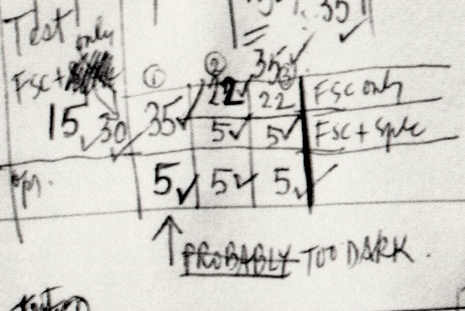
This is a shot in the dark really but the comment Penn makes here in his working notes illustrates the challenges of multilayering.

5085533917_b24fbdff6b_o.jpg

My best guess is that he has printed the first layer and then written ‘probably too dark’, in effect predicting how the next layer will print. He has then printed the next layer and come to the conclusion that it is 'too dark' and crossed out the ‘probably’.
 
Last edited by a moderator:
OP
OP
Davec101

Davec101

Member
Allowing Ads
Joined
Jul 29, 2005
Messages
1,216
Location
Cambridge, U
Format
Large Format
I should add that by and far this is the most pleasurable, informative thread I have had the pleasure to be involved in and learn from on any forum over the last 5 years.

Dave you deserve big kudo's from this community for sharing what you are doing.

Bob

Thanks guys for your kind comments, it has been a pleasure getting feedback from other people who share the same interest in Penns platinum prints.
 

PVia

Member
Allowing Ads
Joined
Oct 3, 2006
Messages
1,057
Location
Pasadena, CA
Format
Multi Format
Dave, I've looked at this worksheet over and over the last few years to try to decipher it. Thanks for bringing it up here...

Another thing to check is if Rives BFK was the same paper back then that it is today, in surface texture, weight and pH.
 
OP
OP
Davec101

Davec101

Member
Allowing Ads
Joined
Jul 29, 2005
Messages
1,216
Location
Cambridge, U
Format
Large Format
Dave, I've looked at this worksheet over and over the last few years to try to decipher it. Thanks for bringing it up here...

Another thing to check is if Rives BFK was the same paper back then that it is today, in surface texture, weight and pH.

Thats what i was thinking, I recall reading in the Arentz book or on the web that changes were made to BFK that made it challenging to get a good print from it. Will have a check.
 

PVia

Member
Allowing Ads
Joined
Oct 3, 2006
Messages
1,057
Location
Pasadena, CA
Format
Multi Format
Almost none of the prints I saw in the Small Trades exhibit at the Getty seemed to show the familiar characteristics of BFK. They were, of course, framed behind glass, but I was sniffing as close as could be.

Have you also seen the margin notes on many of the prints? You can see them on test fragments in his "A Notebook at Random" book, things like "X8000 3'16" 15 min 3 x (PB).
 
OP
OP
Davec101

Davec101

Member
Allowing Ads
Joined
Jul 29, 2005
Messages
1,216
Location
Cambridge, U
Format
Large Format
Well its not in the Arentz book although i did come across the 'Platinum Printers Prayer'

'Oh Lord, when a product changes, in the matter of course, I pray, that only once, it be better, instead of worse' :smile:

Other papers Penn used were Bienfang amd Strathmore. Apparently Bienfang is a favorite of well known platinum printer Lois Conner.
 

PVia

Member
Allowing Ads
Joined
Oct 3, 2006
Messages
1,057
Location
Pasadena, CA
Format
Multi Format
I know about the Strathmore but are you sure about Penn's use of Bienfang?
 
OP
OP
Davec101

Davec101

Member
Allowing Ads
Joined
Jul 29, 2005
Messages
1,216
Location
Cambridge, U
Format
Large Format
Almost none of the prints I saw in the Small Trades exhibit at the Getty seemed to show the familiar characteristics of BFK. They were, of course, framed behind glass, but I was sniffing as close as could be.

Have you also seen the margin notes on many of the prints? You can see them on test fragments in his "A Notebook at Random" book, things like "X8000 3'16" 15 min 3 x (PB).

The small trades prints that were at the National Gallery of Art (washington) in 2005 were on Arches, however thats all it states. I think i recall the other day seeing the Arches emboss on his 'Camel Pack' print and the mention of 'Satine'.
 
Last edited by a moderator:
OP
OP
Davec101

Davec101

Member
Allowing Ads
Joined
Jul 29, 2005
Messages
1,216
Location
Cambridge, U
Format
Large Format
I know about the Strathmore but are you sure about Penn's use of Bienfang?

Am sure, a number of the New Guinea prints were on Bienfang.. oh and one of the well known prints 'women with Roses' This has to be one of my all time favorite prints of his wife.
 
OP
OP
Davec101

Davec101

Member
Allowing Ads
Joined
Jul 29, 2005
Messages
1,216
Location
Cambridge, U
Format
Large Format
Have you also seen the margin notes on many of the prints? You can see them on test fragments in his "A Notebook at Random" book, things like "X8000 3'16" 15 min 3 x (PB).

Have not seen those notes, can you scan them in? I presume the X8000 refers to his light source and exposure times.
 
OP
OP
Davec101

Davec101

Member
Allowing Ads
Joined
Jul 29, 2005
Messages
1,216
Location
Cambridge, U
Format
Large Format
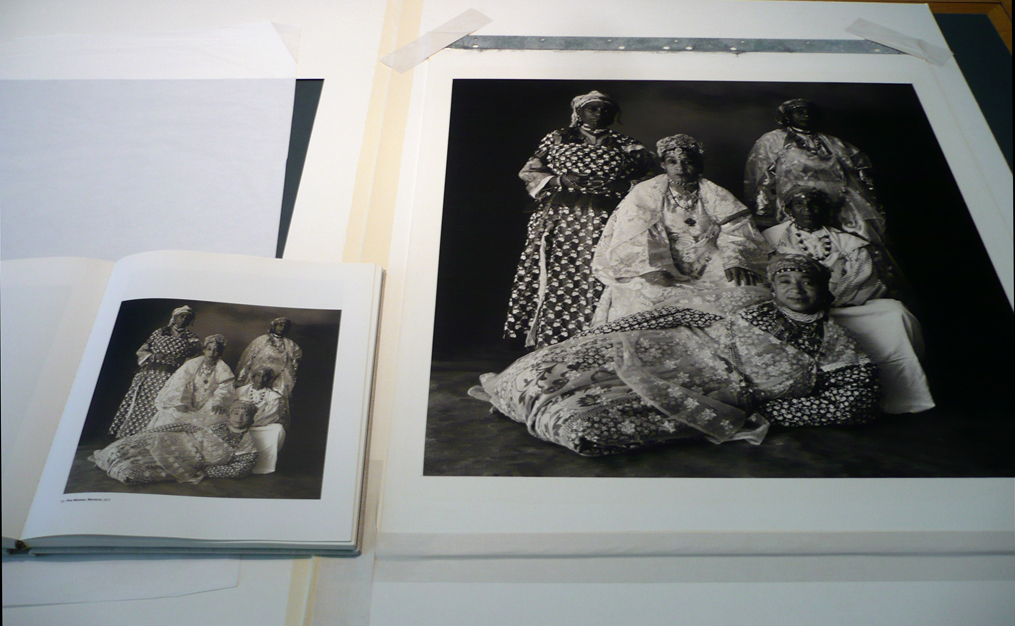
This is one image that i have yet to upload from a while back when i was looking at the differences between the book reproductions and the actual prints that might be of interest to some. It shows quite significant differences in density, tone and hue between the two that is important to emphasise to those who have not seen the original prints which is a must for anyone interested in platinum prints or indeed Penn's work.

5088364845_f1552890f6_o.jpg
 
Last edited by a moderator:

Solarize

Member
Allowing Ads
Joined
Apr 21, 2006
Messages
350
Location
London, Engl
Format
Medium Format
This has been a very interesting thread. For my own experiments over the last few days; I have tried a two hit pt/pd print, using two negatives.
I'd been creating a new set of curves following a switch in printing workflow, and landed on a print with very open shadows. The highlights were spot on, so in a crude and spontaneous experiment, I recoated and layered a far denser negative with heavily masked highlights over the top. I wanted more depth in the shadows with little change to the highlights. Although my results were not predictable, at all scientific or refined, the results were almost as hoped. The mid-tones were brought up to better density, the maximum black increased (visual assessment only) and the highlights remained about the same. I would imagine through proper testing and curve creation, that prints of greater depth could be created.

While I'm not sure I would coat twice for general tonality, the increase in DMax was appreciable. These experiments are much appreciated David, and I look forward to seeing the progress. With the Kenro Izu series of Cyanotype over pt/pd, the depth of the bluish black shadow is beautiful. Once I have proper registration sorted*, I will experiment with Cyan hits on the shadows of Palladium prints - with a bit of luck creating a split tone of sorts with warmish highlights.

*I really fudged registration on the print below. If anyone could point me toward advice on using pins to improve the results, it would be much appreciated.

- Ciaran
 
OP
OP
Davec101

Davec101

Member
Allowing Ads
Joined
Jul 29, 2005
Messages
1,216
Location
Cambridge, U
Format
Large Format
This has been a very interesting thread. For my own experiments over the last few days; I have tried a two hit pt/pd print, using two negatives.
I'd been creating a new set of curves following a switch in printing workflow, and landed on a print with very open shadows. The highlights were spot on, so in a crude and spontaneous experiment, I recoated and layered a far denser negative with heavily masked highlights over the top. I wanted more depth in the shadows with little change to the highlights. Although my results were not predictable, at all scientific or refined, the results were almost as hoped. The mid-tones were brought up to better density, the maximum black increased (visual assessment only) and the highlights remained about the same. I would imagine through proper testing and curve creation, that prints of greater depth could be created.

While I'm not sure I would coat twice for general tonality, the increase in DMax was appreciable. These experiments are much appreciated David, and I look forward to seeing the progress. With the Kenro Izu series of Cyanotype over pt/pd, the depth of the bluish black shadow is beautiful. Once I have proper registration sorted*, I will experiment with Cyan hits on the shadows of Palladium prints - with a bit of luck creating a split tone of sorts with warmish highlights.

*I really fudged registration on the print below. If anyone could point me toward advice on using pins to improve the results, it would be much appreciated.

- Ciaran

Good to see one of my recent platinum printing students, following in my footsteps.
 
Last edited by a moderator:

Bob Carnie

Subscriber
Allowing Ads
Joined
Apr 18, 2004
Messages
7,735
Location
toronto
Format
Med. Format RF
Re registration issues

look at the image above your post. You will see that the paper is mounted to aluminum with the registration punch holes visible.
I use Strosser punch for all my past and future multiple hit prints. I will punch on the long side of the print. Penns prints I have seen here and at my shop were punched on the short side.
Also note that the prints I saw were paper both sides of the aluminum.
Also note for good registration one should punch through the paper/aluminum/paper to not have a air gap which over the long exposures would pull the film towards the punch holes and cause miss registration.

Punch pins are made or better stated, vacumn Exposing units like for example Nuark 26k have a rubber blanket whose sole purpose is to allow the pins to sink into them so that there is a perfect contact between film and paper.

Dave , does the exposing unit you use have a large blanket that will allow the pins to sink??? very important.
Laying down the film onto the pins is very critical and the decisive moment one would say for critical registration. Believe me when I say this as a bad laydown will only show itself after you have done the exposure and process and then it is too late.


This has been a very interesting thread. For my own experiments over the last few days; I have tried a two hit pt/pd print, using two negatives.
I'd been creating a new set of curves following a switch in printing workflow, and landed on a print with very open shadows. The highlights were spot on, so in a crude and spontaneous experiment, I recoated and layered a far denser negative with heavily masked highlights over the top. I wanted more depth in the shadows with little change to the highlights. Although my results were not predictable, at all scientific or refined, the results were almost as hoped. The mid-tones were brought up to better density, the maximum black increased (visual assessment only) and the highlights remained about the same. I would imagine through proper testing and curve creation, that prints of greater depth could be created.

While I'm not sure I would coat twice for general tonality, the increase in DMax was appreciable. These experiments are much appreciated David, and I look forward to seeing the progress. With the Kenro Izu series of Cyanotype over pt/pd, the depth of the bluish black shadow is beautiful. Once I have proper registration sorted*, I will experiment with Cyan hits on the shadows of Palladium prints - with a bit of luck creating a split tone of sorts with warmish highlights.

*I really fudged registration on the print below. If anyone could point me toward advice on using pins to improve the results, it would be much appreciated.

- Ciaran
 

Bob Carnie

Subscriber
Allowing Ads
Joined
Apr 18, 2004
Messages
7,735
Location
toronto
Format
Med. Format RF
Here is a observation for those going down the multiple neg approach.

Observation: I think that one hurdle we all will have is the buildup of density when now we think we have blocked it out with the negative density of the second negative.
Dave has already shown us this problem.

This is natural and for silver I have taken this overall increase in stride and adjusted the first exposure accordingly.
Most of you folks are using ink jet negatives which IMHO will only give more scattering of light than lets say the film Mr Penn would have been using.
I will not bet the farm but I will make this note that I believe that He or his printer would also be masking out on top of all the negatives to reduce this effect, thus if he was making three negative exposures there would also be possibly two or three blocking masks. Therefore I would argue or state with inkjet negs you may be wanting to either hand cut masks or make them with selections in PS to lay over the negs.. Holy shit batman , now he is saying not only make multiple negs, but now he is saying to make blocking masks for each negative.. IS HE CRAZY..
time will tell.

In the old, old , old days of photography 1980's, that is exactly what we had to do when making multiple hit transparancys or if not the image would flare out and become too flat. In our case the image would get lighter and flatter.
I will be using film off my Lambda and even though the effect will be less as I believe real film rather than inkjet will have its blocking advantages and sharpness , I will for sure be making unsharp masking films to lay on each exposure.

Hope this helps and I hope this will become obvious to those of you brave enough to follow Mr Penn's great footsteps.
 

Solarize

Member
Allowing Ads
Joined
Apr 21, 2006
Messages
350
Location
London, Engl
Format
Medium Format
Good to see one of my recent platinum printing students, following in my footsteps.

Thanks David. It feels good to have overcome the frustrations of the initial learning curve. I am now delighted with the results of my normal process, and am starting to tackle the finer points of alt printing. The beauty of these incremental improvements is that the failures are much less disheartening! The workshop absolutely got me off to a good start.

Ciaran
 

Solarize

Member
Allowing Ads
Joined
Apr 21, 2006
Messages
350
Location
London, Engl
Format
Medium Format
Thanks Bob. We have a family friend in the printing business. Unfortunately he has dumped most of his older gear; vacuum frames and so on... but it's possible he might have a punch knocking around. I'll have to talk to him.
I'm going to get down to the print room, probably tomorrow, and see the above example in person. Thanks.

Ciaran

Re registration issues

look at the image above your post. You will see that the paper is mounted to aluminum with the registration punch holes visible.
I use Strosser punch for all my past and future multiple hit prints. I will punch on the long side of the print. Penns prints I have seen here and at my shop were punched on the short side.
Also note that the prints I saw were paper both sides of the aluminum.
Also note for good registration one should punch through the paper/aluminum/paper to not have a air gap which over the long exposures would pull the film towards the punch holes and cause miss registration.

Punch pins are made or better stated, vacumn Exposing units like for example Nuark 26k have a rubber blanket whose sole purpose is to allow the pins to sink into them so that there is a perfect contact between film and paper.

Dave , does the exposing unit you use have a large blanket that will allow the pins to sink??? very important.
Laying down the film onto the pins is very critical and the decisive moment one would say for critical registration. Believe me when I say this as a bad laydown will only show itself after you have done the exposure and process and then it is too late.
 

PVia

Member
Allowing Ads
Joined
Oct 3, 2006
Messages
1,057
Location
Pasadena, CA
Format
Multi Format
This is one image that i have yet to upload from a while back when i was looking at the differences between the book reproductions and the actual prints that might be of interest to some. It shows quite significant differences in density, tone and hue between the two that is important to emphasise to those who have not seen the original prints which is a must for anyone interested in platinum prints or indeed Penn's work.

I'm not sure what book that is, but it is generally agreed that Penn's book, Passage, represents the pinnacle of traditionally printed photo books, with quadritone negatives crafted by Richard Benson and Thomas Palmer, two giants in the printing trade, and printed by Franklin Graphics of Providence, Rhode Island. The reproductions in Passage are ridiculously beautiful, great dMax and separation of tones...unsurpassed in the printing trade to this day, IMO.
 
OP
OP
Davec101

Davec101

Member
Allowing Ads
Joined
Jul 29, 2005
Messages
1,216
Location
Cambridge, U
Format
Large Format
Re registration issues

Dave , does the exposing unit you use have a large blanket that will allow the pins to sink??? very important.
Laying down the film onto the pins is very critical and the decisive moment one would say for critical registration. Believe me when I say this as a bad laydown will only show itself after you have done the exposure and process and then it is too late.

Hi Bob

I think it will allow pins, the vaccum frame has an air valve that i use so the laydown is not so sudden like with older unit's i have had. I have had only one registration issue on the third layer of one print however i was in hurry to get the print exposed, other than that things seem fine at the moment. Should i get a problem in the future i know who to call! :smile:
 
Photrio.com contains affiliate links to products. We may receive a commission for purchases made through these links.
To read our full affiliate disclosure statement please click Here.

PHOTRIO PARTNERS EQUALLY FUNDING OUR COMMUNITY:


Ilford ADOX Freestyle Photographic Stearman Press Weldon Color Lab Blue Moon Camera & Machine
Top Bottom