

markbarendt
Member
Run those tests and let us know what you find.In thanking wiltw for his illustrative tests, I am pondering that they really show why incident light meter are graciously provided with a lumisphere. Their use would be quite error prone if we had to devise any time the exact proper angle at which to use them. The lumisphere takes a lot of complexity out of this. Gives us the light "around the subject" not the light "mostly perpendicular to a certain plane of the subject".
On the other hand, if a subject is plane, such as a dark wooden table, that we want to photograph while maintaining, in the slide, the dark tone of the wood:
- supposing we are using an incident light meter we would obtain more precise results by using the disc instead of the sphere;
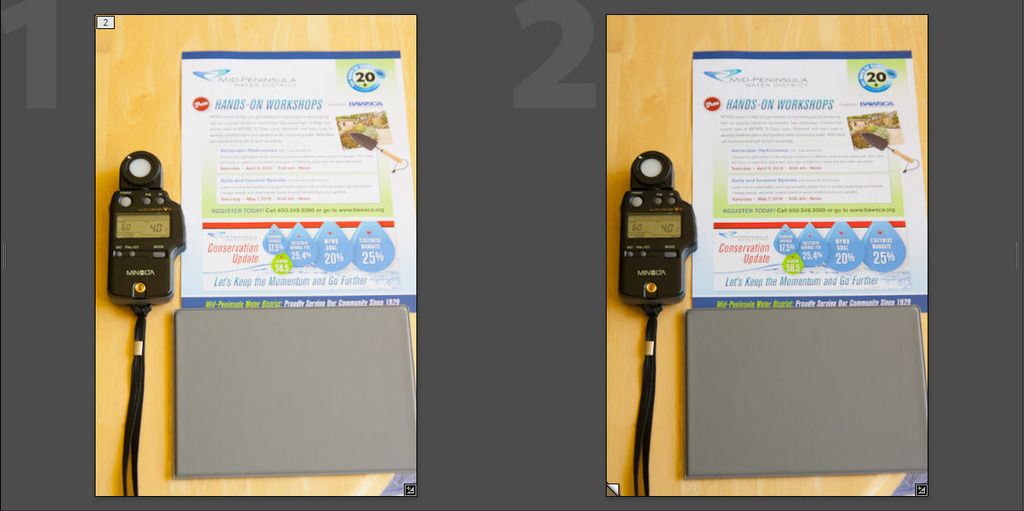
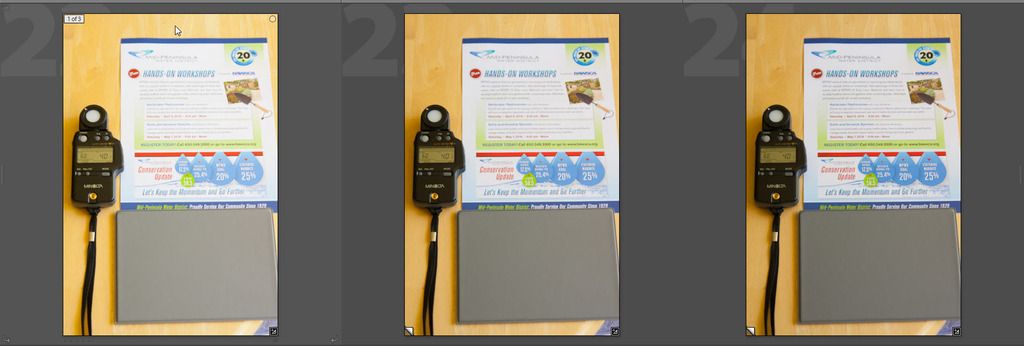
- supposing we are using a grey card for whatever reason, I think we would obtain more precise results by placing the grey card flat on the table, and not at a certain angle. We would then read the spot metering on the grey card laying on the table, and we would have the result we would use if the table was grey. Then we would close 1 stop because we want the wood to be dark.
Using the grey card on the same plane of a plane subject (document, painting, mosaic, fresco, pavement, floor, manhole, table...) corresponds to the use of the disc. If the flare on the card is very different from the flare on the subject, we are going to have a less precise indication.
Orienting the grey card half-way between source and lens-subject axis is an attempt to average the light "around" the subject just like a lumisphere would do. That is also a way to try to minimize flare, probably.
But if the subject IS flat and if it has flare, then the disc or card laying on the plane should give a better reading.