• Welcome to Photrio!
    Registration is fast and free. Join today to unlock search, see fewer ads, and access all forum features.
    Click here to sign up

Kodak 120 film - backing paper problems - emulsions affected

Somewhere...

D
Somewhere...

  • 5
  • 2
  • 110
Iriana

H
Iriana

  • 7
  • 1
  • 175

Recent Classifieds

Forum statistics

Threads
202,752
Messages
2,845,105
Members
101,505
Latest member
PeterFFM
Recent bookmarks
1
-) the corresponding figure has no contact with the emulsion, but is divided from it by the base.
When rolled up on the spool. the numbers and letters on the back of the 120 backing paper are pressed against the front (emulsion) of the next layer of film in the roll.
 
Not the corresponding figures.
Letting even the flipping of figures aside, the location of a backing number somehow transferred to the emulsion side would be shifted in respect to its original position.
 
The way I understand Bill Burk is that when he said "corresponding" he was referring to the numbers and figures on the back of the backing paper that were pressed against the emulsion - one set when the film was on the feed spool before exposure, and the other set when the film was on the takeup spool after exposure.
I don't believe he meant the frame numbers in the rebate of the film.
 
Matt, we all have it about the figures printed on the backing paper. Bill hinted at the possibility of the transferred images not being caused by the figures proper but by corresponding images created somehow at some stage of the printing process and I commented on that.
 
That the backing paper as a whole most likely was the cause was common belief here anway. Even the thread title implies that. So that is not surprising.
 
Fixing this problem was one of the most difficult problems Kodak has faced in years. It did not show up on any internal tests AFAIK and was only discovered after customers began seeing it. I'm just glad that the problem was fixed for the rest of the people who still had faith in them.

PE
Did Kodak ever issue a recall? I only found out about this problem when I started developing the 20 odd rolls that I recently shot (most with beautiful numbers in the sky now). I bought them after this issue was already known, and as far as I can see, the affected batches are still being sold around here. If Kodak hasn't issued a recall, that is, I think, enough to distrust them.
 
I have changed my position on this.

I stretched out a backing paper and marked where my Bessa II would position each frame. Then I oriented affected frames over their imprint (emulsion to corresponding ink image).

Rolled the film and paper together a bit and lo and behold. I have an alignment.

Image is where ink touches emulsion after it’s been shot and rolled on.

Three different affected rolls align this way.

So the image forms after the film is shot in all my cases. Where ink touches emulsion (and where a visible image develops), the film develops to less density than where plain paper touches emulsion.

C4CB5A5C-D7FD-46B3-BA1A-8CD2350FAE3E.jpeg
 
I know nothing about this from a marketing POV, just some very general and vague technical details.

PE
 
Rolled the film and paper together a bit and lo and behold. I have an alignment.

Image is where ink touches emulsion after it’s been shot and rolled on.

Three different affected rolls align this way.

Thanks for this change Bill, because your earlier observations made me think that the problem was even weirder than I thought it was.

So it may have something to do with the partially exposed emulsion being more sensitive to the effects of the ink that forms the numbers and letters.
Sort of like the post-exposure flashing part of the Kodak Safelight Test.
 
I noticed the ink was hydrophobic. My theory is ink kept the emulsion “dry” while the backing paper around it acted like a sponge to moisture. The emulsion touching paper absorbed and released a little moisture over time into the emulsion making it softer, while the emulsion touching ink stayed relatively dry retaining its hardness.

I don’t know about other people, but I hold my face close to the Bessa II while composing and focusing. On a good walk my breath could introduce a lot of moisture to the unsealed camera.
 
I noticed the ink was hydrophobic. My theory is ink kept the emulsion “dry” while the backing paper around it acted like a sponge to moisture. The emulsion touching paper absorbed and released a little moisture over time into the emulsion making it softer, while the emulsion touching ink stayed relatively dry retaining its hardness.

I don’t know about other people, but I hold my face close to the Bessa II while composing and focusing. On a good walk my breath could introduce a lot of moisture to the unsealed camera.

No chance of breath entering the back when I use my Rolleiflex SLX. Yet, I had one single roll of TMY, which had the imprints. That single roll was bought in Hong Kong and I assume it was humid storage there.

What I'm wondering is if the metallised wrapper shouldn't prevent that. Or is it the heat causing this.

Two propacks of tx400 with the affected emulsion numbers didn't show any sign of the problem. But these were bought from Foto Impex. Well stored by them and by me.
 
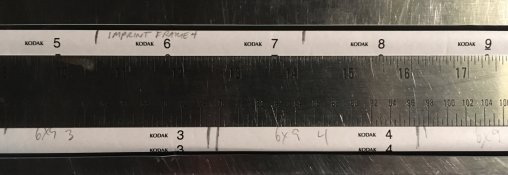
Check the frame imprints positioning.

If the frame numbers are less than the actual frame... it’s after shooting. If the frame numbers are greater than the actual frame then it’s pre-shooting.

Mine all happened after shooting, that film was ok when it was sealed but the issue happened when it was not in its sealed wrapper any longer. Now its environment was under “my control”.
 
Last edited:
The effect (AFAIK) happened before you purchased and exposed the film!!!! It was the product of a bad batch of paper + ink and bad storage before purchase.

PE
 
05F83E55-EEF3-4CD2-9C7D-392EFFF85FFA.jpeg
Not the corresponding figures.
Letting even the flipping of figures aside, the location of a backing number somehow transferred to the emulsion side would be shifted in respect to its original position.
Right, that’s what I meant. When it’s fresh, the backing paper of the upcoming frame(s) was touching the emulsion of the frame you are revealing. On the take-up side of the camera, the backing paper from the just finished shot(s) will roll under and touch the emulsion. The shift can be about two inches. The direction of the shift tells whether image formation occurred before or after camera exposure.

In a post from September 2017, I reported that I had a roll where I wasn’t able to visualize how the alignment related to the obvious ink imprints. I went back to my notes today. The notes identify the roll in question. I found the film and aligned it to my stretched out backing paper.

I found the shift. The shift is to the right. In this case the image formed before the roll entered the camera. This roll was impacted by poor storage before I shot it.

But it was my doing. When I first heard about this issue, I theorized the issue involved the “carbon black”. So I bought a Japanese pen with shiny ink and I drew glyphs all over the backing paper in the dark and rolled the film back to use later.

I allowed this roll to be unsealed in the uncontrolled humidity of my garage near the coast for a year. Then I shot and developed it right away.

This one roll shifts to the right.

I find all my normal usage examples (where I shoot and then maybe let the film sit in the garage for a year before I develop) align to ink with the image shifted towards previous numbers.

My confirmed belief now is that image forms after exposure (if you shoot and then develop much later). Unless you break the seal before using. But it forms during unsealed storage.

 
So just to be clear we are talking about the old problem not something new in December 2018??

That's right. This is the old problem. I am not aware of any problem with current stock.
 
I love TMY, TMX, Portra, Ektar . I never got burned. I treat film like ice cream . I try to only order during cool or cold months .Store everything in refrigerator. I'm pretty sure I was fortunate. I just didn't have any rolls that had problems. I know people really got burned.

I hope that this incident doesn't stop people from using these products. I really think Kodak's film line up is phenomenal. It's a modern miracle. I shoot a lot of the other guys film as well, Fujichrome, Ilford sheet and roll films.

I hope people new(or returning) to analog understand, the backing paper issue with Kodak 120 film has been resolved. It's OK to buy Kodak 120 film, period
Best Regards Mike
 
I planned to check the new film out. So I picked up a couple rolls TMY2 today.

Turns out I just got more film with old paper. I could have checked batch numbers first, but visiting the camera store is a social occasion and I got caught up in my storytelling...

So I have an opportunity to test my theory. I am going to keep the film sealed until I shoot, and afterwards I will develop it as soon as possible.

It might be important to keep film cool and dry until shooting and process immediately thereafter.

Sounds like advice we’ve been given for a long time.

I looked at the picture on John Sexton’s blog. I am confident the overall gloss addresses the issue.
 
The effect (AFAIK) happened before you purchased and exposed the film!!!! It was the product of a bad batch of paper + ink and bad storage before purchase.

PE
That's my understanding as well. A friend of mine has been in fairly intensive contact with Alaris after having purchased several dozens of rolls of tmx 120 and noting the problem. Alaris eventually informed him that the combination of ink with bad storage during transport (film stored in a trailer that got too hot) caused the problems. In the end, Alaris swapped his tmx rolls for triX, but the whole episode took many months.
 
Photrio.com contains affiliate links to products. We may receive a commission for purchases made through these links.
To read our full affiliate disclosure statement please click Here.

PHOTRIO PARTNERS EQUALLY FUNDING OUR COMMUNITY:


Ilford ADOX Freestyle Photographic Stearman Press Weldon Color Lab Blue Moon Camera & Machine
Top Bottom