• Welcome to Photrio!
    Registration is fast and free. Join today to unlock search, see fewer ads, and access all forum features.
    Click here to sign up

Kodachrome II 8mm Developing

1972

A
1972

  • 13
  • 7
  • 137

Forum statistics

Threads
202,591
Messages
2,842,815
Members
101,394
Latest member
Marketa
Recent bookmarks
0

Bob H

Member
Allowing Ads
Joined
Jul 29, 2024
Messages
3
Location
Nebraska
Format
Digital
Hi folks,

Was unsure, but this felt like the best place to post this...

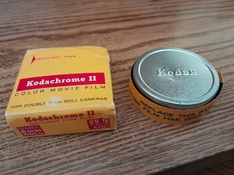
While rummaging through some old boxes I recently found a roll of 8mm Kodachrome II film and I'm hoping someone here has the setup to develop it for me.

I'm aware that this can only be done now in B&W and I have no idea what's on it or if it has even been exposed, so if anyone can assist I'd be grateful.

Thank you,
Bob
 

Attachments

  • 20240729_115151 - 2.jpg
    20240729_115151 - 2.jpg
    1,000.4 KB · Views: 89
The roll can be developed without a processor in a special tank. LOMO (the real thing, not Lomography) used to make one decades ago, and other models exist. Most labs that process cine film would be able to do it for you. I know a few places in Sydney so you should have no problem finding one locally.
I would explore local labs before using FilmRescue as processing Kodachrome in B&W would be no different than processing a normal cine film.
If I were you I would process it as a negative since reversal could be tricky. This is how I developed several photographic rolls of Kodachrome. The results were pretty good.
 
I have no idea what's on it or if it has even been exposed

Being unfamiliar with old 8mm, but I wonder; isn’t the spool inside the can light-proof?
A bit like 220 film, with paper in each end - and wouldn’t there be some sort of indication on the end paper strip that it would have been exposed?

I am only familiar w current Super8 processing, and where I live development of a roll of vintage S8 film and scanning approaches €100 prepaid without guarantees - I don’t know if they refund scanning costs if the film is blank.
 
Wonder how that is practically accomplished?

Take a few buckets and a few liters of developer. Turn off lights. Dump film into bucket. Slosh around. After x minutes, transfer film to second bucket with water and some cleaning vinegar. Then into third bucket with fixer. Not rocket science; it's just a crude approach and yes, there's a risk of damaging the emulsion in places, but hey, it's moving images so a defect on a frame here and there doesn't matter that much as it's only visible for 42 milliseconds.
 
Being unfamiliar with old 8mm, but I wonder; isn’t the spool inside the can light-proof?
A bit like 220 film, with paper in each end - and wouldn’t there be some sort of indication on the end paper strip that it would have been exposed?

A double-8 spool is fully opaque with no holes, but the outside winding of film will be seen when you remove it from the can. You load the film, which sacrifices the first several feet by being exposed to light, but the remjet (pretty sure there's remjet on Kodachrome) does a good job of blocking light from the rest of the film. After the spool runs to the end (exposed), you remove it and turn it over and feed it back through again to expose the other side. Develop then slit the film.
 
What you need is a cine enthusiast with a Lomo tank or a Morse rewind tank to process this. I do have a Lomo tank but I've never had success with old Kodachrome so I am very reluctant to try processing someone else's film.
 
Take a few buckets and a few liters of developer. Turn off lights. Dump film into bucket. Slosh around. After x minutes, transfer film to second bucket with water and some cleaning vinegar. Then into third bucket with fixer. Not rocket science; it's just a crude approach and yes, there's a risk of damaging the emulsion in places, but hey, it's moving images so a defect on a frame here and there doesn't matter that much as it's only visible for 42 milliseconds.

Ditto. No need for a cinema developing tank for a one time use. With bucket large enough, 25 ft of film will squiggle freely. Wear gloves. there should be little danger of scratching film.
 
Why not just cut off a few feet from the roll and process that. If there's something useful on the roll, you can decide if you want to change the process for "improved" results. If there's nothing there, then you can throw out the rest.
 
Hi folks,

Was unsure, but this felt like the best place to post this...

While rummaging through some old boxes I recently found a roll of 8mm Kodachrome II film and I'm hoping someone here has the setup to develop it for me.

I'm aware that this can only be done now in B&W and I have no idea what's on it or if it has even been exposed, so if anyone can assist I'd be grateful.

Thank you,
Bob

So, to be clear you are asking if any member here can process this? Do you want it as a B&W positive that can be watched with a projector?

You're not going to try and process it yourself under any circumstances?

Obviously it can be done, the likelihood of getting anything without an expert developing this first as a black and white negative, then using high resolution scans and some enhancement software is low.

No quick solution for 60 year old Kodachrome.

Best Regards Mike
 
Hi, here is the B&W (negative) processing guide for Kodachrome that has been tested in real life:


If you want to process it into B&W positive, you might have to experiment with light exposure between developers and bleach/fix.
 
I would be very hesitant attempting to process film that old as a positive. Fog is the enemy of reversal.
 
Wow! I didn't expect so much awesome feedback. Thank you, guys!

Take a few buckets and a few liters of developer. Turn off lights. Dump film into bucket. Slosh around. After x minutes, transfer film to second bucket with water and some cleaning vinegar. Then into third bucket with fixer. Not rocket science

With bucket large enough, 25 ft of film will squiggle freely. Wear gloves. there should be little danger of scratching film.

Ditto. No need for a cinema developing tank for a one time use. With bucket large enough, 25 ft of film will squiggle freely. Wear gloves. there should be little danger of scratching film.

I like this bucket idea. and even though I know nothing about developing, I am sure someone near me does... and also has the required stuff.

And, [B]mshchem[/B], the answer to your question is, or was yes. However, that was when I figured it may take some kind of serious gadgetry to do this. Now, with the ideas provided, AND provided I can locate some developing enthusiast(s) locally, I feel this may be simpler that expected. Thanks for having my 6. and I will be taking all feedback given to heart.

Also, [B]blee1996[/B]... thank you for that link! I will check it out as well.

Not sure how long til this gets done, but I'll make a note to follow up with my results. After all is said and done... I hope the dang this isn't blank! 😎

Thank you all again for all your responses!
 
I have a finished super 8 cassette kodachrome given to me, and i would like to develop it out. It is made in May 1988.
Anyone know how long should I develop in order to make it into a reversal bw?
 
I asked Gemini AI:

WHERE CAN I DEVELOP KODACHROME FILM?

Developing Kodachrome in its original, vibrant color (the K-14 process) is no longer possible. The last lab in the world to offer this service, Dwayne’s Photo in Kansas, processed its final roll in January 2011 after Kodak stopped manufacturing the specialized chemicals required.
However, if you have an old roll of Kodachrome, you still have two main options in 2026:

1. Develop as Black & White (The Most Reliable Option)​

Because Kodachrome is essentially a complex black-and-white film with color dyes added during the (now extinct) development process, it can still be processed as high-quality black-and-white negative film.
  • Film Rescue International: They specialize in "lost" and expired film. They can develop Kodachrome into B&W and even offer a digital colorization service to approximate the original look.
  • Blue Moon Camera and Machine: Known for their expertise with vintage formats, they offer B&W processing for Kodachrome.
  • Process One: They offer dedicated services to turn old Kodachrome rolls into B&W negatives.

2. Specialty "Rescue" Labs (Experimental Color)​

A few specialized labs have developed proprietary methods involving high-end scanning and AI-assisted color restoration to try and "bring back" color from Kodachrome.
  • Andrew’s Analog Service Center: As of 2026, they offer a specialty service using a process they call PhotoFlux. They claim to be able to restore color to old Kodachrome and C-22 film stocks, though they note it is a blend of chemistry and digital reconstruction.

Important Things to Know Before You Send It​

  • No Guarantees: These films are often decades old. Heat, humidity, and radiation (X-rays) can degrade the hidden images.
  • Rem-Jet Backing: Kodachrome has a black "rem-jet" layer that most modern labs cannot handle. Do not send Kodachrome to a standard 1-hour lab or a typical local lab; the rem-jet will ruin their machines and your film.
  • Cost: Expect to pay significantly more than standard development (usually $20–$40 per roll) due to the manual labor involved.
Pro Tip: If you decide to develop it yourself at home, you must manually remove the black rem-jet backing using a baking soda bath before or during development, or you'll end up with a mess of black soot.
Would you like me to find the current mailing address or pricing for one of these specific labs?

 
If you use the rough "bucket method", you’ll need two buckets - one for the developer and one for the stop bath. In the dark, first unwind the film into a "ball", trying not to scratch it too much and not to crease it. The goal is to immerse it all at once so that development is as even as possible. Use long rubber gloves. Gently "massage" the ball of film in the bucket - on the one hand, there's the risk of damaging the emulsion too much (some damage is inevitable), but on the other hand you need to avoid layers sticking together and preventing the chemistry from penetrating. Once the development time is up, quickly transfer the film to the stop bath, and after about 30 seconds you can continue in the light.
The film will look very dark. After fixing, take a large container of water and carefully remove the remjet backing with your fingers. If your developer had a sufficiently high pH, it should come off easily.
After removing the remjet, the film will again look opaque and very dark. But if there is an image, it will be visible. This film, similar to Ektachrome, has a special AHU yellowish opaque layer, which in the normal process would be removed during the bleach step, but you can't use that step here. However, you can use a special bleaching bath after fixing - sodium thiosulfate and citric acid…
 
If you use the rough "bucket method", you’ll need two buckets - one for the developer and one for the stop bath. In the dark, first unwind the film into a "ball", trying not to scratch it too much and not to crease it. The goal is to immerse it all at once so that development is as even as possible. Use long rubber gloves. Gently "massage" the ball of film in the bucket - on the one hand, there's the risk of damaging the emulsion too much (some damage is inevitable), but on the other hand you need to avoid layers sticking together and preventing the chemistry from penetrating. Once the development time is up, quickly transfer the film to the stop bath, and after about 30 seconds you can continue in the light.
The film will look very dark. After fixing, take a large container of water and carefully remove the remjet backing with your fingers. If your developer had a sufficiently high pH, it should come off easily.
After removing the remjet, the film will again look opaque and very dark. But if there is an image, it will be visible. This film, similar to Ektachrome, has a special AHU yellowish opaque layer, which in the normal process would be removed during the bleach step, but you can't use that step here. However, you can use a special bleaching bath after fixing - sodium thiosulfate and citric acid…

I've 3d printed a reel for them, but unfortunately my printer isn't large enough to print the tank so have to use a 10L bucket. what i am looking is if i can dev them into a bw reversal which might be projectable from a projector. I've tried with kodachrome+D76 before and removed the remjet with prebath for ECN-2 and worked quite well.

what i am looking right now is ILFORD's bw reversal technique, https://www.ilfordphoto.com/reversal-processing/?___store=ilford_brochure&___from_store=ilford_uk , i don't have PQ Universal but expired Dektol and Ilford Multigrade. Not sure will the method work on Kodachrome
 
Photrio.com contains affiliate links to products. We may receive a commission for purchases made through these links.
To read our full affiliate disclosure statement please click Here.

PHOTRIO PARTNERS EQUALLY FUNDING OUR COMMUNITY:


Ilford ADOX Freestyle Photographic Stearman Press Weldon Color Lab Blue Moon Camera & Machine
Top Bottom