The rude or pithy answer to the OP is
'negatives are like purses or wallets, if they don't have enough silver (coins) at the 'bottom' they and you are poor (bad).'
They are simple ways of judging this.
First
If you look at the negative emulsion side towards you, against a dark back ground but illuminating the negative from the side and if you can see (after trying hard at lots of angles) a passable positive image then you are at least 2 stops underexposed, or way underdeveloped and it will be a hard to print, not impossible but you will need to burn and dodge and split grade variable contrast print, scanning wont be easy either.
You need to avoid negatives like this, the rule is don't underexpose and over develop, bluntly 'pushing' ISO is an invention of the devil...
Second if you cant get a positive image your negatives may still be just a little underexposed.
So to judge this degree of underexposure hold up the negative in front of a light source and look at your zone 1 shadow... but you need to know what zone 1 is...
Jump cut back to (a cine term, for a flash back) when you were taking the shot, when you meter before pushing the button, a meter on camera will give you good results 99% of the time if you take formal family shots with the sun behind the camera. But if the sun is not behind or are in streets etc. then you may need to make adjustments.
Answell Adams the doyen of beautiful prints with detail both in the shadow and clouds used a simple light (selenium) meter most of the time, when you point it at a subject it says the amount of light it sees in light units, you transfer this to a calculator which is calibrated in zones, if you point the meter at a large shadow that is just not black and set the calculator to zone 1 then zone one on the negative will just have printable detail - if you have a good meter, correct ISO, good film, good camera and good developer...
Back to your negative and more simply if you don't have detectable silver in the negative where you want shadow detail on the print you have problems, may only be part of a stop, but there is no recovery for clear film like in film rebates (e.g. 35 mm sprocket hole areas is clear film, or frame number area with 120).
To judge how much is wrong with exposure you need to shoot a whole film of relatives in line up, wiith sun behind you at 1/3 stop ISO settings 125, 160, 200, 250, 320, etc., for HP5, noting the start value, develop and print and look at prints and negatives and decide what speed you should set the film to depending on the print quality/style you like. This is paying for experience, there is no cheaper way, it also calibrates your cameras shutter. aperture ring, developing timer and thermometer, and developing solution... if you buy a new camera you need to repeat this...
The more fragile answer is to set your light meter/camera to one stop slower than box speed (for HP5 200 ISO) and shoot another film. Some people do this all the time because a stop over exposure should not be a problem for 99% or negatives, unless you name is Answell Adams and you want gossamer clouds. You need to look at a real Adam's print on a wall in an exhibition to understand how good a good a print can be, but the doyen of candid shots Henri Cartier Bresson, said 'Adams and Weston are mad they are taking photo graphs of rocks', his negatives were more difficult to print cause his subjects were more transient than rocks.
The third way is to try and print your negatives at home you only need to get printing out paper and a sheet of glass several 'clips' and some card, or post a help thread in alternative processes, or use normal paper as below... google 'printing out frame'
But dont buy one from ebay
http://www.ebay.com/bhp/contact-print-frame.
In the past the 35mm or 120 people used a 'Patterson contact printing frame' to file contacts of each film on 10x8 paper hole punching the 10x8 print, but lots of people used a 10x8 plate glass sheet (flame polished to have smooth edges) instead of buying from Patterson, and any plastic bowl...
Any of the 'printing out paper' contact printing is possible in daylight with simple bits and pieces if you have a sheet of glass, even if you live in an apartment with no dark room, as only sun light and drapes are needed.
If my English is poor PM me for email help... I do use a meter like Answell's (calculator calibrated in zones) and have to meter for (each) zone 'one' in city streets when the sun is out.
Noel
Note
Google printing out paper (PoP) and read this following copy and paste, or go to the alternative process sub forum... if you cannot get PoP normal printing paper will do.
'...
Keith Dugdale , Sep 05, 2012; 03:39 p.m.
Hi all,
My first post, hope this thread is still alive.
The answer to Nomads question is to expose for anything from 6 minutes to a couple of hours, yes really. I do not have the time for Ilford Multigrade, but Kentmere Art Classic will take two hours in sunshine. Agfa VC Premium about 15 mins.
100grams Potassium thiosulphate to 1 litre of water as a fix.
As with all photo alt the answer to most question is trial and error.
Keith Dugdale.
...'
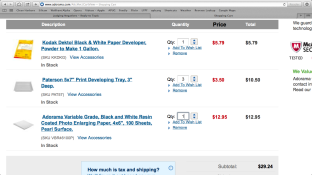
so next time you are in photo shop buy some silver bromide paper as above, postcard size, some fix powder {Potassium thiosulphate or Sodium thiosulphate} find a one litre bottle, label it will Hazchem skull and cross bone.
Use kitchen scales for 100 gms or two heaped soup spoons, old washing bowl...